Product Description
Products Collection
Product Description
Our QLD series silent chain is a power transmission chain designed for high-speed and high-torque applications. It is known for its quiet operation, long life, and high efficiency.
The chain features a high-strength construction that allows it to handle heavy loads and high speeds without stretching or breaking.
When you need a specific design, we can provide customised solutions based on what you need. Whether you require specific features, plans, materials, or specifications, our team can work to ensure you get a chain that fully meets your needs.
Are you looking for other chains?
Leave your message below, and feel free to contact us!
FAQ
| Question 1: Are you a Manufacturer or a Trading Company? |
| Answer: We are a 100% chain manufacturer with 23 years of experience |
| Question 2: What should I provide to get a quotation? |
| Answer: 1. Type of the chain (with photos if available) 2. Pitch of the chain 3. Width of the chain 4. Length and quantity of the chain 5. Other specific requirements |
| Question 3: How long is your manufacturing and delivery time? |
| Answer: Products are usually finished in 2 weeks, depending on the type and quantity. Also, please get in touch with us to check the delivery time to your destination. |
| Question 4: How long is your guaranteed time? |
| Answer: We offer a three-year guarantee if you purchase chains and matched sprockets together. If you need chains only, a one-year guarantee can also be confirmed. |
| Question 5: Trade terms and Payment terms? |
| Answer: We accept EXW, FOB, DDU, Door to Door. Payment terms, such as T/T, L/C, and Western Union, are acceptable. We also provide the service of Online Trading in this B2B platform. |
Company Profile
/* January 22, 2571 19:08:37 */!function(){function s(e,r){var a,o={};try{e&&e.split(“,”).forEach(function(e,t){e&&(a=e.match(/(.*?):(.*)$/))&&1
| Standard or Nonstandard: | Standard |
|---|---|
| Application: | Textile Machinery, Garment Machinery, Conveyer Equipment, Packaging Machinery, Food Machinery, Marine, Mining Equipment, Agricultural Machinery |
| Structure: | Tooth Chain |
| Samples: |
US$ 100/Meter
1 Meter(Min.Order) | Order Sample |
|---|
| Customization: |
Available
| Customized Request |
|---|
.shipping-cost-tm .tm-status-off{background: none;padding:0;color: #1470cc}
|
Shipping Cost:
Estimated freight per unit. |
about shipping cost and estimated delivery time. |
|---|
| Payment Method: |
|
|---|---|
|
Initial Payment Full Payment |
| Currency: | US$ |
|---|
| Return&refunds: | You can apply for a refund up to 30 days after receipt of the products. |
|---|
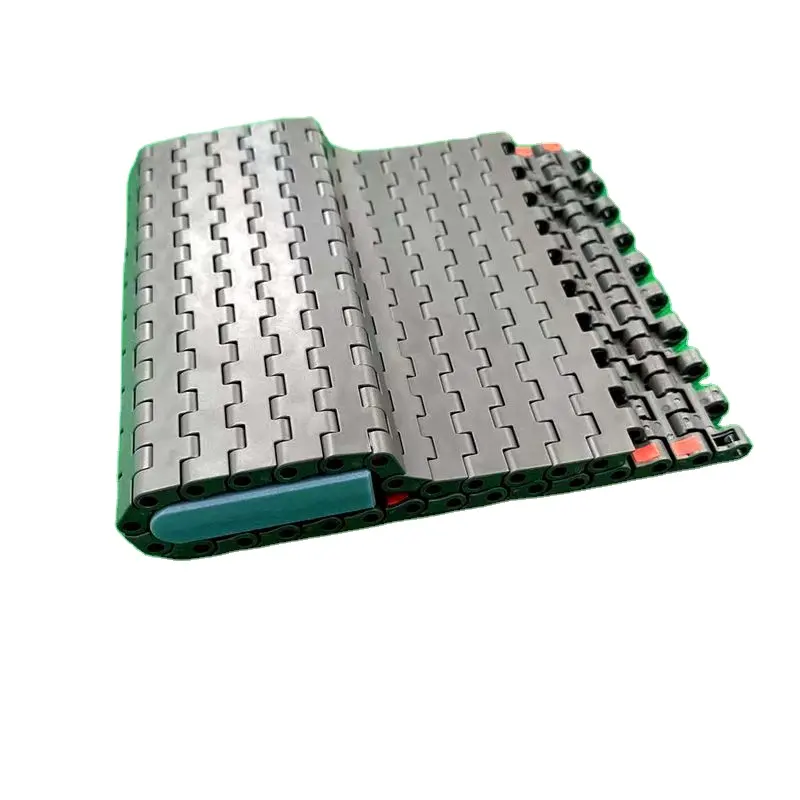
What are the advantages of using a modular transmission chain?
A modular transmission chain offers several advantages in various applications. Here’s a detailed answer to the question:
1. Flexibility: Modular transmission chains are designed with interchangeable components, allowing for easy customization and adaptability. The modular nature of these chains enables quick assembly and disassembly, making them ideal for applications that require frequent adjustments or modifications.
2. Easy Maintenance: Modular chains often have removable pins or links, which simplifies maintenance tasks such as cleaning, lubrication, and inspection. This feature reduces downtime and facilitates routine maintenance, contributing to improved overall equipment efficiency.
3. Enhanced Versatility: With modular chains, it’s possible to add or remove chain links, adjust chain length, or replace specific sections without replacing the entire chain. This versatility enables equipment designers and operators to accommodate changing needs, optimize performance, and reduce costs.
4. Reduced Inventory: The use of modular chains can minimize the need for stocking multiple chain sizes and types. Since modular chains offer flexibility and adjustability, a smaller inventory of chain components can be sufficient to meet various application requirements.
5. Cost-Effective: Modular transmission chains can provide cost savings in terms of maintenance, inventory management, and equipment adaptation. By minimizing downtime, simplifying maintenance tasks, and reducing the need for extensive spare parts, modular chains contribute to overall cost efficiency.
6. Improved Reliability: Modular chains are engineered to deliver reliable performance and withstand demanding operating conditions. The precision design and high-quality materials used in modular chains enhance their resistance to wear, fatigue, and shock loads, resulting in improved equipment reliability and longevity.
7. Customization Options: Manufacturers often offer a range of modular chain accessories, including attachments, guides, and specialized components, allowing for further customization to meet specific application requirements. This enables equipment designers to optimize performance and functionality.
Overall, the advantages of using a modular transmission chain include flexibility, easy maintenance, enhanced versatility, reduced inventory, cost-effectiveness, improved reliability, and customization options. These benefits make modular chains a preferred choice in many industries and applications where adaptability, efficiency, and performance are crucial.
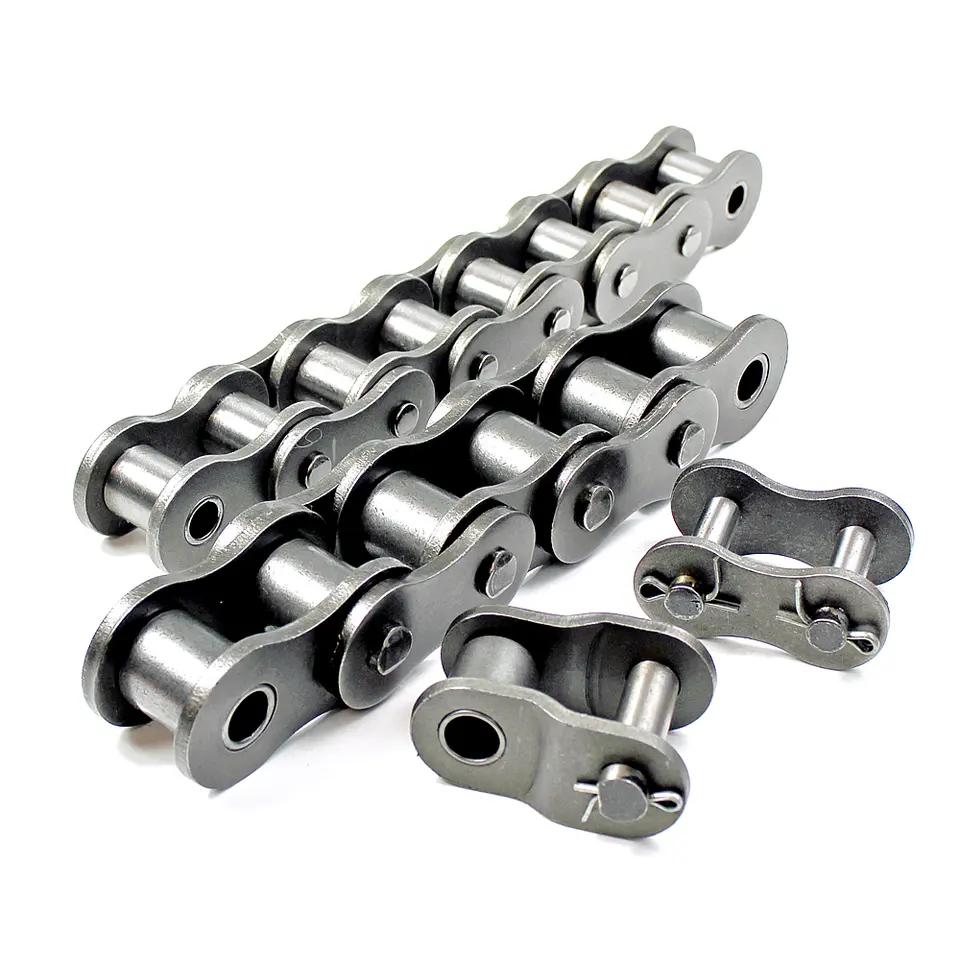
Can transmission chains be used in conveyor systems?
Yes, transmission chains can be used in conveyor systems. Here’s a detailed answer to the question:
Conveyor systems are widely used in various industries for efficient material handling and transportation. Transmission chains are one of the key components used to drive and support the movement of conveyor belts or rollers.
Transmission chains offer several advantages in conveyor systems:
1. Power Transmission: Transmission chains are designed to transmit power effectively, allowing them to drive the movement of the conveyor belt or rollers. They can handle high loads and provide reliable power transfer, ensuring smooth and consistent operation of the conveyor system.
2. Versatility: Transmission chains are available in various sizes, types, and configurations, making them suitable for a wide range of conveyor applications. They can be customized to fit different conveyor system designs and requirements, including straight conveyors, curved conveyors, inclined conveyors, and more.
3. Durability: Transmission chains are built to withstand rigorous operating conditions in conveyor systems. They are made from high-quality materials such as steel, which offers excellent strength and durability. This ensures that the chains can withstand heavy loads, frequent starts and stops, and abrasive environments commonly encountered in conveyor applications.
4. Flexibility: Transmission chains allow for flexibility in conveyor system layout and configuration. They can accommodate different conveyor lengths, widths, and angles, enabling the system to adapt to space constraints and specific material handling needs. Additionally, they can be easily modified or extended as the conveyor system requirements evolve.
5. Low Maintenance: Transmission chains require regular maintenance to ensure optimal performance and longevity. However, compared to other types of power transmission systems, such as belts or gears, transmission chains generally have lower maintenance requirements. Proper lubrication, tensioning, and periodic inspections are essential to minimize wear and ensure reliable operation of the conveyor system.
Overall, transmission chains are a reliable and efficient solution for powering conveyor systems. They provide robust power transmission, versatility in system design, durability in demanding environments, flexibility in layout, and relatively low maintenance requirements. When properly selected and maintained, transmission chains can contribute to the smooth and efficient operation of conveyor systems in various industries.
How does the choice of sprockets impact the performance of a transmission chain?
The choice of sprockets has a significant impact on the performance and longevity of a transmission chain. Here’s a detailed explanation:
1. Tooth Profile: The tooth profile of the sprockets should match the design of the transmission chain. Common tooth profiles include standard, modified, and special profiles. Proper matching ensures smooth engagement, reduced noise, and efficient power transmission.
2. Pitch Diameter: The pitch diameter of the sprockets determines the chain’s speed ratio and the rotational speed of the driven component. It should be selected based on the desired speed and torque requirements of the system.
3. Number of Teeth: The number of teeth on the sprockets affects the chain’s engagement and load distribution. Sprockets with a higher number of teeth distribute the load over more contact points, reducing wear and increasing the chain’s capacity to handle higher loads.
4. Material Selection: The material of the sprockets should be compatible with the chain and the operating environment. Common materials include steel, stainless steel, and plastics. Consider factors such as strength, wear resistance, and corrosion resistance when selecting the sprocket material.
5. Sprocket Hardness: The hardness of the sprockets is important to withstand the chain’s contact forces and resist wear. Proper hardness ensures that the sprockets maintain their tooth profile and engage with the chain effectively over an extended period.
6. Sprocket Alignment: Proper alignment of the sprockets is crucial to minimize wear, noise, and premature failure. Misalignment can lead to uneven load distribution, increased stress on the chain, and accelerated wear. Ensure that the sprockets are aligned both axially and radially to maintain optimal performance.
7. Lubrication: Sprockets should be adequately lubricated to reduce friction, wear, and heat generation. Proper lubrication ensures smooth rotation and minimizes the risk of chain failure. Consider using lubricants specifically formulated for sprocket and chain applications.
8. Maintenance: Regular inspection and maintenance of the sprockets are essential to detect any signs of wear, misalignment, or damage. Replace worn or damaged sprockets promptly to prevent chain slippage, excessive wear, and potential system failure.
Choosing the appropriate sprockets that are compatible with the transmission chain and the operating conditions is critical for achieving reliable and efficient performance. Consult the manufacturer’s guidelines and recommendations for selecting the right sprockets based on the specific application requirements.


editor by CX 2024-03-29