A confectionery plant in Chungcheong Province upgraded its exposed conveyor drives from standard carbon steel chain to nickel-plated chain in 2021 — the correct decision for an environment with occasional sugar dust condensation and periodic ambient humidity. By 2023, three of the eight upgraded chain positions had developed reddish-brown staining beneath the nickel plating on the link plates. The maintenance team initially believed the plating was “failing” and requested a quality complaint against the supplier. Investigation showed the plating was intact — but the chain had been routed past the pasteurisation oven where steam jets were used for product demoulding. The localised steam exposure was creating condensate on the chain at a temperature of 60–70°C, which accelerated under-plating corrosion at pinhole defects in the nickel. The plating on the remaining five positions — not in the steam zone — showed no corrosion at all after two years. The specification was not wrong; the application boundary was not mapped correctly when the upgrade was specified.
Plated chain selection requires three pieces of information: what the plating protects against, what it does not protect against, and where the transition point is between the two conditions in the specific application. Without all three, the selection produces either unnecessary cost (specifying stainless when nickel would have worked) or premature failure (specifying nickel in an environment that requires stainless).

What Chain Plating Actually Does — and the Mechanism of Its Failure
Chain plating works by creating a physical barrier between the steel substrate and the corrosive environment. The plating material — nickel, zinc, or zinc-chromate composite — does not corrode in the target environment, so the steel below it remains protected. This barrier mechanism is highly effective when the plating is continuous and defect-free. The problem is that no electroplated or electroless-plated chain is perfectly continuous — the plating process creates microscopic porosity at the surface, particularly at the plate edges, pin ends, and at any mechanical contact zone.
At pinholes and porosity in the plating, the corrosive environment reaches the steel substrate directly. When this happens in an environment that is aggressive enough to corrode steel, the corrosion spreads laterally under the plating surface — a process called under-plating corrosion or filiform corrosion. The plating appears intact from the outside while the steel beneath is actively corroding. This is the mechanism that makes plated chain in aggressive environments worse than unplated steel — at least with unplated steel, the corrosion is visible and measurable, allowing replacement before structural failure.
Electroless Nickel vs Electrolytic Nickel Plating: Why the Process Matters for Chain
Two distinct nickel plating processes are used for roller chain: electrolytic nickel plating (conventional electroplating) and electroless nickel (chemical deposition without electrical current). The processes produce coatings with different properties that matter significantly for chain performance.
For industrial chain applications, electroless nickel (EN) is the standard when the specification calls for “nickel-plated chain” in any environment beyond simple indoor humidity protection. EN plating at 20–25 µm provides the same NSS (neutral salt spray) resistance as electrolytic nickel at 50+ µm because the uniform coverage and lower porosity are structurally more significant than thickness alone. When a supplier quotes “nickel-plated” without specifying the process, confirm whether it is electrolytic or electroless before accepting the specification for food-adjacent or outdoor applications.
Zinc-Plated and Zinc-Chromate Chain: Sacrificial Protection and Its Limits
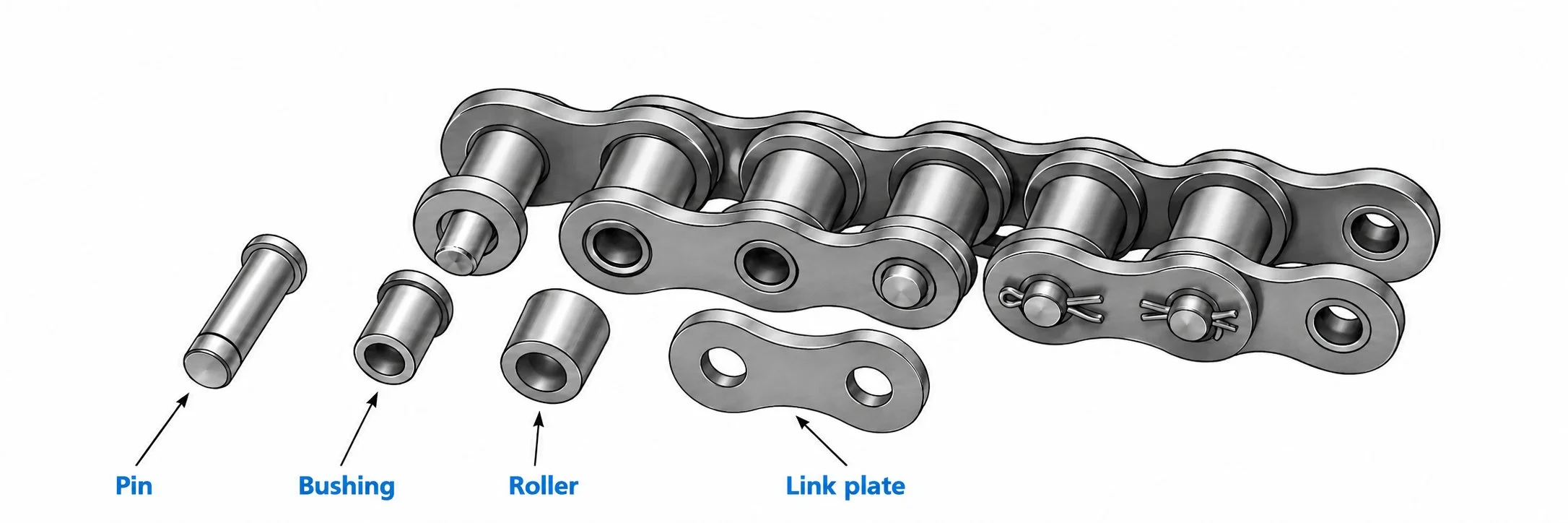
Zinc plating operates on a fundamentally different protection principle from nickel plating. Nickel is noble relative to steel — it protects by forming a barrier, and if breached, the steel corrodes preferentially at the defect site. Zinc is sacrificial relative to steel — the zinc corrodes preferentially in the galvanic couple with steel, protecting the steel at any breach point by providing electrons that suppress the steel oxidation reaction. This sacrificial mechanism means that zinc-plated chain continues to protect the steel substrate even after the plating is damaged or breached, as long as zinc remains adjacent to the exposed steel.
The practical consequence is that zinc plating is more forgiving in environments with mechanical wear, abrasion, or impact that damages the plating surface. A zinc-plated chain that has had its plating worn through at the roller-sprocket contact zone continues to receive cathodic protection from the surrounding zinc on the link plates. A nickel-plated chain with the same worn-through zone has unprotected steel at the contact point with no sacrificial action from adjacent nickel.
Zinc-chromate (dichromate-passivated zinc, also called “yellow chromate” or “clear chromate”) adds a conversion coating over the zinc layer that passivates the zinc surface and significantly extends its useful life before the sacrificial zinc layer is consumed. NSS resistance of zinc alone is typically 24–48 hours; zinc-chromate extends this to 120–200 hours in the same test conditions.
| Treatment | Mechanism | NSS Resistance (hours) | Chloride Limit | Typical Cost Premium | Best Environments |
|---|---|---|---|---|---|
| No treatment | None | 2–8 | — | Základní hodnota | Dry indoor only |
| Electrolytic zinc | Sacrificial | 24–48 | <50 ppm | +12–18% | Outdoor (non-coastal), light humidity |
| Zinc-chromate | Sacrificial + passivation | 120–200 | <100 ppm | +18–28% | Agricultural outdoor, mild chemical exposure |
| Electrolytic nickel | Barrier | 48–96 | <80 ppm | +20–30% | Indoor humidity, food-adjacent (dry) |
| Electroless nickel (EN) | Barrier (uniform) | 200–500 | <200 ppm | +35–55% | Washdown, food processing, light outdoor marine |
| 304 Stainless | Passive film (Cr₂O₃) | 500–1,000+ | <80 ppm sustained | +80–120% | Food contact, CIP washdown, mild outdoor |
| 316L Stainless | Passive film + Mo | 1,000–2,000+ | <400 ppm sustained | +120–180% | Seafood, dairy, marine, chlorinated washdown |
How to Choose: A Three-Question Decision Framework
The correct corrosion protection specification can be determined by answering three questions in order. The first answer that produces a clear result determines the specification — do not continue to later questions if an earlier one gives an unambiguous answer.
Nickel-Plated Chain in Food-Adjacent Applications: What the Regulations Actually Say
Nickel-plated chain occupies an ambiguous regulatory position in food processing environments. Nickel is not classified as a food-safe metal under NSF/ANSI 51 — the standard requires that all food-contact surfaces be made of materials that will not contaminate food with toxic substances. Nickel can leach in the presence of acidic food products (pH below 5) or in high-chloride environments at elevated temperatures. For direct food contact, nickel-plated chain is not acceptable under any food safety standard.
However, for food-adjacent applications — where the chain is in the vicinity of food processing but does not contact the product — electroless nickel chain is widely used and accepted. The determining factor is whether incidental contact with food is possible. On overhead conveyor drives above food processing lines, electroless nickel chain is a practical and accepted solution because the plating provides adequate corrosion resistance against the ambient humidity and occasional condensate in the environment, and incidental contact with the product below is not possible.
For applications where the chain is close to the product and incidental contact is possible — including lateral chain runs at the same height as the product, chain inside hopper housings, or any drive where lubricant drip from the chain could reach the product — stainless steel chain with NSF H1 food-grade lubricant is the required specification regardless of whether the chain is “nickel-plated” or not.
Industry-Specific Plating Selection
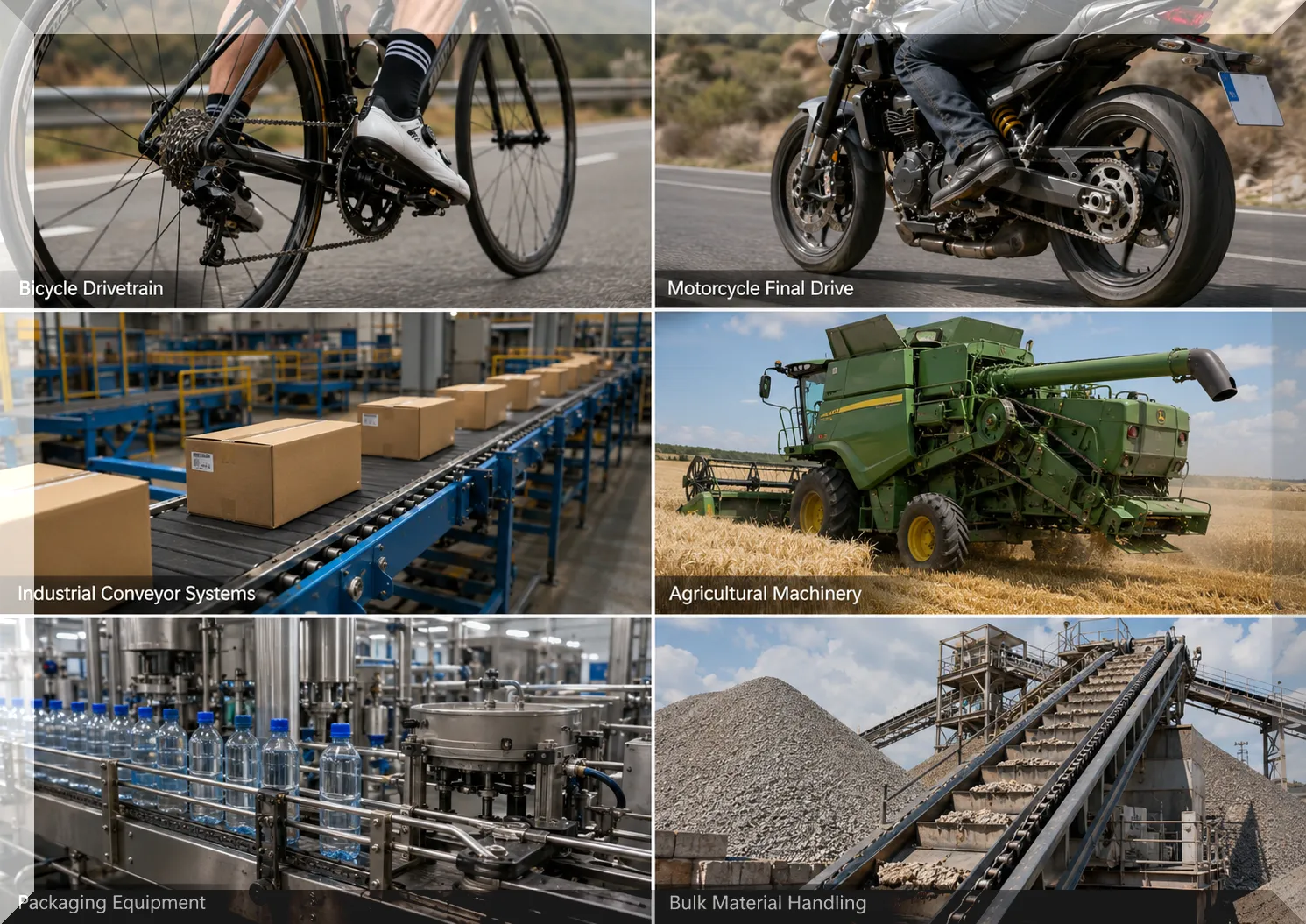
Confectionery and dry food processing. Ambient humidity in sugar handling and confectionery lines is typically 40–70% RH with occasional condensation during product temperature transitions. Standard carbon steel chain corrodes at these humidity levels in cycles of 2–6 months. Electroless nickel chain extends the replacement interval to 18–36 months in the same environment — a direct cost reduction from fewer replacement events. The confectionery incident at the start of this article illustrates the boundary: EN chain works in the bulk of the line environment, but at steam-contact zones, the correct specification is 304 stainless roller chain with sealed O-ring configuration.
Agricultural outdoor machinery. Zinc-chromate plated chain is the standard for outdoor agricultural drives exposed to rainfall, morning dew, and soil dust — conditions where pure humidity protection (nickel) is insufficient but full corrosion resistance (stainless) is unnecessary and economically unjustified. Grain drill seed metering drives, fertiliser spreader drives, and irrigation pump chain drives in Korean agricultural regions all represent appropriate zinc-chromate applications. The chain is replaced annually as part of season-end maintenance; the zinc-chromate plating provides the corrosion protection needed for the 8-month outdoor storage period between seasons.
Automotive components washing and painting lines. Overhead conveyor chain in automotive body painting facilities is exposed to paint overspray, solvent vapour, and periodic solvent-wash cleaning of the conveyor hardware. Electroless nickel chain provides adequate protection against the solvent vapour and humidity in these environments. However, if the chain passes through the direct spray zone of a washing or phosphating stage, stainless chain is required — phosphating chemicals (iron phosphate, zinc phosphate) are aggressive enough to attack both zinc and nickel plating at process temperatures.
General industrial indoor environments. The largest category of applications where plated chain is unnecessarily specified is general indoor industrial use in climate-controlled manufacturing facilities. Korean industrial facilities with HVAC-controlled environments maintaining below 60% RH rarely produce corrosion on carbon steel chain within a 12-month replacement cycle. For these applications, standard carbon steel sprockets and unplated chain with correct lubrication at the specified interval represents the most economical specification. The premium for EN nickel plating is justified only where the replacement interval would otherwise be shortened by corrosion — if standard chain lasts its full designed service life without visible corrosion, the plating provides no benefit.
Identifying Plating Type on Existing Chain Without Documentation
When replacing a chain where the original specification is unknown and documentation has been lost, identifying the plating type from the chain itself is straightforward using a combination of visual and simple field tests:
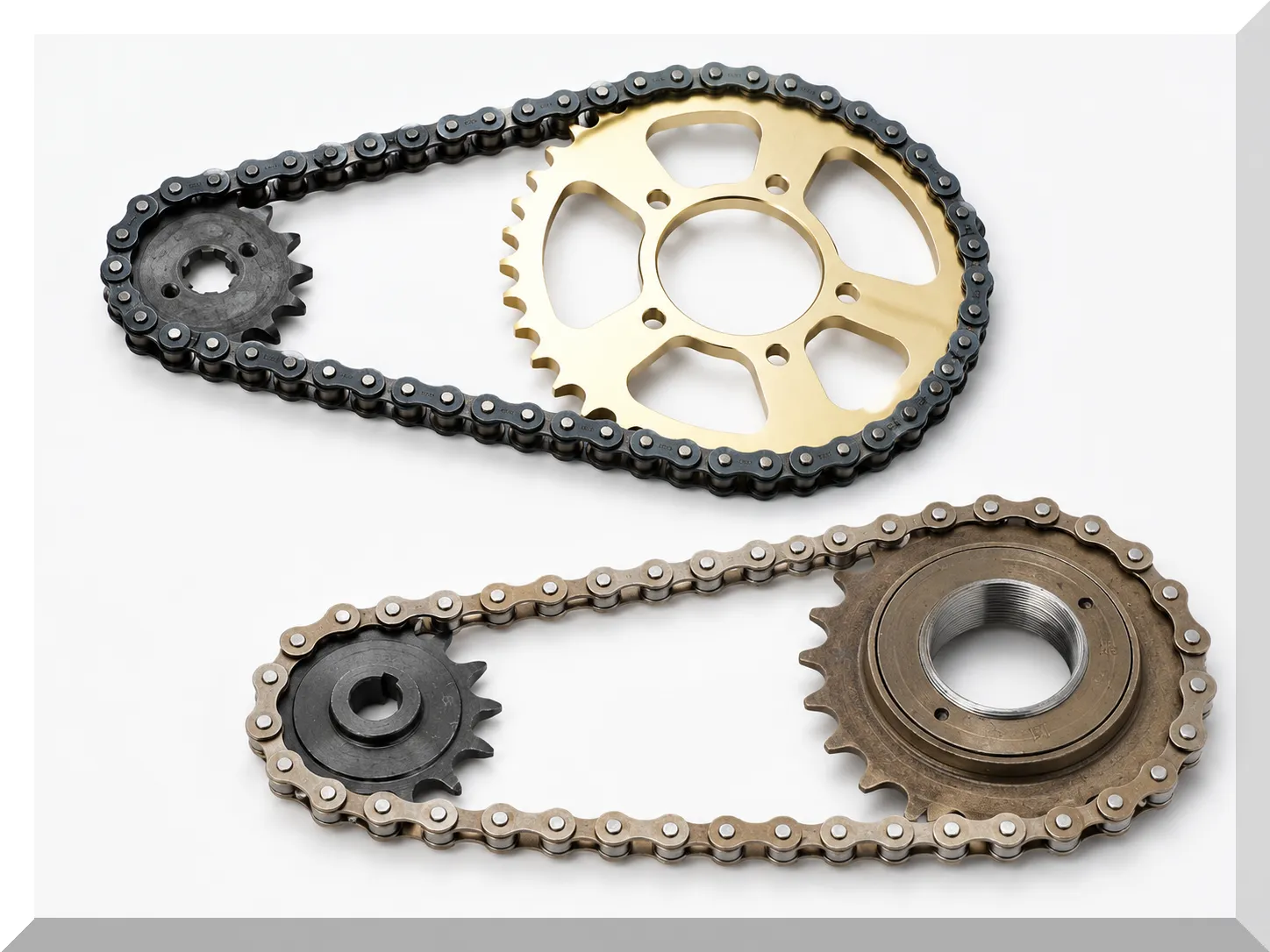
- Colour assessment: Silver-white with a slight blue tint and very uniform reflectivity → electrolytic nickel. Silver-white with a matte surface and slight golden tint at edges → electroless nickel. Dull grey-silver → zinc. Yellow-gold tinge → zinc-chromate (dichromate passivation). Dark blue-black → zinc with black passivation. Bright silver-white with very uniform reflectance and no tint → possible polished carbon steel — clean and check for rust with a cotton swab moistened with water for 30 seconds.
- Magnet test: All carbon steel chain (plated or not) is strongly magnetic. 304 stainless is weakly magnetic to non-magnetic. 316L stainless is essentially non-magnetic. A chain that responds minimally to a strong magnet is stainless steel — the plating type is irrelevant.
- Scratch test on link plate face (not contact surface): Scratch lightly with a steel tool. Nickel plating scratches to a silver-white substrate identical to the plating colour. Zinc plating scratches to a visibly darker grey with a slightly granular surface. Stainless steel scratches to an identical colour with a smooth bright mark. Carbon steel scratches to a grey surface that turns red-brown within 24 hours of exposure to air.
Často kladené otázky
Zinc, Nickel and Standard Chain Stocked — Stainless Made to Order
Tell us your environment — humidity level, liquid contact type, chloride source, food-contact requirement — and we confirm the correct protection specification before any order is placed.
Střihač: Cxm