Product Description
|
Product |
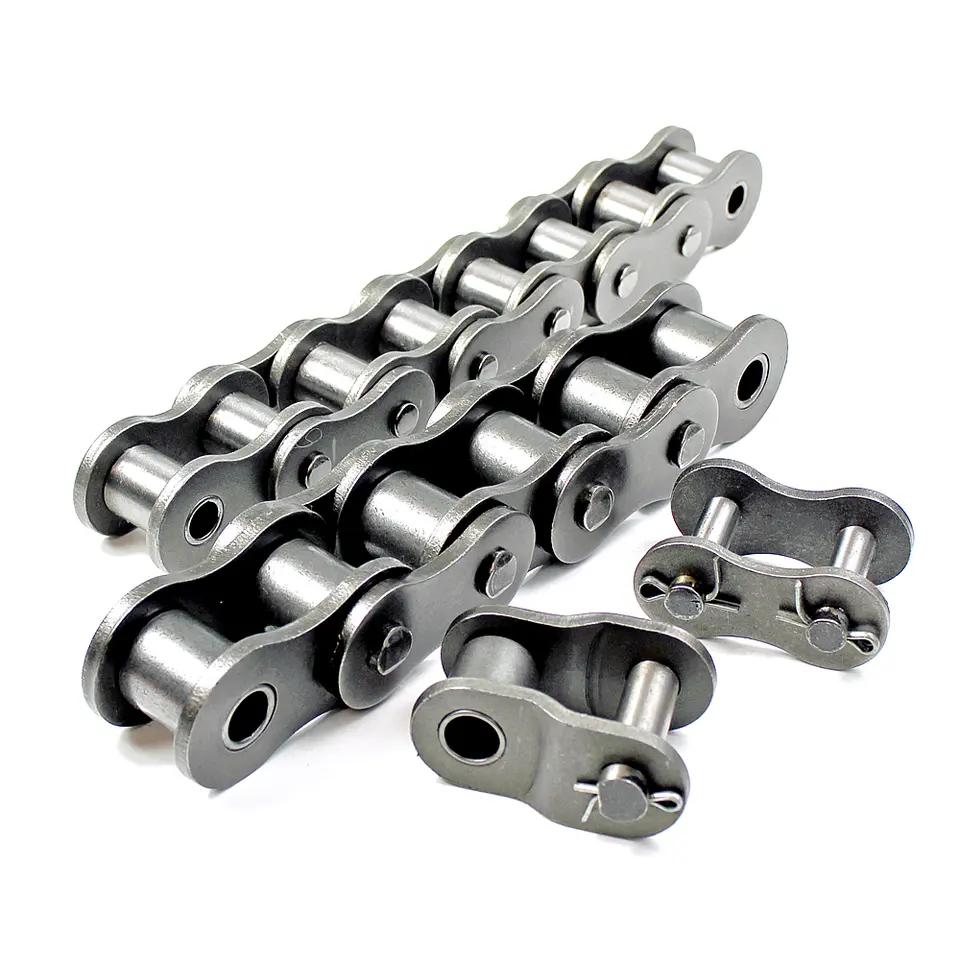
Standard Double Pitch Roller chain |
||
|
Material |
40Mn steel,304 stainless steel, 316 stainless steel and 201 stainless steel. |
||
|
Types |
Standard chains and special chains, such as A or B series chains, roller chains, driving chains, conveyor chains, hoisting chains, agricultural chains, sprockets, gears, wheels and so on. |
||
|
Series |
A series(12.7-50.8mm pitches),B series (9.525-50.8mm pitches)and the heavy series. |
||
|
Short pitch precision roller chain |
Simplex Roller Chains&Bushing Chains: 04C-1,06C-1,085-1,08A-1,10A-1,12A-1,16A-1,20A-1,24A-1,28A-1,32A-1,36A-1,40A-1,48A-1 04C-2,06C-2,085-2,08A-2,10A-2,12A-2,16A-2,20A-2,24A-2,28A-2,32A-2,36A-2,40A-2,48A-2 04C-3,06C-2,085-3,08A-3,10A-3,12A-3,16A-3,20A-3,24A-3,28A-3,32A-3,36A-3,40A-3,48A-3 |
||
|
Chain link type |
Standard links (without attachment) and non-standard links (with attachment).
A1: One-side,one hole cranked attachments. |
||
|
Our Products Advantage |
1. Every step from production order to the packing process has a strict quality inspection. |
||
1.Fast delivery: Standard products can be delivered in as fast as 20 days
2.Good service: timely reply, prompt quotation, responsible for the product
3.High cost performance: can maintain price stability for a certain period of time, bringing greater profits to customers
4.Good quality: production and testing have corresponding supervision to ensure product quality and get high praise from customers
5.OEM service: products can be customized according to drawings and requirements
We are responsible for the ordered products. We are very confident in the products we produce. Of course, if you have any problems after receiving the goods, you can contact us directly. We will confirm and negotiate in time to solve your difficulties.
| Standard or Nonstandard: | Standard |
|---|---|
| Application: | Textile Machinery, Garment Machinery, Conveyer Equipment, Packaging Machinery, Electric Cars, Motorcycle, Food Machinery, Mining Equipment, Agricultural Machinery, Car |
| Surface Treatment: | Oil Blooming |
| Samples: |
US$ 35/kg
1 kg(Min.Order) | Order Sample |
|---|
| Customization: |
Available
| Customized Request |
|---|
.shipping-cost-tm .tm-status-off{background: none;padding:0;color: #1470cc}
| Shipping Cost:
Estimated freight per unit. |
about shipping cost and estimated delivery time. |
|---|
| Payment Method: |
|
|---|---|
|
Initial Payment Full Payment |
| Currency: | US$ |
|---|
| Return&refunds: | You can apply for a refund up to 30 days after receipt of the products. |
|---|

How does the choice of chain attachment affect the functionality of a transmission chain?
The choice of chain attachment plays a critical role in the functionality and performance of a transmission chain. Here’s a detailed answer to the question:
1. Load Capacity: Different chain attachments are designed to handle specific types and amounts of loads. The selection of the appropriate attachment is crucial to ensure that the transmission chain can safely and efficiently carry the intended load. The type of attachment, such as extended pins, cleats, or slats, can determine the chain’s ability to handle heavy or irregular loads.
2. Application Compatibility: The choice of chain attachment should align with the specific application requirements. Different industries and applications may require specialized attachments that are designed to address particular challenges or provide specific functionalities. For example, attachments used in conveying systems may include rollers, flights, or grippers to facilitate smooth material transfer.
3. Alignment and Tracking: Certain chain attachments, such as guide rails or track systems, help to ensure proper alignment and tracking of the transmission chain. These attachments minimize the risk of chain derailment or misalignment, which can lead to operational issues and reduced efficiency.
4. Positioning and Orientation: Some applications require precise positioning or orientation of objects or components. Chain attachments, such as indexing pins or brackets, are designed to facilitate accurate positioning or rotation of objects along the chain’s path. These attachments contribute to the reliable and precise operation of the transmission chain.
5. Material Handling: In material handling applications, chain attachments are often used to secure or hold items during transport. Attachments like hooks, clamps, or brackets enable the secure attachment of objects to the chain, preventing slippage or displacement during movement. This ensures safe and efficient material handling operations.
6. Specialized Functions: Chain attachments can provide additional functions based on specific application requirements. For example, attachments such as sensors, RFID tags, or lubrication reservoirs can be integrated into the chain design to enable monitoring, tracking, or lubrication functions. These specialized attachments enhance the overall functionality and performance of the transmission chain.
It’s important to select the appropriate chain attachment based on the specific application needs, load requirements, and desired functionality. Consulting with industry experts or chain manufacturers can help in determining the most suitable attachment options for optimal transmission chain performance.
How does the precision of manufacturing impact the performance of a transmission chain?
The precision of manufacturing plays a crucial role in the performance and reliability of a transmission chain. Here’s a detailed answer to the question:
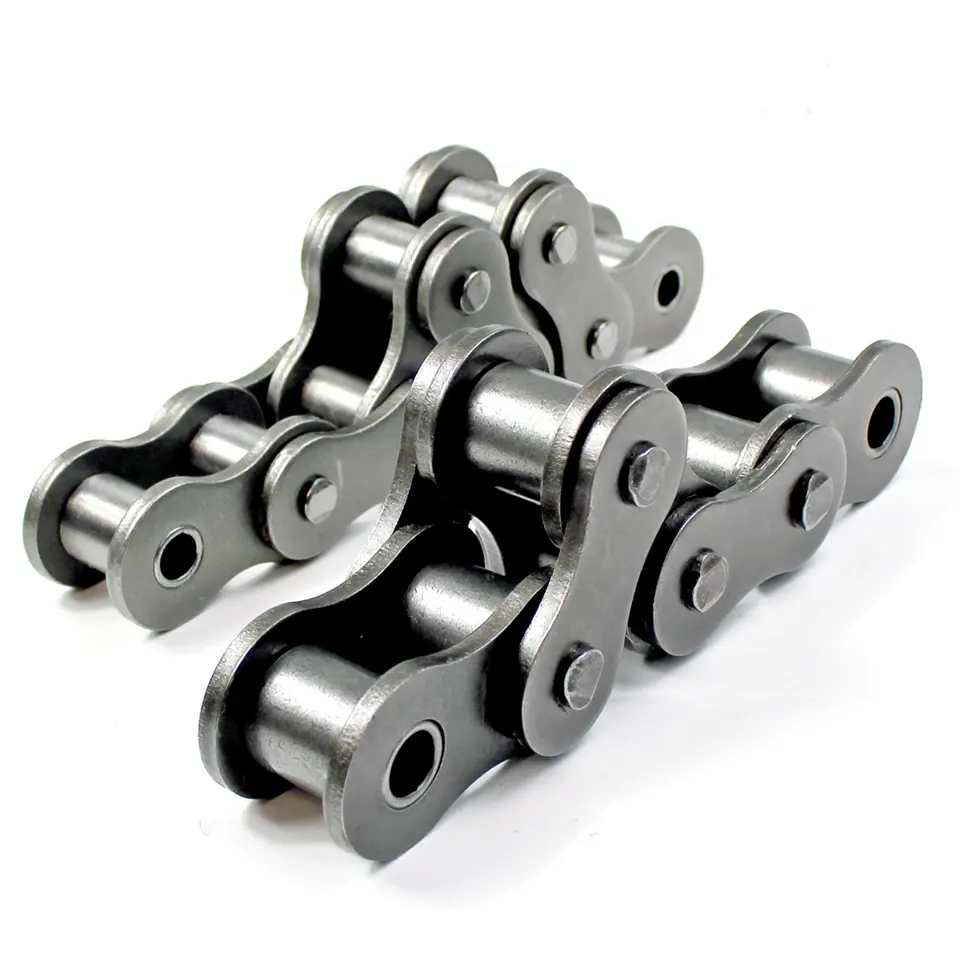
1. Accurate Chain Pitch: The precision of manufacturing ensures that the chain pitch, which is the distance between consecutive chain links, is consistent and accurate. A precise chain pitch is essential for proper engagement with the sprockets and ensures smooth power transmission.
2. Uniform Chain Link Dimensions: Precise manufacturing ensures that the dimensions of the chain links are uniform throughout the chain. This uniformity is crucial for maintaining proper alignment, load distribution, and engagement with the sprockets.
3. Consistent Roller Diameter: In roller chains, the diameter of the rollers is an important factor in reducing friction and wear. Precise manufacturing ensures that the roller diameter is consistent, allowing for smooth rolling action and efficient power transfer.
4. Straight Side Plates: The side plates of a transmission chain need to be straight and parallel to ensure proper chain alignment and engagement with the sprockets. Precise manufacturing ensures that the side plates are accurately formed, minimizing the risk of misalignment and premature wear.
5. Quality Control and Tolerance Management: Precision manufacturing involves rigorous quality control measures to ensure that the chain components meet the required specifications and tolerances. This helps to maintain the overall integrity and performance of the chain.
6. Reduced Noise and Vibration: A well-manufactured transmission chain with precise dimensions and uniform components results in reduced noise and vibration during operation. This contributes to a quieter and smoother running system, enhancing the overall efficiency and comfort.
7. Enhanced Durability and Lifespan: The precision of manufacturing directly impacts the durability and lifespan of a transmission chain. Accurate dimensions, uniform components, and proper tolerances ensure that the chain can withstand the expected loads, resist wear, and maintain its performance over an extended period.
It’s important to select transmission chains from reputable manufacturers known for their precision manufacturing processes and adherence to quality standards. Proper installation, regular maintenance, and following manufacturer guidelines are also crucial for maximizing the performance and longevity of the transmission chain.
What are the benefits of using a self-lubricating transmission chain?
A self-lubricating transmission chain, also known as a maintenance-free chain, offers several advantages in various applications. Here are the key benefits:
- Reduced Maintenance: Self-lubricating chains eliminate the need for regular manual lubrication, reducing maintenance time and costs. They are designed with built-in lubrication systems that continuously release lubricant as needed, ensuring optimal chain performance.
- Extended Chain Life: The consistent and controlled lubrication provided by self-lubricating chains helps reduce friction, wear, and corrosion, thereby extending the chain’s operational life. This results in improved reliability and reduced downtime.
- Enhanced Efficiency: Self-lubricating chains maintain their lubrication over an extended period, promoting smooth and efficient power transmission. This helps to minimize power losses and maximize the overall efficiency of the system.
- Cleaner Environment: Since self-lubricating chains release lubricant only when necessary, there is less chance of excess lubrication accumulating and contaminating the surrounding environment. This makes them suitable for applications where cleanliness is crucial, such as food processing, pharmaceuticals, and cleanroom environments.
- Consistent Performance: The self-lubricating feature ensures a constant and reliable supply of lubrication to critical areas of the chain, even in challenging operating conditions. This helps to maintain consistent performance and reduce the risk of premature chain failure.
- Application Versatility: Self-lubricating chains are available in various sizes and configurations, making them suitable for a wide range of applications. They can be used in industries such as automotive, packaging, material handling, and automation.
By choosing a self-lubricating transmission chain, you can enjoy the benefits of reduced maintenance, extended chain life, improved efficiency, a cleaner environment, consistent performance, and versatility in application.


editor by CX 2023-11-07