Product Description
OUR PRODUCTS LIST:
A and B series single/double/triple standard roller chain and no-standard roller chain
| DIN/ISO | ANSI | Pitch | Roller | Width | Pin | Pin | Lnner | Plate | Ultimate | Average | weight | |
| KIN/ISO | ANSL | between | diameter | length | plate | thick | tensile | tensile | per | |||
| Chain | Chain | inner plates | depth | -ness | strength | strength | meter | |||||
| No. | No. | P | d1 | b1 | d2 | L | Lc | h2 | T | Q | Q0 | q |
| max | min | max | max | max | max | max | min | |||||
| mm | mm | mm | mm | mm | mm | mm | mm | kN/LB | kN | kg/m | ||
| *03C | *15 | 4.7625 | 2.48 | 2.38 | 1.62 | 6.1 | 6.9 | 4.3 | 0.6 | 1.80/409 | 2 | 0.08 |
| *04C-1 | *25 | 6.35 | 3.3 | 3.18 | 2.31 | 7.9 | 8.4 | 6 | 0.8 | 3.50/795 | 4.6 | 0.15 |
| *06C-1 | *35 | 9.525 | 5.08 | 4.77 | 3.58 | 12.4 | 13.17 | 9 | 1.3 | 7.90/1795 | 10.8 | 0.33 |
| 085-1 | 41 | 12.7 | 7.77 | 6.25 | 3.58 | 13.75 | 15 | 9.91 | 1.3 | 6.67/1516 | 12.6 | 0.41 |
| 08A-1 | 40 | 12.7 | 7.95 | 7.85 | 3.96 | 16.6 | 17.8 | 12 | 1.5 | 14.10/3205 | 17.5 | 0.62 |
| 10A-1 | 50 | 15.875 | 10.16 | 9.4 | 5.08 | 20.7 | 22.2 | 15.09 | 2.03 | 22.20/5045 | 29.4 | 1.02 |
| 12A-1 | 60 | 19.05 | 11.91 | 12.57 | 5.94 | 25.9 | 27.7 | 18 | 2.42 | 31.80/7227 | 41.5 | 1.5 |
| 16A-1 | 80 | 25.4 | 15.88 | 15.75 | 7.92 | 32.7 | 35 | 24 | 3.25 | 59.70/12886 | 69.4 | 2.6 |
| 20A-1 | 100 | 31.75 | 19.05 | 18.9 | 9.53 | 40.4 | 44.7 | 30 | 4 | 88.50/20114 | 109.2 | 3.91 |
| 24A-1 | 120 | 38.1 | 22.23 | 25.22 | 11.1 | 50.3 | 54.3 | 35.7 | 4.8 | 127.00/28864 | 156.3 | 5.62 |
| 28A-1 | 140 | 44.45 | 25.4 | 25.22 | 12.7 | 54.4 | 59 | 41 | 5.6 | 172.40/39182 | 212 | 7.5 |
| 32A-1 | 160 | 50.8 | 28.58 | 31.55 | 14.27 | 64.8 | 69.6 | 47.8 | 6.4 | 226.80/51545 | 278.9 | 1.1 |
| 36A-1 | 180 | 57.15 | 35.71 | 35.48 | 17.46 | 72.8 | 78.6 | 53.6 | 7.2 | 280.20/63682 | 341.8 | 13.45 |
| 40A-1 | 200 | 63.5 | 39.68 | 37.85 | 19.85 | 80.3 | 87.2 | 60 | 8 | 353.80/80409 | 431.6 | 16.15 |
| 48A-1 | 240 | 76.2 | 47.63 | 47.35 | 23.81 | 90.5 | 103 | 72.39 | 9.5 | 51.30/115977 | 622.5 | 23.2 |
| DIN/ISO | Pitch | Roller | Width | Pin | Pin | Lnner | Plate | Ultimate | Average | weight | |
| KIN/ISO | between | diameter | length | plate | thick | tensile | tensile | per | |||
| Chain | inner plates | depth | -ness | strength | strength | meter | |||||
| No. | P | d1 | b1 | d2 | L | Lc | h2 | T | Q | Q0 | q |
| max | min | max | max | max | max | max | min | ||||
| mm | mm | mm | mm | mm | mm | mm | mm | kN/LB | kN | kg/m | |
| 04B-1 | 6 | 4 | 2.8 | 1.85 | 6.8 | 7.8 | 5 | 0.6 | 3.2/682 | 3.2 | 0.11 |
| 05B-1 | 8 | 5 | 3 | 2.31 | 8.2 | 8.9 | 7.1 | 0.8 | 5.0/1136 | 5.9 | 0.2 |
| *06B-1 | 9.525 | 6.35 | 5.72 | 3.28 | 13.15 | 14.1 | 8.2 | 1.3 | 9.0/2045 | 10.4 | 0.41 |
| 08B-1 | 12.7 | 8.51 | 7.75 | 4.45 | 16.7 | 18.2 | 11.8 | 1.6 | 18.0/4091 | 19.4 | 0.69 |
| 10B-1 | 15.875 | 10.16 | 9.65 | 5.08 | 19.5 | 20.9 | 14.7 | 1.7 | 22.4/5091 | 27.5 | 0.93 |
| 12B-1 | 19.05 | 12.07 | 11.68 | 5.72 | 22.5 | 24.2 | 16 | 1.85 | 29.0/6591 | 32.2 | 1.15 |
| 16B-1 | 25.4 | 15.88 | 17.02 | 8.28 | 36.1 | 37.4 | 21 | 4.15/3.1 | 60.0/13636 | 72.8 | 2.71 |
| 20B-1 | 31.75 | 19.05 | 19.56 | 10.19 | 41.3 | 45 | 26.4 | 4.5/3.5 | 95.0/21591 | 106.7 | 3.7 |
| 24B-1 | 38.1 | 25.4 | 25.4 | 14.63 | 53.4 | 57.8 | 33.2 | 6.0/4.8 | 160.0/36364 | 178 | 7.1 |
| 28B-1 | 44.45 | 27.94 | 30.99 | 15.9 | 65.1 | 69.5 | 36.7 | 7.5/6.0 | 200.0/45455 | 222 | 8.5 |
| 32B-1 | 50.8 | 29.21 | 30.99 | 17.81 | 66 | 71 | 42 | 7.0/6.0 | 250.0/56818 | 277.5 | 10.25 |
| 40B-1 | 63.5 | 39.37 | 38.1 | 22.89 | 82.2 | 89.2 | 52.96 | 8.5/8.0 | 355.0/80682 | 394 | 16.35 |
| 48B-1 | 76.2 | 48.26 | 45.72 | 29.24 | 99.1 | 107 | 63.8 | 560.0/127272 | 621.6 | 25 | |
Products show
Our workshop
Our hot treatment equipment
FAQ
Q1. What is your terms of packing?
A: Generally, we pack our goods in single color box. If you have special request about packing, pls negotiate with us in advance, we can pack the goods as your request.
Q2. What is your terms of payment?
A: T/T 30% as deposit, and 70% before delivery. We’ll show you the photos of the products and packages
before you pay the balance. Other payments terms, pls negotiate with us in advance, we can discuss.
Q3. What is your terms of delivery?
A: EXW, FOB, CFR, CIF.
Q4. How about your delivery time?
A: Generally, it will take 25 to 30 days after receiving your advance payment. The specific delivery time depends
on the items and the quantity of your order.
Q5. Can you produce according to the samples?
A: Yes, we can produce by your samples or technical drawings. We can build the molds and fixtures.
Q6. What is your sample policy?
A: We can supply the sample if we have ready parts in stock, but the customers have to pay the sample cost and
the courier cost.We welcome sample order.
Q7. Do you test all your goods before delivery?
A: Yes, we have 100% test before delivery
Q8: How do you make our business long-term and good relationship?
1. We keep good quality and competitive price to ensure our customers benefit ;
2. We respect every customer as our friend and we sincerely do business and make friends with them,
no matter where they come from.
/* March 10, 2571 17:59:20 */!function(){function s(e,r){var a,o={};try{e&&e.split(“,”).forEach(function(e,t){e&&(a=e.match(/(.*?):(.*)$/))&&1
| Material: | Alloy |
|---|---|
| Structure: | Roller Chain |
| Surface Treatment: | Polishing |
| Chain Size: | 1/2"*11/128" |
| Feature: | Fire Resistant, Oil Resistant, Heat Resistant |
| Transport Package: | Non-Fumigation Wooden Box, by Air, by Ocean |
| Samples: |
US$ 2/Meter
1 Meter(Min.Order) | |
|---|
| Customization: |
Available
| Customized Request |
|---|
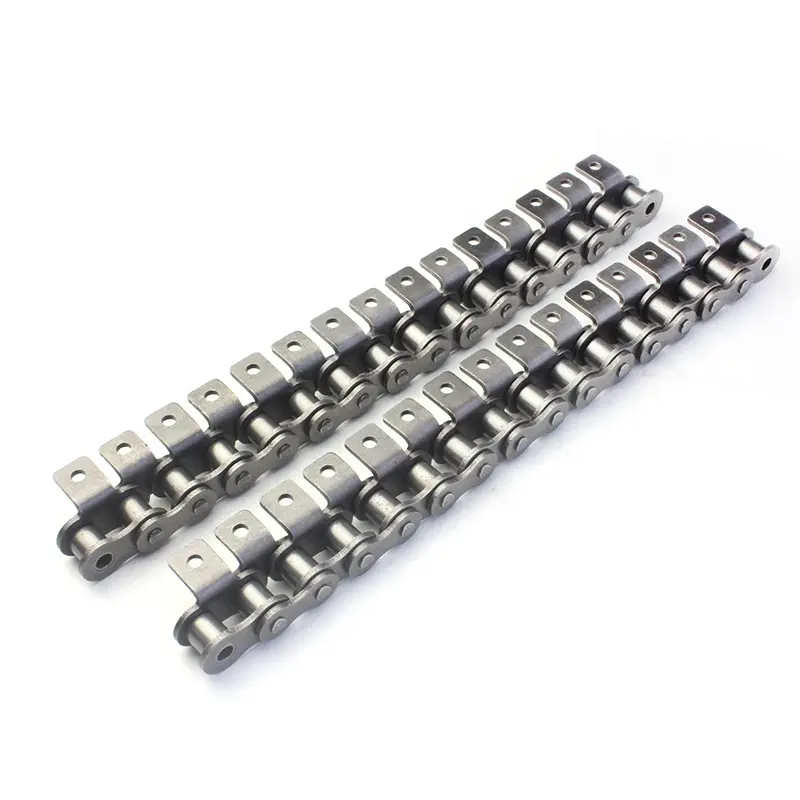
How does the elongation of a transmission chain affect its lifespan?
Transmission chains are subject to gradual elongation over time as a result of wear and fatigue. The elongation of a transmission chain refers to the increase in its length due to the stretching of the chain’s components. Here’s a detailed explanation of how elongation affects the lifespan of a transmission chain:
1. Increased Slack: As a transmission chain elongates, it develops more slack between the chain links. The increased slack reduces the chain’s tension and can negatively impact its performance. Excessive slack can lead to chain skipping, misalignment, and reduced power transmission efficiency. This can cause vibrations, noise, and accelerated wear on the chain and sprockets.
2. Accelerated Wear: Elongation puts additional stress on the chain’s pins, bushings, and rollers. The increased tension and movement between the chain’s components lead to accelerated wear and fatigue. This can result in chain elongation becoming a self-perpetuating problem, as the worn components further contribute to elongation and reduced performance.
3. Decreased Load Capacity: Elongation reduces the effective pitch length of the transmission chain, resulting in decreased load-carrying capacity. The reduced load capacity can limit the chain’s ability to handle heavy loads or transmit power effectively. This can lead to premature failure or damage to the chain and associated machinery.
4. Increased Maintenance Requirements: Elongated transmission chains require more frequent maintenance and adjustment to maintain proper tension and performance. Regular monitoring and adjustment of chain tension are necessary to minimize wear, prevent excessive elongation, and ensure optimal power transmission. Failure to address elongation promptly can lead to more severe damage to the chain and other components, resulting in costly repairs and downtime.
5. Reduced Service Life: The elongation of a transmission chain directly affects its service life. As the chain elongates, its performance, efficiency, and load-carrying capacity gradually deteriorate. The rate of elongation depends on various factors such as chain quality, operating conditions, lubrication, and maintenance practices. Over time, if elongation is not addressed, the chain may become unable to perform its intended function effectively, leading to chain failure and the need for replacement.
To mitigate the negative effects of elongation and extend the lifespan of a transmission chain, regular maintenance, including proper lubrication and tension adjustment, is crucial. Periodic inspections for signs of wear, elongation, and fatigue should be conducted to identify potential issues early and take appropriate corrective measures. Additionally, selecting high-quality chains and following manufacturer recommendations for installation, operation, and maintenance can help minimize elongation and maximize the chain’s lifespan.
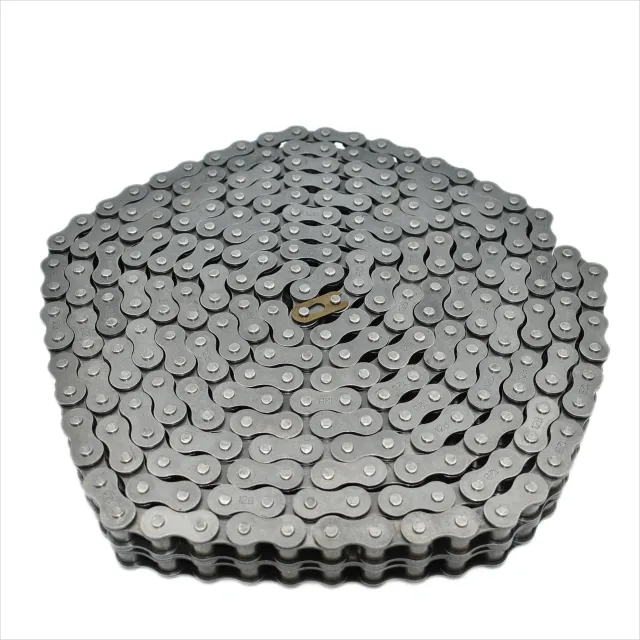
Can transmission chains be used in agricultural machinery?
Yes, transmission chains are commonly used in various types of agricultural machinery. Here’s a detailed answer to the question:
Agricultural machinery often requires reliable and efficient power transmission to perform tasks such as harvesting, planting, tilling, and transporting. Transmission chains offer several advantages that make them suitable for agricultural applications:
1. High Strength and Load Capacity: Agricultural machinery often operates in demanding conditions and handles heavy loads. Transmission chains are designed to have high tensile strength and load-carrying capacity, making them capable of withstanding the rigorous demands of agricultural tasks.
2. Versatility: Transmission chains can be used in different agricultural machinery types, including tractors, combines, balers, harvesters, and sprayers. They are adaptable to a wide range of power transmission requirements, including transmitting torque, speed, and motion.
3. Durability: Agricultural environments can be harsh, with exposure to dirt, debris, moisture, and variable weather conditions. Transmission chains are built to withstand such conditions, and their robust construction and materials ensure long-lasting performance in agricultural machinery.
4. Easy Maintenance: Agricultural operations often involve extended working hours and remote locations. Transmission chains are relatively easy to inspect, lubricate, and maintain, allowing for efficient maintenance schedules in the field.
5. Cost-Effective: Compared to other power transmission options, transmission chains offer a cost-effective solution for agricultural machinery. They provide reliable power transfer, have a long service life when properly maintained, and are available at competitive prices.
When using transmission chains in agricultural machinery, it is essential to select the appropriate chain type and size based on the specific requirements of the equipment. Factors such as load capacity, speed, operating environment, and maintenance considerations should be taken into account to ensure optimal performance and longevity of the transmission chain.
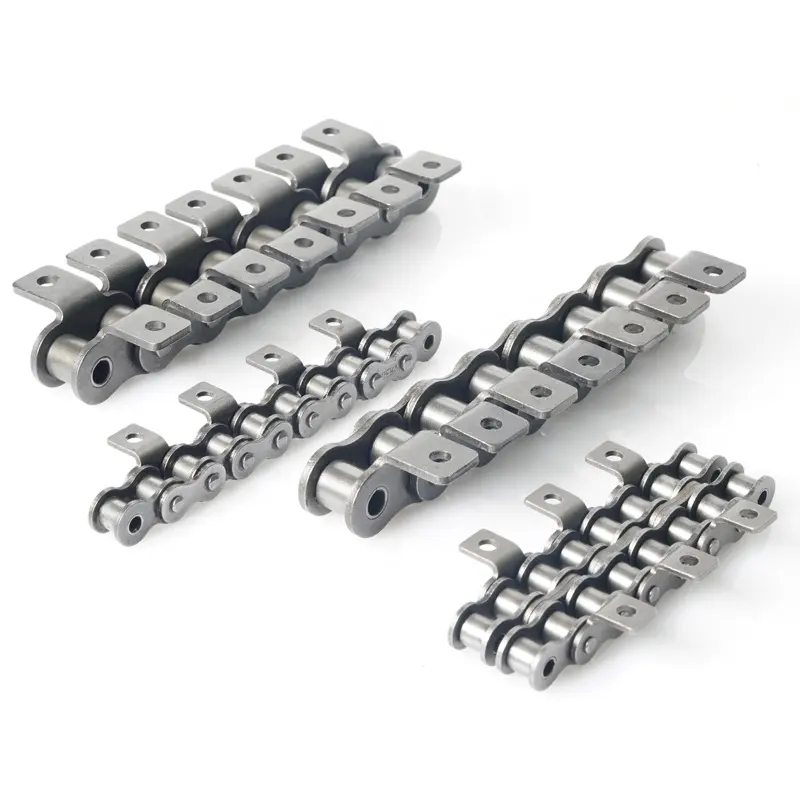
What are the main differences between standard and heavy-duty transmission chains?
Standard and heavy-duty transmission chains are designed to meet different load and performance requirements. Here are the main differences between these two types:
- Load Capacity: Heavy-duty transmission chains are built to handle higher loads and provide greater strength compared to standard chains. They are designed to withstand heavier and more demanding applications.
- Construction: Heavy-duty transmission chains are typically constructed with thicker plates, larger pins, and stronger components to enhance their durability and load-carrying capacity.
- Size: Heavy-duty transmission chains are often larger in size compared to standard chains to accommodate the increased load requirements.
- Weight: Due to their robust construction, heavy-duty transmission chains tend to be heavier than standard chains.
- Durability: Heavy-duty chains are engineered to have greater wear resistance, fatigue resistance, and overall durability to withstand harsh operating conditions and prolonged usage.
- Applications: Standard transmission chains are suitable for lighter-duty applications where moderate loads are involved, such as light machinery, conveyors, and small equipment. Heavy-duty transmission chains, on the other hand, are designed for heavy machinery, industrial equipment, mining applications, and other demanding environments.
It’s important to consider the specific requirements of your application, including load capacity, operating conditions, and expected lifespan, to determine whether a standard or heavy-duty transmission chain is the right choice.


editor by CX 2023-12-26