A seafood processing plant on Korea’s south coast installed what its purchasing department ordered as “stainless steel sprockets” for a new shrimp conveyor line in early 2024. The sprockets were manufactured from 304 stainless steel with a standard machined finish. Within six months, the tooth faces had developed a red-brown discolouration consistent with crevice corrosion, and two sprockets had developed pitting on the bore inner surface where moisture had pooled during production. The issue was not that 304 stainless was used — it was that 304 stainless is susceptible to chloride-induced crevice corrosion, and the washdown water at this plant contained 180 ppm chloride from the seawater used in the shrimp chilling tanks. For this specific environment, 316L stainless — which contains molybdenum for chloride resistance — was the required grade, not 304. The difference in material cost between the two grades at this sprocket size was approximately 15%.
Stainless steel sprocket specification requires three decisions beyond simple material choice: the correct stainless grade for the corrosion environment, the correct surface finish for the hygienic application, and the correct approach to lubrication at the chain-sprocket interface. Each of these decisions is independent, and all three must be correct for the installation to perform as intended.
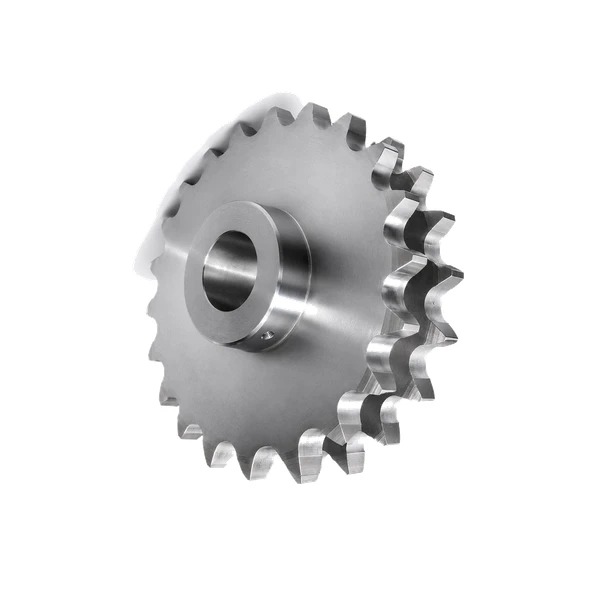
Stainless Steel Grades Used for Sprockets: What Actually Differs Between Them
| Grade | Cr / Ni / Mo (%) | Chloride Resistance | Hardness (machined) | Tooth Wear Rate vs CS | Typical Use Case |
|---|---|---|---|---|---|
| 304 / 1.4301 | 18Cr / 8Ni / 0Mo | Moderate — below ~80 ppm Cl⁻ | 170–200 HB | 2.5–3.5× higher | Food processing (non-chloride), light acid, mild washdown |
| 316L / 1.4404 | 16Cr / 10Ni / 2Mo | Good — up to ~400 ppm Cl⁻ | 165–195 HB | 2.5–4.0× higher | Seafood processing, CIP lines, light marine, chlorinated washdown |
| 316Ti / 1.4571 | 16Cr / 11Ni / 2Mo + Ti | Good — Ti stabilises vs sensitisation | 170–200 HB | 3.0–4.0× higher | High-temperature food process (above 400°C weld zones) |
| Duplex 2205 / 1.4462 | 22Cr / 5Ni / 3Mo | Excellent — >1,000 ppm Cl⁻ | 260–310 HB | 1.4–1.8× higher | Marine environments, brine processing, offshore, chemical plant |
| 904L / 1.4539 | 20Cr / 25Ni / 4.5Mo | Excellent — sulphuric acid resistance | 170–190 HB | 3.5–5.0× higher | Chemical plant, acid pickling baths, phosphoric acid handling |
Surface Finish for Food-Grade Sprockets: What Hygienic Design Actually Requires
The European Hygienic Engineering and Design Group (EHEDG) and the 3-A Sanitary Standards both specify that food-contact surfaces must have a maximum surface roughness of Ra ≤ 0.8 µm (often stated as 0.8 µm Ra = approximately 32 µin Ra in American specifications). This is not an arbitrary number — it is the threshold below which common food pathogens (Listeria, Salmonella, E. coli) cannot form stable biofilms. Above Ra 0.8 µm, the surface texture provides physical retention sites that protect bacteria from cleaning chemicals.
A standard machined stainless sprocket from CNC turning has a typical surface finish of Ra 1.6–3.2 µm. This is below the hygienic design threshold. For direct food-contact applications, sprocket surfaces require additional finishing: grinding to Ra ≤ 0.8 µm on all product-contact faces, followed by electropolishing to reduce surface peaks and passivate the stainless steel surface. For non-contact surfaces (backs of sprockets, side faces that do not touch the product or the chain), standard machined finish is acceptable.
Beyond surface finish on the sprocket faces, hygienic design also addresses the geometry of product-retention zones. A standard B-hub sprocket has a recessed area between the hub face and the back of the sprocket disc — a crevice that collects product residue and is difficult to clean. Hygienic sprocket designs for direct food-contact use either eliminate the hub-disc crevice entirely (A-plate configuration with no hub projection on the product side) or seal the crevice with a continuous radius weld. This geometric requirement is separate from material and surface finish, and it is the reason standard industrial sprockets — even in 316L stainless with Ra 0.8 µm finish — are not automatically food-grade components.
FDA 21 CFR and NSF Compliance for Stainless Sprockets
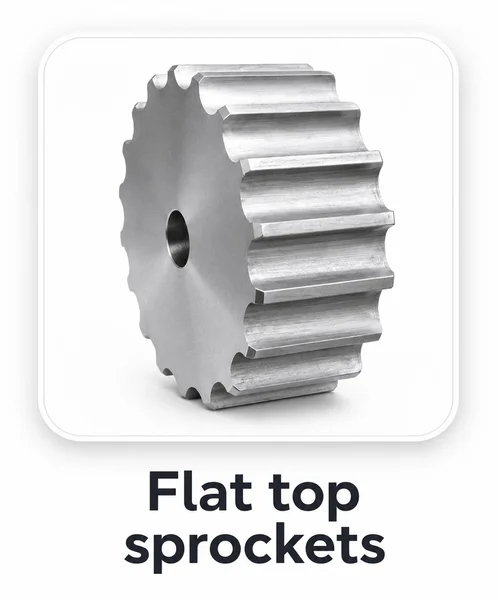
FDA 21 CFR Part 177 (indirect food additives — polymers) and Part 170–186 (generally recognised as safe substances) do not directly regulate stainless steel component use in food processing equipment, because stainless steel is not a food additive in the regulatory sense. FDA regulation of stainless steel sprockets operates through the broader framework of 21 CFR Part 110 (Current Good Manufacturing Practice), which requires that all equipment surfaces that contact food must be made of materials that will not contaminate the food and can be cleaned and sanitised.
NSF/ANSI Standard 51 (Food Equipment Materials) is the most directly applicable certification standard for stainless steel food processing components in Korea and across the Asia-Pacific region. NSF/ANSI 51 certification requires: material identification and traceability (mill certificate, heat number); surface finish verification (Ra measurements at multiple points on product-contact surfaces); corrosion resistance testing; and absence of prohibited surface treatments or coatings that could migrate into food. A stainless sprocket with an NSF/ANSI 51 certification provides documentary evidence of compliance suitable for HACCP audit purposes.
- 304 stainless, passivated, Ra ≤ 0.8 µm
- 316L stainless, passivated or electropolished
- Duplex 2205 (high-chloride zones)
- UHMW polyethylene (idler positions)
- Acetal (POM) — some grades, dry-run idlers
- Carbon steel (any surface treatment)
- Zinc-plated or cadmium-plated steel
- Cast iron (porous — cannot be sanitised)
- Stainless with non-food-grade lubricant applied to tooth face
- Any plastic with non-food-grade plasticisers
- Carbon steel with non-stick coating (verify coating food-grade and intact)
- Nickel-plated steel (below food contact zone only)
- Aluminium (where product contact is incidental and alloy is food-grade)
- Stainless — standard machined finish (non-direct-contact zones)
Industry-Specific Stainless Sprocket Specifications
Seafood and aquaculture processing. The highest-demand stainless application in Korean food processing is seafood — specifically plants handling shrimp, crab, and fish where seawater-contaminated washdown water creates chloride concentrations that attack 304 stainless. The minimum grade specification for these environments is 316L. For facilities close to the shoreline or those using direct seawater in chilling tanks, chloride concentrations in the plant atmosphere can exceed 500–800 ppm during summer operations — the threshold where 316L begins to show borderline crevice corrosion susceptibility. Duplex 2205 is the correct grade for sprockets in direct seawater-spray zones. Stainless and duplex steel sprockets for food processing are available with material certificates and NSF surface finish documentation on request.
Dairy and beverage bottling. CIP (Clean-in-Place) systems use alternating hot caustic (NaOH, 1–2%, 80°C) and hot acid (HNO3 or H3PO4, 0.5–1%, 60°C) cycles for line cleaning. This CIP chemistry is generally compatible with 316L stainless — the passivated oxide layer on 316L withstands caustic and nitric acid cycles well. However, some CIP systems use chlorinated alkaline detergents (containing hypochlorite) at concentrations that attack even 316L at elevated temperatures. For dairy lines using chlorinated CIP chemistry: electropolished 316L stainless is the minimum specification for sprockets; in practice, most European and Korean dairy equipment OEMs specify 316L electropolished as the default.
Chemical plant and pharmaceutical manufacturing. Sprockets in chemical plant conveyor systems are often required to resist specific chemical environments rather than generic “corrosion.” The correct grade selection requires identifying the specific chemical, its concentration, and the operating temperature, then cross-referencing against published corrosion resistance data for each stainless grade. For sulphuric acid above 65% concentration: 904L is the appropriate stainless grade. For hydrochloric acid at any concentration: standard austenitic stainless provides poor resistance, and Hastelloy or titanium sprockets may be necessary. For pharmaceutical GMP environments: 316L electropolished with 1 µm Ra or better, with all surfaces capable of CIP and SIP (sterilise-in-place) without disassembly.
Marine and offshore applications. Conveyor and drive sprockets on offshore platforms, coastal fish farming equipment, and boat deck machinery operate in continuous salt spray and immersion environments. PREN (Pitting Resistance Equivalent Number) is the metric used to compare stainless grades for marine use: PREN = %Cr + 3.3×%Mo + 16×%N. For marine service (PREN ≥ 40 required): 316L has PREN ≈ 24 — marginal; Duplex 2205 has PREN ≈ 35 — better; Super Duplex 2507 has PREN ≈ 42 — suitable for continuous immersion. Most Korean coastal aquaculture conveyors specify 316L as a minimum, with Duplex 2205 for direct spray and immersion zones.
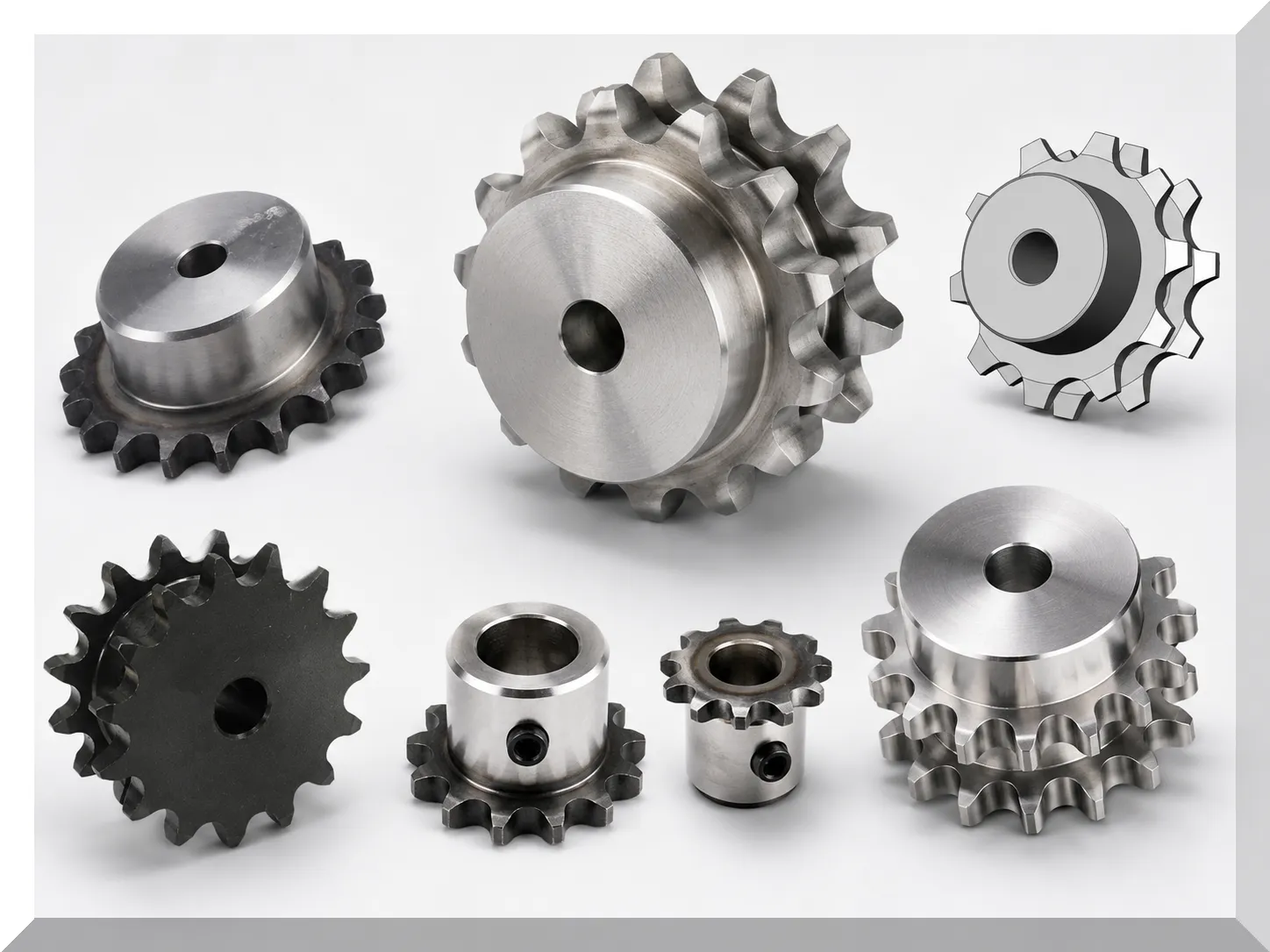
When UHMW Plastic Outperforms Stainless Steel for Sprocket Applications
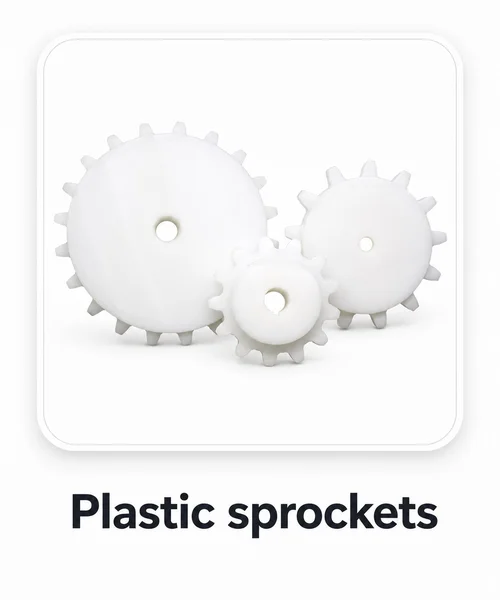
UHMW polyethylene sprockets — the correct choice for dry-running idler positions above food product, where any lubrication is a contamination risk.
For idler sprocket positions in food processing environments — sprockets that guide chain but do not transmit drive force — UHMW polyethylene (ultra-high-molecular-weight polyethylene) often outperforms stainless steel in practical use. UHMW has a coefficient of friction against standard roller chain of approximately 0.1–0.15, compared to 0.18–0.25 for stainless steel against the same chain. This lower friction means UHMW idler sprockets require no lubrication to run smoothly — the self-lubricating property of UHMW means the chain slides over the idler teeth without the metal-to-metal adhesion that requires oil or grease at a stainless steel contact.
The critical limitation of UHMW sprockets is load and speed capacity. UHMW is suitable for idler (guide) positions only — it cannot transmit significant drive torque because the tooth faces are too soft (Shore D 63–65) to resist the contact stress at drive positions without rapid wear. Temperature limits are also much lower than stainless: UHMW begins to creep under sustained load above 80°C and should not be used in continuous-duty applications above 65°C ambient. For below-80°C, low-load idler positions above a food conveyor where any lubricant contamination risk is unacceptable, UHMW is the technically correct choice over stainless.
Lubrication at the Stainless Sprocket-Chain Interface: The Unavoidable Problem
Stainless steel sprockets do not eliminate the need for lubrication — they change the type of lubricant that is acceptable. In food-adjacent and food-contact environments, the only permissible lubricants are NSF H1 registered food-grade lubricants. These are formulated without base oils or additives that would produce unacceptable contamination risk if incidental food contact occurred. NSF H1 lubricants are required at all points where incidental food contact with the lubricant is possible — which in most food processing environments means everywhere on the chain and sprocket system.
The practical consequence is that food-grade chain lubricants typically have shorter service life and lower film strength than standard industrial lubricants. A standard mineral-oil chain lubricant maintains a hydrodynamic film at the pin-bushing interface for 8–12 hours under continuous operation. An equivalent NSF H1 food-grade lubricant maintains the equivalent film for 4–6 hours before re-application is required. This shorter interval must be accounted for in the maintenance schedule — an automated lubrication system (drip oiler or micro-spray, food-grade lubricant) is often the only practical way to maintain the required application frequency in a production environment where manual lubrication between shifts is not feasible.
For stainless sprockets paired with sealed stainless roller chain, the external lubrication requirement reduces significantly because the chain internal interface is sealed with factory-applied NSF H1 grease. External lubrication in these systems addresses only the roller-sprocket tooth contact, not the pin-bushing interface — the application interval can be extended to 8–12 hours of operation without compromising the critical internal bearing surfaces.
Completing a Stainless Sprocket Specification: All Required Information
A complete stainless sprocket specification for a food processing application requires eight data points. Missing any of them results in receiving a component that satisfies some requirements but fails others:
- Chain pitch and series: ANSI number or ISO equivalent, including strand count.
- 歯の本数: Confirmed from physical measurement or documentation.
- Material grade: 304, 316L, Duplex 2205, or other — specific grade, not “stainless”.
- Surface finish requirement: Ra value on product-contact surfaces, with specification of which surfaces. “Food grade” is not a surface finish specification — “Ra ≤ 0.8 µm on tooth faces and bore” is.
- Surface treatment: Passivated only, electropolished, or standard machined.
- 穴径とキー溝: To ±0.05 mm on bore, with keyway standard (DIN 6885 metric or ASME B17.1 inch).
- ハブスタイル: A-plate (preferred for food contact — no crevices), B-hub, or C-hub. State whether hub faces require the same surface finish as the product-contact surfaces.
- Certifications required: Material test certificate (MTC), NSF/ANSI 51 compliance declaration, EHEDG documentation, or other.
よくある質問
Stainless Sprockets Supplied With Material Certificate and Surface Finish Documentation
Specify chain pitch, tooth count, stainless grade, surface finish requirement, bore dimensions, and hub style. We supply MTC, NSF compliance declarations, and Ra measurement certificates on request for food-grade applications.
編集者: Cxm