A Busan food processing plant spent 45 minutes changing a worn sprocket on its packaging line indexer in 2022. The maintenance technician had to pull the shaft, press the sprocket off using a hydraulic press in the maintenance shop, machine a new bore on a lathe (the replacement sprocket was a different shaft diameter), and reinstall the shaft. For a drive that requires sprocket changes three or four times per year due to format changes and wear, this was consuming approximately three hours of maintenance time per year, plus the cost of bore machining. In 2023, a QD-bushed sprocket set was installed on the same drive. Sprocket changes now take 8 minutes. The annual maintenance cost for that sprocket position dropped by approximately 80%. The capital cost of the QD conversion paid back in seven weeks.
That outcome — significant maintenance cost reduction from a mounting system change — is typical for applications that have been running with the wrong mounting philosophy. The selection between QD, taper lock, and plain bore sprockets is not primarily a technical question about strength or precision. It is a maintenance management question about how frequently the sprocket needs to come off, what tools and skills are available in the field, and what level of shaft-mounting accuracy the application requires.
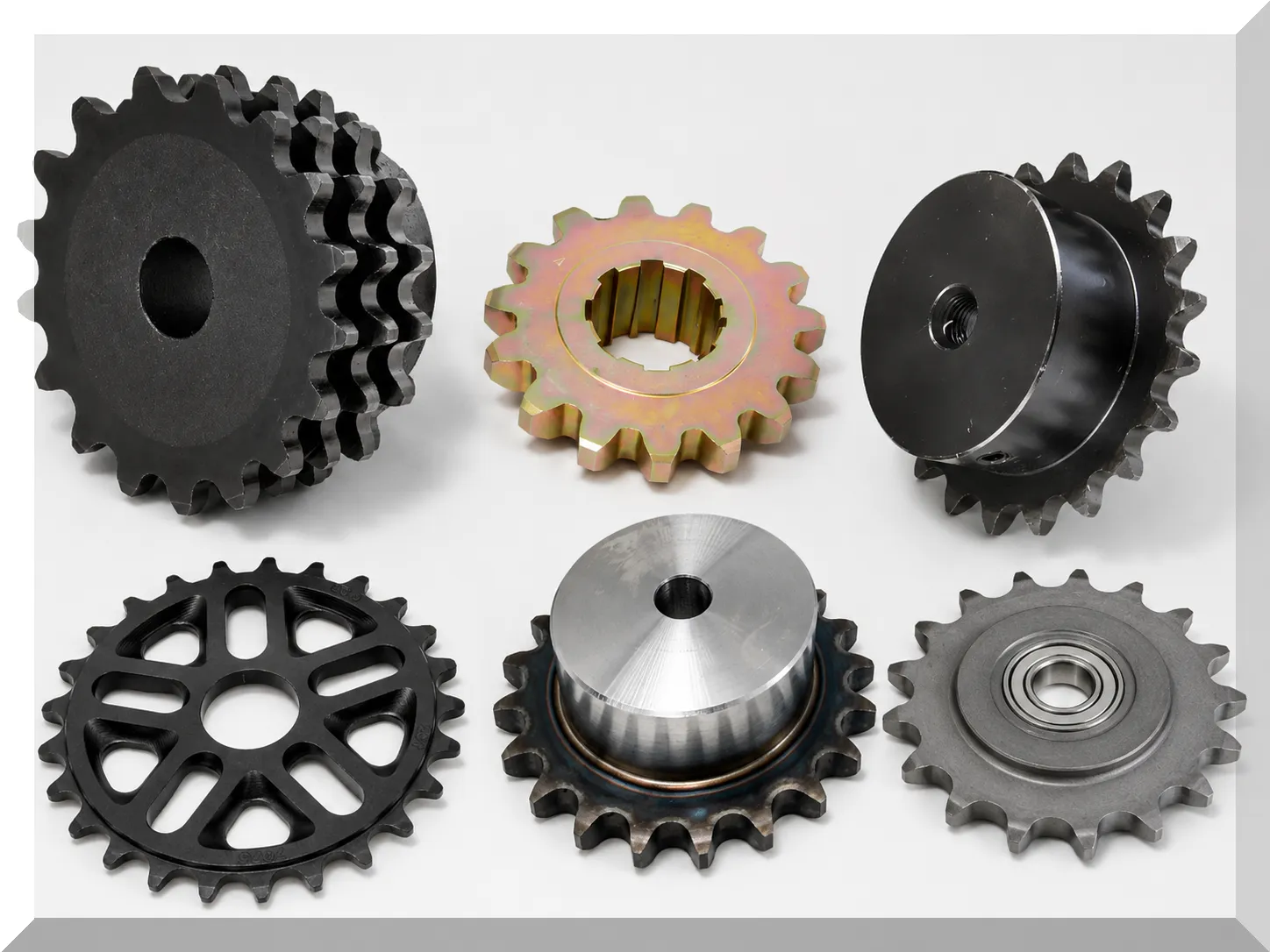
How Each Mounting System Works
Full Comparison: Performance, Precision, and Practical Considerations
| Παράγοντας | QD Bushed | Κωνικό κλείδωμα | Plain Bore |
|---|---|---|---|
| Installation time (first fit) | 5–10 min | 10–15 min | 15–45 min (machining extra) |
| Removal time | 3–6 min (no puller) | 8–12 min (jacking screws) | 20–90 min (puller required) |
| Concentric accuracy (TIR) | 0.05–0.15 mm | 0.025–0.05 mm | 0.01–0.03 mm (interference fit) |
| Shaft diameter flexibility | High — change bushing only | High — change bushing only | None — fixed bore per sprocket |
| Shaft damage on removal | None if correct procedure | None if correct procedure | Possible fretting on shaft keyway with repeated removal |
| Torque capacity (relative, same hub) | Ψηλά | Ψηλά | Highest (full shaft engagement) |
| Axial positioning accuracy | ±1 mm (adjustable) | ±0.5 mm (adjustable) | Fixed by machined shoulder or collar |
| Cost: bushing + sprocket vs plain bore | +40–70% initial purchase | +35–60% initial purchase | Lowest initial cost |
| Tools required on site | Hex keys + torque wrench | Hex keys + torque wrench | Puller (may require shop return) |
| Re-use after removal | Sprocket body: yes. Bushing: inspect first. | Sprocket body: yes. Bushing: inspect for cracks. | Sprocket: yes if bore undamaged. Shaft: inspect keyway. |
| Best suited for | Frequent changes, varied shaft diameters, field service | Precision drives, permanent installs, varied shaft diameters | Low-change-frequency, high-load, fixed shaft diameter |
Taper Lock and QD Bushing Series: Selecting the Right Size
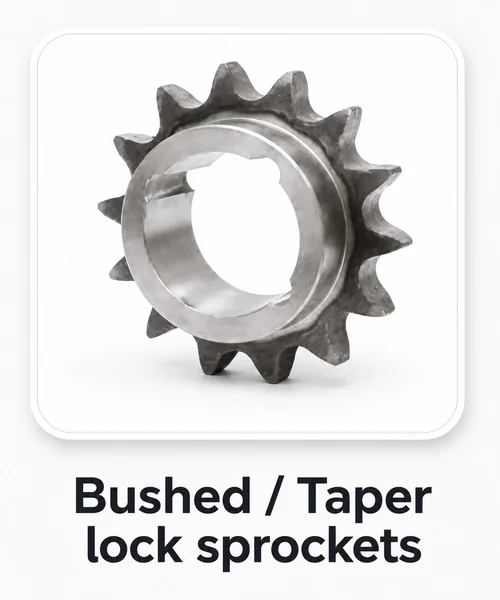
Taper lock bushings are available in standard series from 1008 (smallest) to 5040 (largest). The series designation encodes two numbers: the first two digits give the maximum bore diameter in eighths of an inch (e.g., “30” in 3020 = 30/8 = 3.75 inches = 95.3 mm maximum bore), and the last two digits give the bushing length in eighths of an inch. This encoding is not always intuitive, but the key practical point is that the series must be matched to both the shaft diameter range and the sprocket hub bore dimensions — the sprocket body is machined to accept one specific taper lock series, and this cannot be changed in the field.
| Taper Lock Series | Min Bore (mm) | Max Bore (mm) | Common ANSI Chain Pitches | Typical Installation Torque (Nm) |
|---|---|---|---|---|
| 1008 | 9.5 | 25.4 | #25, #35, small #40 | 8–18 |
| 1108 | 14 | 28.6 | #35, #40 | 18–28 |
| 1210 | 12.7 | 31.8 | #40, #50 | 28–40 |
| 1610 | 14 | 44.5 | #40, #50, #60 | 55–80 |
| 2012 | 19 | 57.2 | #50, #60, #80 | 80–130 |
| 2517 | 25.4 | 69.9 | #60, #80, #100 | 130–190 |
| 3020 | 25.4 | 82.5 | #80, #100, #120 | 190–270 |
| 3535 | 25.4 | 101.6 | #100, #120, #140 | 270–380 |
| 4040 | 38.1 | 114.3 | #120, #140, #160 | 380–520 |
Installation torque must be followed precisely — under-torqued bushings slip on the shaft under load, producing fretting wear that damages both the bushing bore and the shaft surface. Over-torqued bushings in the 1008 and 1108 series can split the bushing flange. A calibrated torque wrench is not optional for production installations; it is a requirement. The bolt torque sequence — alternating between the clamping bolts rather than tightening all on one side first — ensures even taper engagement and prevents the bushing from cocking in the hub bore.
Application Fit Guide: Which System for Each Scenario
- Format changes require sprocket removal more than 4× per year
- Multiple shaft diameters exist across similar machines (one sprocket body, different bushings)
- Field service requires toolbox-only removal without workshop equipment
- Packaging, food processing, pharmaceutical format-change drives
- High-availability lines where maintenance window is under 30 minutes
- Positional accuracy and low run-out are critical (precision indexing, servo drives)
- Semi-permanent installations that change occasionally but require high concentricity
- Multiple shaft diameters across similar machines — shaft diameter varies but position precision must be maintained
- Conveyors where sprocket position relative to frame must be repeatable after replacement
- European-standard equipment using metric taper bore sprockets
- Sprocket changes occur fewer than 2× per year (wear only, no format changes)
- Very high shock loads where bushing slip risk must be eliminated entirely
- Fixed shaft diameters with no variation across the fleet
- Low-cost, long-life installations in simple conveyor or general industrial drives
- Budget-constrained procurement where lowest unit cost is the primary requirement
Industry-Specific Mounting System Choices
Korean automotive assembly plants. Body-in-white conveyor systems use taper lock sprockets with verified concentric accuracy — the chain positioning tolerances in these systems are tight enough that bushing runout above 0.10 mm causes chain tracking problems on curved sections. Taper lock is preferred over QD specifically because the wedge geometry self-centres the bushing within the sprocket bore, providing the lower runout that these precision conveyors require. The sprockets are changed infrequently — typically at annual shutdowns — so the slower removal time of taper lock versus QD is not a significant operational consideration.
Food and beverage packaging. Bottling and canning lines run at high speed with multiple container sizes changing multiple times per week. QD-bushed sprockets dominate because the format change time directly affects line output. The 8-minute format change capability of a QD system, compared to the 45-minute plain-bore alternative, is the single most significant operational advantage at this application type. Stainless steel QD sprockets in JA and SK bushing series are standard for Korean and Japanese food processing OEM equipment in the #35 and #40 chain pitch range.
Agricultural and general industrial drives. Plain bore sprockets dominate agricultural machinery — combine feeder drives, grain elevator legs, and rice thresher drives — because these applications have fixed shaft diameters, low format-change requirements, and are serviced by operators and technicians without specialist tooling. A basic puller is sufficient for planned annual maintenance. The lower unit cost of plain bore sprockets and the simplicity of keyed-shaft installations make this the economically rational choice for these applications. Plain bore roller chain sprockets in standard ANSI pitch sizes are maintained in Korean warehouse stock for same-week delivery to agricultural equipment dealers and maintenance depots.
Mining and cement bulk handling. For high-torque drives in mining and cement processing, both taper lock (large series: 3535, 4040, 5040) and plain bore configurations are used. The choice depends on shaft access. When the sprocket shaft is readily accessible for bearing removal to extract a plain-bore sprocket, plain bore is preferred — the maximum torque capacity of a keyed plain-bore sprocket is higher than a bushed equivalent at the same hub size because the key engages the full bore depth rather than the clamping friction of a bushing. When shaft accessibility is poor and the sprocket is buried in a housing, taper lock provides the easiest field access because extraction requires only the jacking screws already supplied with the bushing — no separate puller is needed.
Five Installation Mistakes That Invalidate the Mounting System’s Benefits
Oil film between the bushing OD and the sprocket bore prevents proper taper seating and reduces the achieved clamping torque by 20–40%. Clean both the bushing outer taper and the sprocket bore with solvent and dry before assembly. Similarly, lightly oil the shaft (not the taper surfaces) to allow the bushing to slide into position without galling.
Tightening all bolts on one side first cocks the bushing in the bore — one side engages the taper fully while the other remains partially released. The resulting non-uniform clamping produces a bushing that sits off-centre in the hub, adding runout and reducing the effective clamping force. Always alternate bolts in small increments until the specified torque is reached uniformly.
QD bushings have two sets of threaded holes — clamping holes and extraction holes. After extraction, the extraction holes have their thread damaged by the extraction load. Reinstalling the bushing with the extraction screws now in the clamping position produces under-torqued clamping that will slip in service. Always reinstall with clamping bolts in the clamping holes and confirm the extraction holes are clear.
Some maintenance shops bore out a plain-bore sprocket hub to fit a larger shaft rather than ordering the correct part. The maximum bore diameter for each sprocket is set by the minimum wall thickness between the bore surface and the nearest tooth root. Exceeding this reduces the tooth section at its stress concentration point and can produce hub fracture under shock loading — particularly on case-hardened sprockets where a thin section has low ductility.
European metric taper lock bushings (used in ISO/DIN-standard equipment) use M-thread bolts; American inch taper lock bushings use UNC thread bolts. The outer dimensions of similar series are nearly identical, but the threaded holes are different. Using metric bolts in UNC holes (or vice versa) produces incomplete thread engagement — the bolts reach the specified torque but at much lower clamping force because the thread form cross-section is smaller. The bushing slips in service almost immediately under load.
Συχνές ερωτήσεις
All Three Mounting Systems Stocked and Custom Bore Machined
Provide your chain pitch, tooth count, shaft diameter, and bushing series — our engineers confirm the correct sprocket body and bushing combination, machine the bore to your specification, and ship within 3–5 business days for standard configurations.
Επιμέλεια: Cxm