Cast Iron vs Steel Sprockets: The Engineering Case for Each — and When the Choice Matters
A feed mill in North Chungcheong Province purchased cast iron sprockets for its conveyor upgrade in 2022 — they were 35% cheaper than the steel equivalent, the supplier confirmed compatibility with the existing #80 chain, and the maintenance manager had used cast iron sprockets successfully on the same type of conveyor at a previous facility. Eighteen months later, two of the twelve drive positions had sprocket tooth fractures. Not wear — fractures. The broken teeth were at the positions where the conveyor carried the bucket elevator loading arm — a position where the conveyor chain experiences a momentary tension spike as each bucket fills on the down-stroke. The cast iron teeth had been fracturing progressively, one tooth tip per bucket-loading event, until multiple teeth were missing and the chain disengaged. The replacement specification was carbon steel 1045 with case hardening. No fractures in the subsequent 30 months of operation. The 35% initial cost saving on the cast iron sprockets cost approximately eight times its value in replacement and downtime expenses over the 18-month period.
Cast iron sprockets are a legitimate engineering specification for the right applications. The error is not choosing cast iron — it is choosing cast iron for applications that include shock loading, a condition where cast iron’s brittle failure mode converts a minor tooth overload into a complete tooth fracture rather than the plastic deformation that would occur in steel.
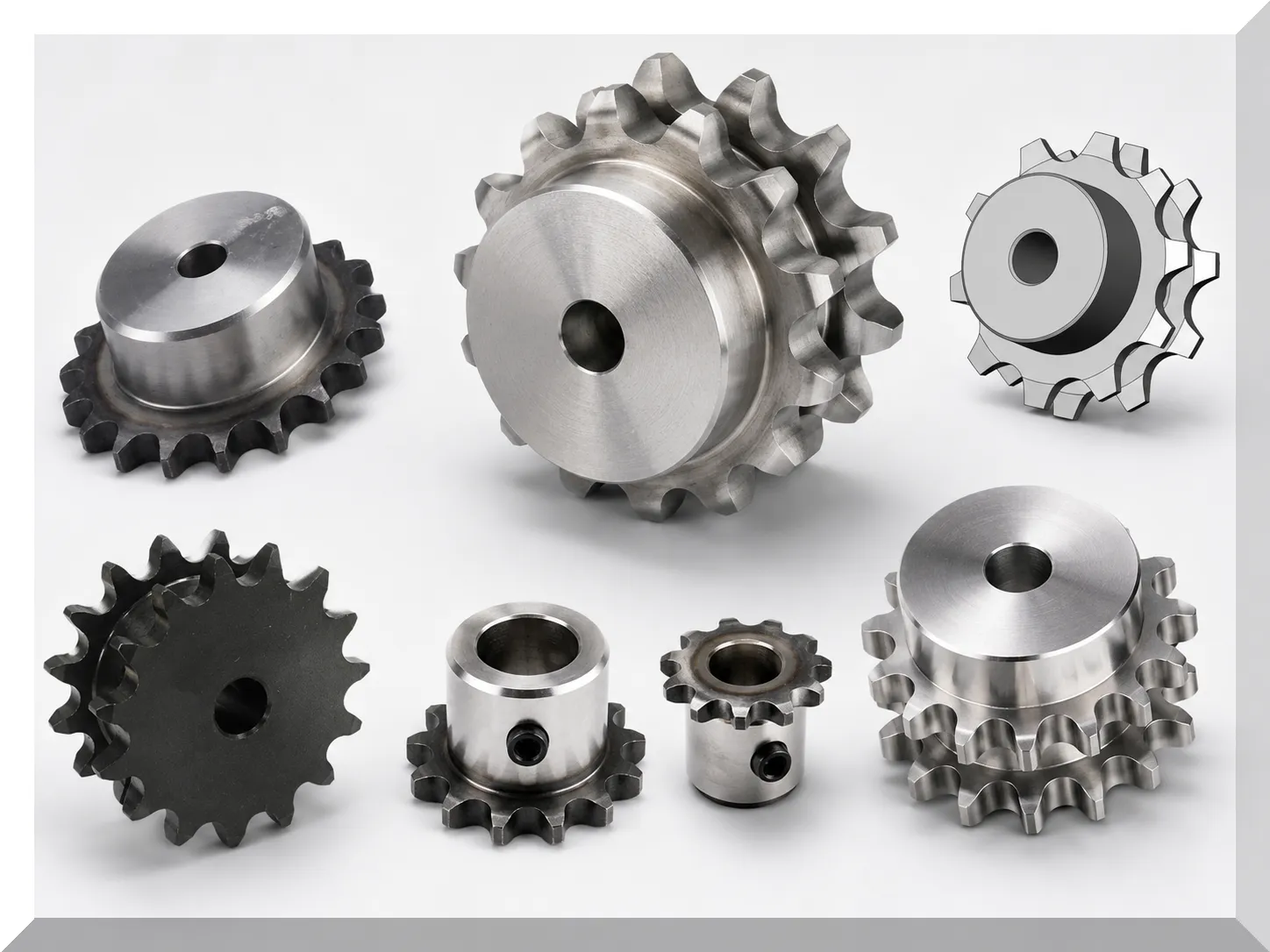
The Three Properties That Determine Sprocket Material Selection
Complete Material Comparison: Seven Sprocket Material Specifications
| Matériel | Tooth Hardness | Shock Resistance | Wear Life (relative) | usinabilité | Cost (relative) | Primary applications |
|---|---|---|---|---|---|---|
| Gray cast iron (FC200) | 160–200 HB | Very low | 1× (reference) | Excellent | Lowest (1.0×) | Light conveyor, low-shock, high-speed quiet drives |
| Ductile iron (FCD450) | 180–240 HB | Modéré | 1.4× | Bien | 1.2–1.4× | Moderate shock, agricultural, lower-speed industrial |
| C45 / 1045 carbon steel (as-machined) | 200–250 HB | Haut | 1.5× | Bien | 1.3–1.6× | Standard industrial drives, plain bore or taper lock |
| 1045 / C45 case-hardened | HRC 55–60 surface | Haut | 5–8× | Good (before hardening) | 1.8–2.5× | Most industrial power transmission — standard specification |
| 4140 / SCM440 alloy steel (Q&T) | 280–340 HB through | Très haut | 3–5× | Modéré | 2.0–3.0× | High shock, heavy-duty conveyors, press transfer |
| 8620 case-hardened | HRC 58–62 surface | Très haut | 7–12× | Modéré | 2.5–3.5× | High-cycle, precision indexing, automotive transmission |
| 304 / 316L stainless | 170–200 HB (as-machined) | Modéré | 0.3–0.5× (lower than CI) | Modéré | 3–5× | Food processing, chemical, washdown — not wear-resistant |
Case Hardening: Why the Tooth Profile Must Be Hardened After Machining, Not Before

Case hardening (carburising or induction hardening) introduces a hard outer layer (case) on the tooth surface while maintaining a tough low-hardness core beneath. This combination — hard surface for wear resistance, tough core for impact resistance — is precisely what the chain-sprocket contact requires: the tooth surface must resist the repeated roller contact stress without wear, while the tooth root must withstand the bending stress from chain pull without fracture.
The critical manufacturing sequence for sprocket production is: machine the tooth profile to final dimensions, then case harden, then apply light finishing only if necessary for bore precision. Hardening a tooth profile that has not yet been machined to final dimensions is not practical; through-hardening a sprocket before tooth machining destroys cutting tool life and produces inaccurate tooth geometry. The hardening step must follow the machining of the tooth profile.
The case depth for sprockets is typically specified as 0.8–1.5 mm for #60–#100 chain applications. Shallower than 0.8 mm risks breakthrough of the case at the tooth root when the tooth bends under chain pull. Deeper than 1.5 mm risks brittleness of the full tooth cross-section if the case depth approaches more than 25–30% of the total tooth thickness. For high-load applications, specifying the case depth explicitly in the purchase order — not simply “case hardened” — is the correct approach.
Material Selection Decision Matrix
- Load is smooth (no shock, no reverse, no jam-and-release)
- Chain speed is moderate-to-high and noise reduction matters
- Budget is the primary constraint with smooth-load conditions confirmed
- High quantity required (cast iron allows complex shapes in quantity at low cost)
- Replacement frequency is predictable and planned — wear, not fracture, is the failure mode
- Any shock loading is present or possible (conveyors with material drop, press transfer, start/stop duty)
- High cycle count requires extended tooth life (shift × 365 days × multi-year)
- The cost of an unplanned failure significantly exceeds the cost differential between cast iron and steel
- Tooth count is small (below 17T) — smaller sprockets have higher per-tooth stress and require better material properties
- This is the standard specification for most industrial power transmission chain drives
- High shock plus high load simultaneously (crusher drives, press transfer with heavy tooling)
- Maximum tooth life is required (multi-year planned maintenance intervals)
- The drive is difficult to access for maintenance (justified by high service cost)
- High-speed precision drives (8620 provides better dimensional stability through heat treatment)
Industry-Specific Sprocket Material Specifications
Korean food and beverage packaging lines. Production packaging lines in Korea’s beverage sector (Hite, OB, Lotte Chilsung) run #60 and #80 chain drives for case conveying and bottle handling at speeds of 30–80 m/min with smooth product loads. Gray cast iron sprockets are widely used in these applications for their vibration damping advantage at moderate-to-high chain speeds. The low shock profile of bottling conveyors — smooth loads, no lump material, no hard starts — keeps cast iron tooth fracture risk very low. However, the lubrication environment requires oil-compatible cast iron — standard grey iron is appropriate; phosphated or treated cast iron for improved corrosion resistance is not required where oil is present. Gray cast iron sprockets for standard ANSI pitches are available in finished bore with standard keyway and set screw configurations.
Steel mill and heavy industry. Scale conveyors, steel strip drag conveyors, and coil transfer drives in Korean and Vietnamese steel facilities require 4140 or 8620 alloy steel sprockets with through-hardening or deep case hardening — the combination of high chain tension, abrasive scale material contamination, and thermal cycling from proximity to furnace zones eliminates both cast iron (shock) and standard carbon steel (insufficient wear life) from consideration. The case hardness specification for steel mill sprockets is typically HRC 58–62 at 1.2–2.0 mm depth, with a hardness certificate required for each batch. Matched heavy-duty chain for these drives is ordered simultaneously to ensure consistent material hardness pairing at the contact interface.
Machines agricoles. Combine harvester drive sprockets and rice mill conveyor sprockets in Korean and Southeast Asian agricultural applications present a split specification: the main feeder drive sprockets (high shock, variable load, stone impact) require ductile iron or case-hardened carbon steel; the low-load clean auxiliary drives (seed metering, straw spreader, chaff spreader) are appropriate applications for gray cast iron where the cost saving per sprocket across a large fleet of machines is a genuine economic advantage.
Foire aux questions
Cast Iron, Carbon Steel and Alloy Steel Sprockets Available Across All ANSI Pitches
Describe your application load type (smooth / moderate shock / heavy shock), chain pitch, tooth count, bore diameter, and required tooth hardness — we specify the correct material and confirm case depth before manufacture.
Éditeur : Cxm