A parts accumulation conveyor at an electronics assembly plant in Suwon ran ANSI #60 single-strand chain on an overhead track system moving 0.8 kg circuit board assemblies at 8 metres per minute. The chain worked reliably but the system weighed more than the designer had intended — the #60 chain was specifying 0.84 kg/m on a 28-metre total circuit, contributing 23.5 kg to the overhead system load. When the system was expanded for a new product line in 2023, the engineer re-evaluated the chain specification. The conveyor speed was 8 m/min, the load per carrier was 0.8 kg, and the longest span was 2.4 metres. None of these values approached the limits of standard #60 chain. He specified double-pitch #2060 chain — same roller diameter as #60, same sprocket compatibility, 0.45 kg/m. The expanded system saved 37 kg of chain weight, reduced the drive motor requirement from 0.75 kW to 0.55 kW, and reduced chain cost by 38% without any reduction in load capacity or reliability.
Double-pitch chain is one of the most under-specified products in the chain catalogue for the applications it is best suited for — slow, light conveyor drives where standard pitch chain is used by default simply because the specifier is more familiar with it. Understanding exactly what double-pitch chain is, how it differs from standard pitch, and where the speed limit makes it unsuitable, enables correct specification of the lighter and less expensive option where it genuinely works.
What Double-Pitch Chain Is — and What Is Not Different
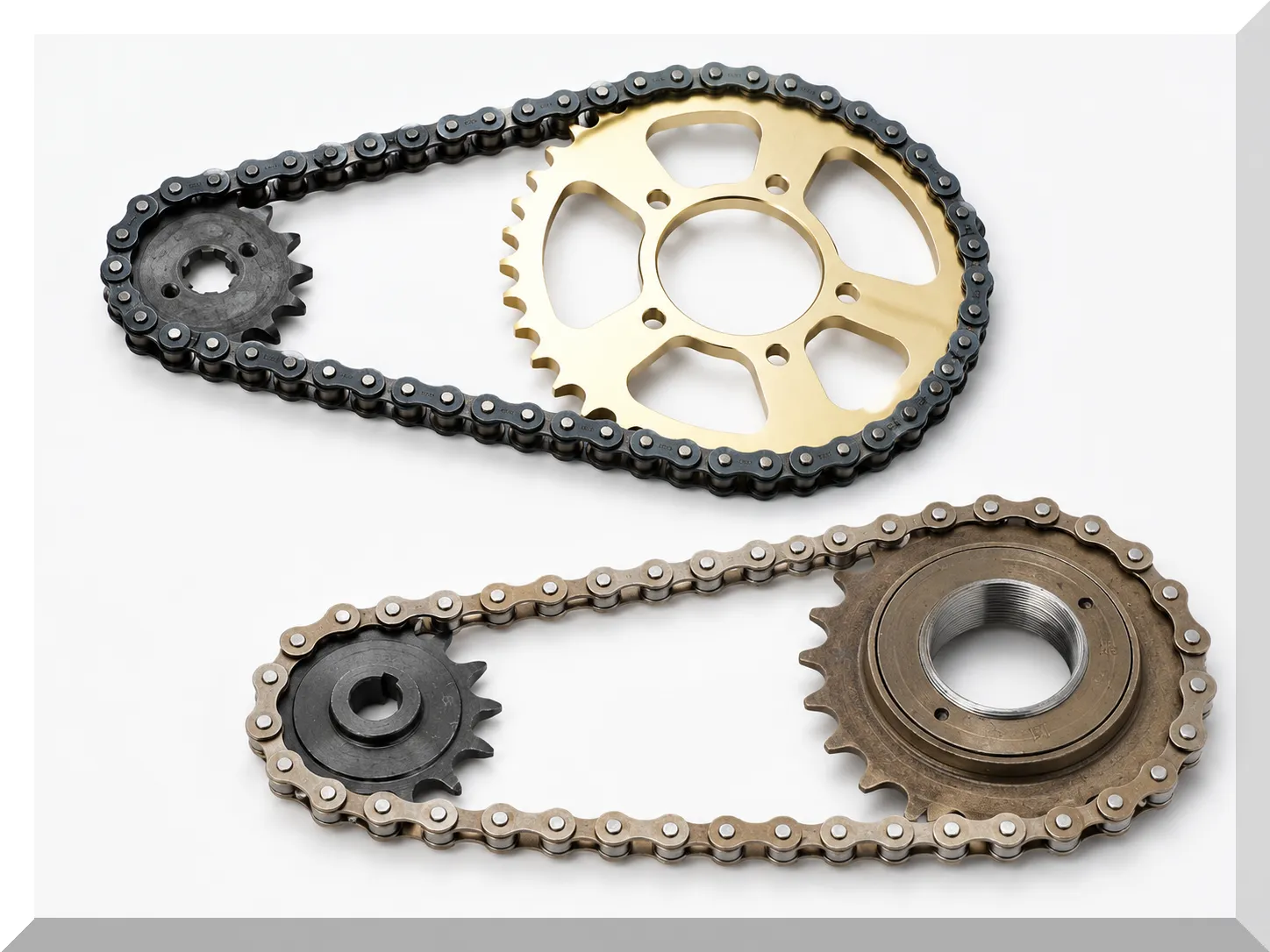
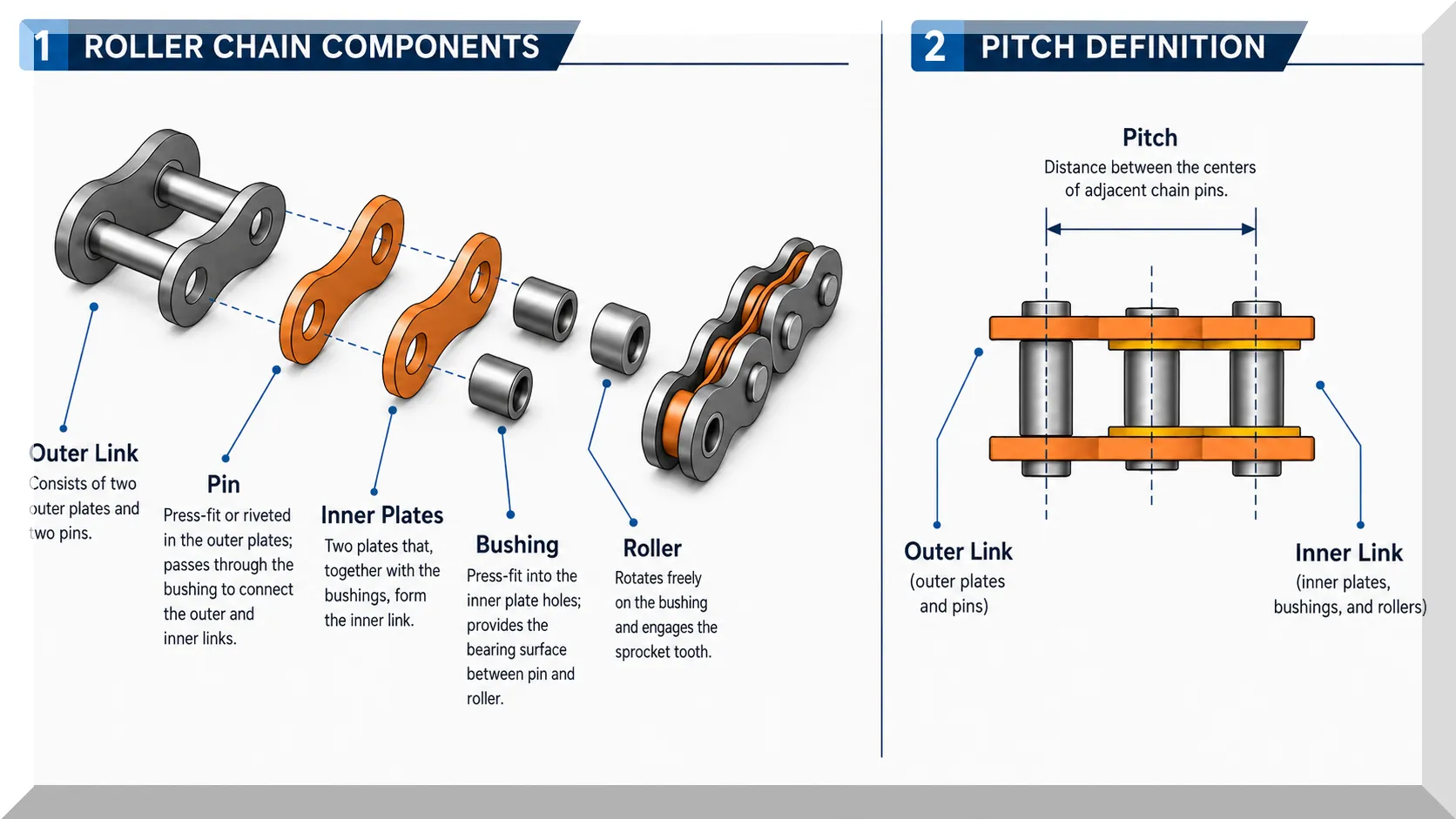
The name “double-pitch” is occasionally misread as “double strength” — this is incorrect. The break load of double-pitch chain per unit length is roughly equal to standard pitch, not doubled. The link plates are the same cross-section. What is doubled is only the pitch between engagement points (rollers), which halves the number of joints per metre of chain. Because there are fewer joints per metre, there is less metal (and less weight) per metre, and less lubrication surface to maintain. The structural integrity is essentially unchanged at a given roller contact point.
Double-Pitch vs Standard Pitch: Complete Dimensional and Performance Comparison
| Propriedade | #60 Standard | #2060 Double-Pitch | Practical Implication |
|---|---|---|---|
| Tom | 19.05 mm | 38.10 mm | Double-pitch means double link length |
| Diâmetro do rolo | 11.91 mm | 11.91 mm ✓ | Identical — runs on same #60 sprockets |
| Largura do link interno | 12.57 mm | 12.57 mm ✓ | Same sprocket face width required |
| Weight per metre | 0.84 kg/m | 0.45 kg/m | 46% lighter — reduces drive power required |
| Carga mínima de ruptura | 31.8 kN | 31.1 kN | Essentially identical structural capacity |
| Joints per metre | 52.5 | 26.2 | Half as many wear points per metre |
| Max practical speed | ~10 m/s (600 m/min) | ~1.0 m/s (60 m/min) | 10:1 speed disadvantage — the critical trade-off |
| Polygon effect at 19T driver | ±1,7% | ±1.7% but at lower chain speed | Same angular variation but lower absolute velocity ripple at low speed |
| Relative cost per metre | 100% | ~62% | 38% cost saving per metre of chain |
Why Double-Pitch Chain Has a Low Speed Limit — The Physics Behind the 60 m/min Rule
The speed limit for double-pitch chain is not an arbitrary manufacturer recommendation — it results from the physics of roller engagement at the sprocket. When a chain engages a sprocket tooth, each roller arrives at the tooth face with a kinetic energy proportional to the square of the impact velocity. The impact velocity depends on the relative velocity between the incoming roller and the tooth face at the moment of contact. For standard roller chain, this impact velocity is related to the polygon effect — the sinusoidal variation in chain velocity as each link subtends an angle on the sprocket.
Double-pitch chain has the same roller as standard pitch — but the link plate connecting successive rollers is twice as long. This means that when a roller engages the sprocket, the preceding roller is not in contact with the sprocket on the other side — it has already left the tooth two pitches back. The chain “hangs” between two contact points separated by 38.10 mm instead of 19.05 mm. This doubled span length means the catenary sag of the unsupported chain section between engagements is four times greater at the same speed (sag scales with the square of span length at constant tension). Above approximately 60 m/min, this sag produces a whipping motion at the incoming tooth face — each roller arrives not cleanly but with a lateral velocity component that increases the impact energy and causes asymmetric wear on the tooth sides and lateral plate wear on the chain.
The practical 60 m/min (1.0 m/s) guideline for double-pitch chain is the speed at which this catenary sag effect on a #2060 chain becomes significant for standard industrial applications. The limit is not absolute — at lighter loads with a well-tensioned chain and frequent support points, double-pitch chain can operate at up to 80 m/min. But above approximately 100 m/min on any double-pitch chain in #60 equivalent or larger pitch, noise and wear increase rapidly and service life drops below what standard pitch would deliver.
Standard vs Extended-Pin Double-Pitch Chain: The Conveyor Variant
Identical to standard roller chain in side-view profile. No lateral extensions on pins. Runs on standard #60 sprockets. Used when the chain simply needs to convey without carrying attachments.
Connecting pins extend beyond the outer link plates on both sides. These extended pin ends accept a cross-bar, carrier, or attachment that connects two parallel chain runs. Used in flat-belt replacement and cross-bar conveyor systems.
Extended link plates on alternate links (K1 or K2 attachment pattern). Provides fixed attachment points at regular pitch intervals for mounting carriers, flights, or product holders to the chain directly.
Double-Pitch Chain Series Reference: All Standard Sizes and Their Equivalents
| Double-Pitch No. | Std Pitch Equiv. | Passo (mm) | Diâmetro do rolo (mm) | Largura interna (mm) | Carga mínima de ruptura (kN) | Peso (kg/m) | Max Speed (m/min) |
|---|---|---|---|---|---|---|---|
| #2040 | #40 | 25.40 | 7.92 | 7.85 | 13.6 | 0.21 | 80 |
| #2050 | #50 | 31.75 | 10.16 | 9.53 | 21.5 | 0.35 | 70 |
| #2060 | #60 | 38.10 | 11.91 | 12.57 | 31.1 | 0.45 | 60 |
| #2080 | #80 | 50.80 | 15.88 | 15.75 | 55.0 | 0.89 | 50 |
| #2100 | #100 | 63.50 | 19.05 | 18.90 | 86.0 | 1.40 | 40 |
| #2120 | #120 | 76.20 | 22.23 | 25.22 | 124.0 | 2.00 | 35 |
† #2060 row highlighted — the most commonly specified double-pitch chain in Korean general industry. Note that maximum speed decreases as pitch increases due to the longer unsupported span length between rollers at each pitch.
Decision Guide: Standard Pitch or Double-Pitch?
- Chain speed ≤ 60 m/min confirmed
- Load per link is light (conveyor carrying weight, not power transmission)
- Chain weight is a system constraint (overhead, elevated, inertia-sensitive)
- Cost reduction is a primary objective without compromise on load capacity
- Lubrication access is limited (fewer joints per metre = fewer lubrication points)
- Application is horizontal or slightly inclined conveyor only
- Chain speed exceeds 60 m/min (standard pitch is mandatory)
- The drive is a high-torque power transmission (not a conveyor)
- The application involves frequent shock loading or reversals
- Precise velocity uniformity is required (polygon effect is larger per RPM)
- Operating temperature exceeds 120°C (longer spans sag more with thermal expansion)
- Vertical elevation changes of more than 3 metres (chain hang weight creates tension spikes at longer pitch)
Industry Applications Where Double-Pitch Chain Is the Standard Specification
Electronics and semiconductor assembly. Overhead trolley conveyors and indexing chain systems in PCB assembly and semiconductor packaging operations are a prime application for #2040 and #2060 double-pitch chain. These systems require low chain weight to minimise the motor load from inertia during frequent stop-start cycles, and they run at very low speeds — typically 2–15 m/min — well within the double-pitch speed limit. The cost saving across a typical electronics plant with 50+ chain conveyor positions is significant. Double-pitch #2040 and #2060 roller chain in both standard and extended-pin configurations is available from our Korean warehouse stock.
Grain and seed handling elevators. Bucket elevator legs in grain cooperatives and agricultural storage facilities use #2060 and #2080 double-pitch chain with K1 or K2 bucket attachment plates. The bucket spacing is determined by the chain pitch — double-pitch chain allows larger bucket spacing with fewer chain joints per bucket, reducing both chain cost and joint maintenance per bucket installed. Elevator leg speeds in Korean rice cooperative facilities are typically 30–45 m/min, comfortably within the #2060 speed limit. For higher-throughput grain terminals operating at 60–80 m/min elevator speeds, standard #60 or #80 chain is the correct specification.
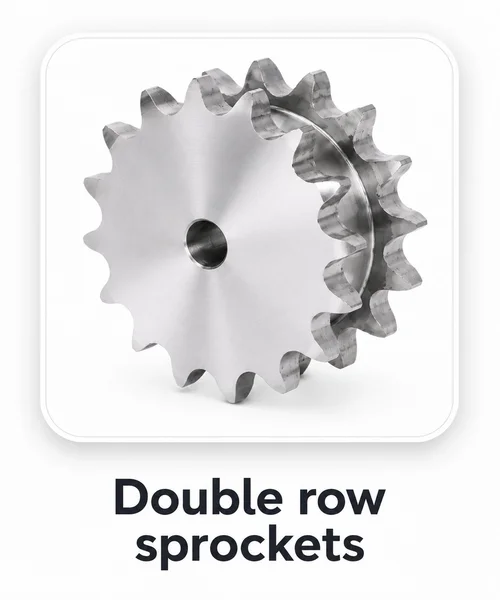
Automotive parts washing and drying lines. Parts washing conveyors use extended-pin double-pitch chain with cross-rods to create a flat conveyor surface for carrying baskets through wash and rinse stages. The slow conveyor speed (5–20 m/min) and the relatively light basket loads (2–15 kg per basket position) suit double-pitch chain well. The open structure of extended-pin double-pitch chain also allows washing liquid to drain freely from the chain surface, reducing corrosion risk compared with the tighter geometry of standard pitch chain. Double-pitch sprockets for extended-pin chain are available in standard bore and taper lock configurations.
Poultry and fish processing conveyors. Overhead rail conveyors in poultry processing plants use extended-pin or K-attachment double-pitch chain to carry carcasses through processing stages. The chain must be light enough for the overhead mounting points to handle, must be cleanable, and must run slowly enough for timed processing operations. Standard chain specification here is #2060 stainless (304 or 316L depending on washdown chemistry) with K1 attachments and open extended pins for carrier mounting.
Perguntas frequentes
Double-Pitch Chain in Standard and Extended-Pin Configurations
#2040 through #2120 stocked in Korean warehouse. Standard, extended-pin, K-attachment, carbon steel, and stainless variants. Same-week availability on standard configurations — confirm series, attachment type, and strand count before ordering.
Editor: Cxm