Plastic Sprockets | Nylatron, Acetal, Nylon — FDA-Approved, Self-Lubricating, Corrosion-Free
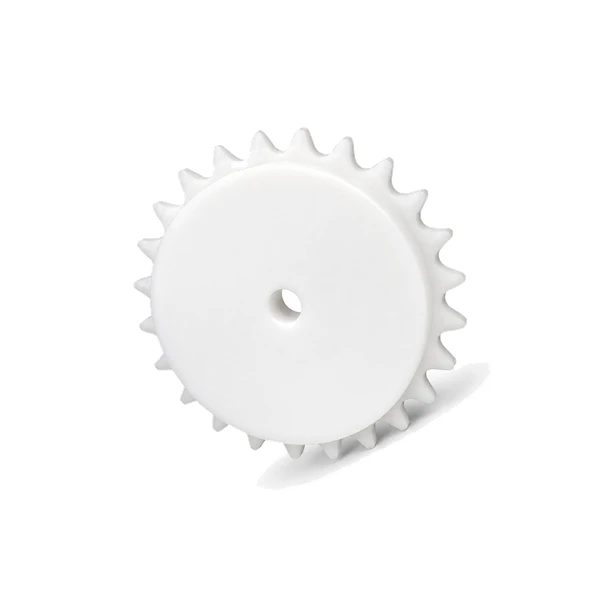
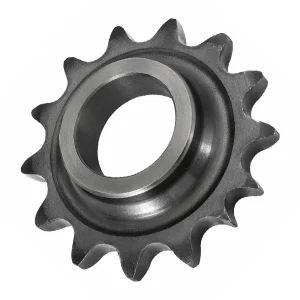
Korea Ever-Power #25 plastic sprockets — Nylatron, Acetal, Nylon, and UHMW — are the correct choice when steel sprockets corrode, contaminate, spark, or make too much noise. Self-lubricating polymer material eliminates grease in food-grade and clean-room applications. FDA-approved grades are available for direct food contact. Plastic tooth deflection under load means several teeth simultaneously share the working load — giving roller chain load capacity that matches the full working load of the #25 chain despite the non-metallic material.
When Plastic Sprockets Outperform Steel — Six Scenarios Where Material Matters
Steel sprockets are the default for most roller chain drives, and rightly so — they are strong, machinable, and inexpensive. But steel fails in a specific set of environments that are common in Korean food production, pharmaceutical manufacturing, chemical processing, and electronics facilities. In each of these scenarios, plastic is not a compromise — it is the engineering-correct material selection:
Wet and wash-down environments. Steel sprockets corrode in daily wash-down cycles even when zinc-plated or black-oxide coated. Rust particles contaminate products on conveyor surfaces below. Plastic sprockets are inherently corrosion-free — no coating to degrade, no rust to shed, indefinite service life in wet conditions as long as load limits are observed.
Lubrication-free zones. In food processing, pharmaceutical production, and clean-room electronics assembly, chain lubricant is a contamination risk. Plastic sprockets are self-lubricating — the polymer material contains internally distributed lubricant that migrates to wearing surfaces during operation, eliminating the need to apply external grease or oil to the sprocket-chain interface.
Noise-sensitive environments. Plastic sprocket teeth deflect slightly under load, damping the impact pulse as each chain roller engages a tooth. This elastic buffering reduces the metallic impact noise of steel-on-steel engagement by a measurable margin. In food packaging lines, office automation equipment, and medical device conveyors where noise levels are regulated or customer-visible, plastic sprockets provide quieter operation without speed reduction.
Chemical resistance. Specific polymer grades resist acids, alkalis, oxidising agents, and solvents that attack steel or stainless steel at different concentrations. In electroplating, pharmaceutical, and chemical processing facilities where chain drives operate in the presence of process chemicals, choosing the correct polymer grade provides corrosion immunity that no metallic sprocket can match.
Non-magnetic and non-conductive requirements. MRI facilities, electronic assembly lines, and certain precision instrument environments require non-magnetic and/or non-conductive drive components. Engineering polymers are inherently non-magnetic and electrically non-conductive — properties that no steel alloy can provide regardless of treatment.
Chain wear reduction. Plastic sprocket teeth are softer than steel chain rollers. Counter-intuitively, this is beneficial: the softer tooth acts as the sacrificial wear element rather than the chain roller. In low-load applications the plastic tooth wears slowly while extending roller life — the sprocket is cheaper to replace than the chain. The tooth deflection behaviour simultaneously reduces impact stress on roller pins and bushings.
Stock #25 Plastic Sprocket Specifications — Nylatron B-Hub Series
Standard stock #25 plastic sprockets are manufactured in Nylatron (nylon with molybdenum disulfide — see material section below) in B-hub style. Pitch diameter is the functional engagement diameter corresponding to #25 chain pitch (6.35 mm). Length through bore is the hub engagement depth for keyway and set screw retention. Stock bore sizes listed are minimum standard bores — larger bores to the maximum physically possible are machined to customer specification.
| Sprocket Size | Teeth | Material | Pitch Dia. (in) | Stock Bore | Length Thru Bore |
|---|---|---|---|---|---|
| 25B10 | 10 | Nylatron | 0.81″ | 1/4″ | 0.485″ |
| 25B11 | 11 | Nylatron | 0.89″ | 1/4″ | 0.485″ |
| 25B12 | 12 | Nylatron | 0.97″ | 5/16″ | 0.485″ |
| 25B13 | 13 | Nylatron | 1.05″ | 5/16″ | 0.485″ |
| 25B14 | 14 | Nylatron | 1.13″ | 5/16″ | 0.485″ |
| 25B15 | 15 | Nylatron | 1.20″ | 5/16″ | 0.485″ |
| 25B16 | 16 | Nylatron | 1.28″ | 5/16″ | 0.485″ |
| 25B17 | 17 | Nylatron | 1.36″ | 5/16″ | 0.485″ |
| 25B18 | 18 | Nylatron | 1.44″ | 3/8″ | 0.485″ |
| 25B19 | 19 | Nylatron | 1.52″ | 3/8″ | 0.485″ |
| 25B20 | 20 | Nylatron | 1.60″ | 3/8″ | 0.485″ |
| 25B21 | 21 | Nylatron | 1.68″ | 3/8″ | 0.485″ |
| 25B22 | 22 | Nylatron | 1.76″ | 3/8″ | 0.485″ |
| 25B24 | 24 | Nylatron | 1.91″ | 3/8″ | 0.485″ |
| 25B26 | 26 | Nylatron | 2.07″ | 3/8″ | 0.485″ |
| 25B28 | 28 | Nylatron | 2.23″ | 3/8″ | 0.485″ |
| 25B30 | 30 | Nylatron | 2.39″ | 3/8″ | 0.485″ |
| 25B36 | 36 | Nylatron | 2.87″ | 1/2″ | 0.610″ |
| 25B40 | 40 | Nylatron | 3.19″ | 1/2″ | 0.610″ |
| 25B48 | 48 | Nylatron | 3.82″ | 1/2″ | 0.610″ |
| 25B54 | 54 | Nylatron | 4.30″ | 1/2″ | 0.610″ |
| 25B60 | 60 | Nylatron | 4.78″ | 1/2″ | 0.443″ |
Plastic Sprocket Materials — Nylatron, Acetal, Nylon, and UHMW Compared
The polymer grade is not a cosmetic choice — it determines load capacity, temperature range, chemical resistance, and whether the sprocket meets FDA or USDA requirements for food contact. Korea Ever-Power supplies #25 plastic sprockets in four standard materials and can source additional engineering polymer grades for specialised applications:
| Property | Nylatron (MoS₂ Nylon) | Acetal (POM) | Nylon (PA6/PA66) | UHMW-PE |
|---|---|---|---|---|
| Self-lubrication | Excellent (MoS₂ filler) | Good | Good | Very Good |
| Abrasion resistance | Very Good | Good | Good | Outstanding |
| Tensile strength | ~80–85 MPa | ~60–70 MPa | ~60–85 MPa | ~25–40 MPa |
| Max continuous temp | 100–115°C | 90–110°C | 100–120°C | 80–100°C |
| Moisture absorption | Low (MoS₂ reduces) | Very Low (~0.2%) | Moderate (2–8%) | Near zero |
| Dimensional stability (wet) | Good | Excellent | Poor (swells in water) | Excellent |
| FDA / Food contact | Grades available | FDA-approved grades | FDA grades available | FDA-approved |
| Ideal application | Dry, load-bearing, precision drives | Wet environments, close-tolerance parts | General dry conveyor duty | Abrasive environments, food contact |
Note on Nylon in wet environments: Plain nylon (PA6 or PA66) absorbs moisture, which causes dimensional swelling that can tighten the bore on the shaft and alter the pitch diameter. In wash-down or immersion applications, specify Acetal (POM) or UHMW-PE instead — both have negligible moisture absorption and maintain dimensional stability across wet operating cycles.
Three Hub Configurations for #25 Plastic Sprockets
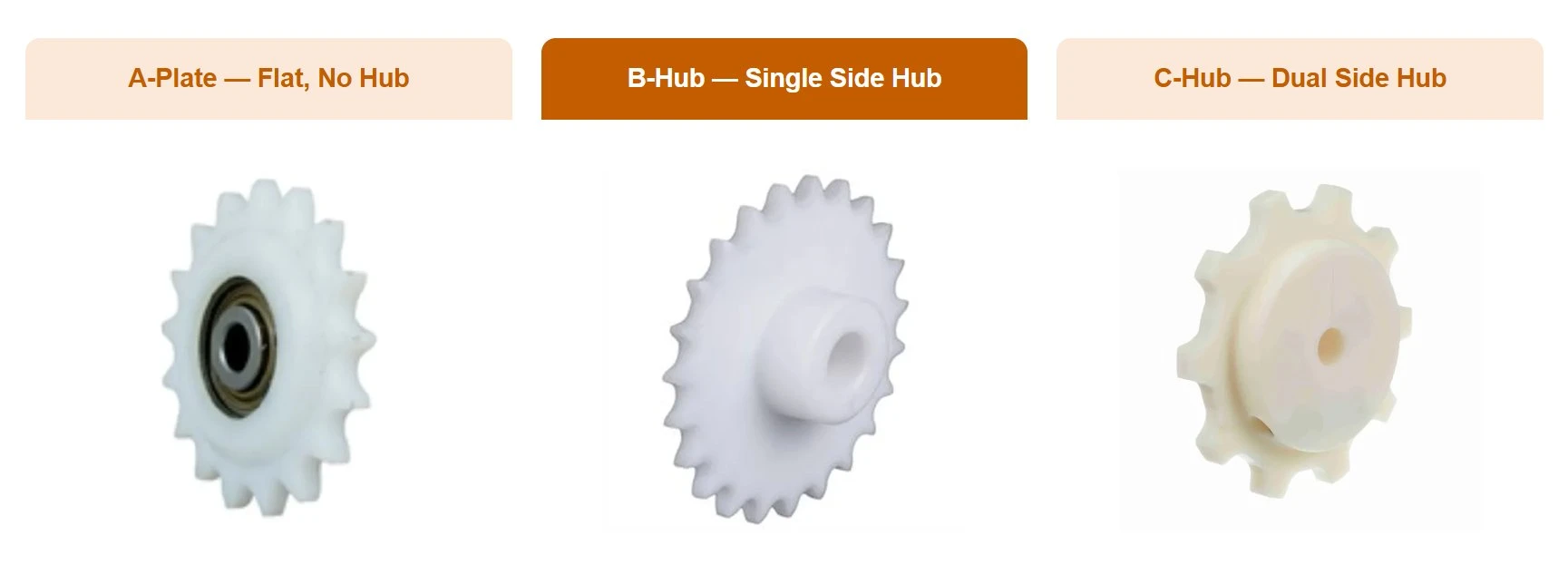
Plastic sprockets are available in the same A-plate, B-hub, and C-hub configurations as steel sprockets. The hub geometry affects shaft engagement length and torque capacity — critical even in plastic, where the plastic material limits the maximum transmissible torque per unit of shaft engagement area.
Matching #25 Plastic Roller Chain — Acetal, Delrin, and Nylatron
For a fully contamination-free, lubrication-free, non-metallic chain drive system, the sprocket and chain should be specified in compatible polymer materials. Korea Ever-Power supplies matching #25 plastic roller chain in three standard materials to pair with the sprockets above:
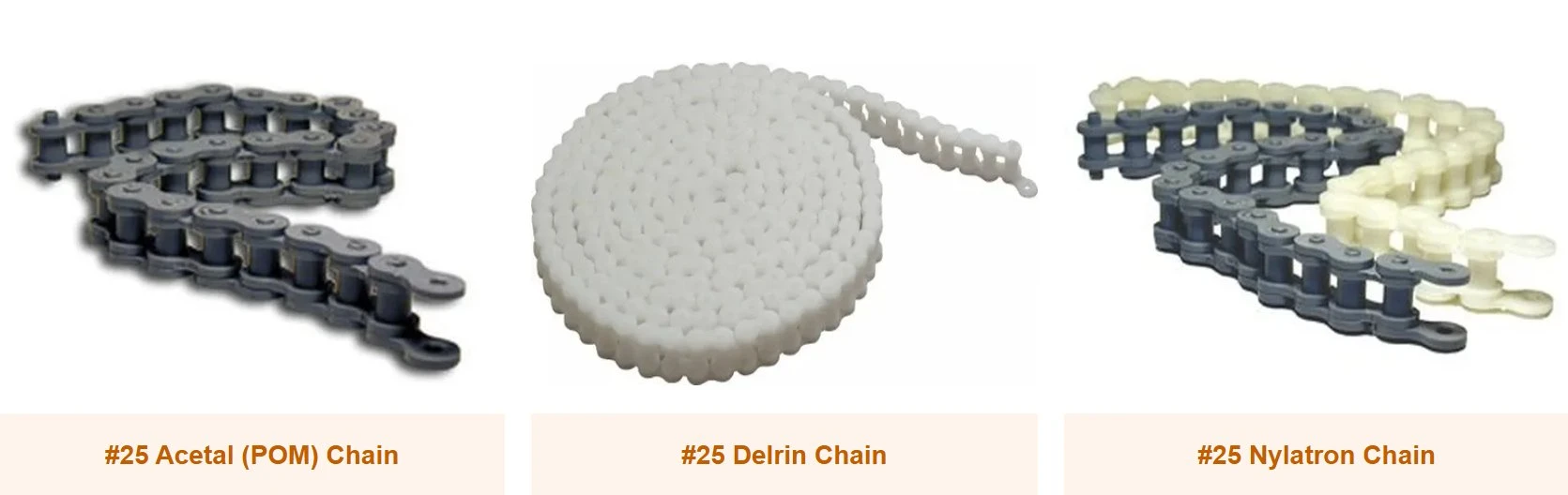
When pairing plastic chain with plastic sprockets, material compatibility between chain and sprocket affects the wear interface. Matching Nylatron chain to Nylatron sprockets keeps the wear pair within the same material family; using Acetal chain with Nylatron sprockets is also common because the different polymers produce a low-adhesion wear couple. Avoid pairing two identical soft polymers in high-load drives — the similar hardness can produce higher adhesive wear than a dissimilar polymer pair. For a fully validated plastic chain and sprocket system for your specific application, contact us with your polymer preference, chain speed, load, and environment.
Custom-Engineered Plastic Sprockets — Non-Standard Requirements
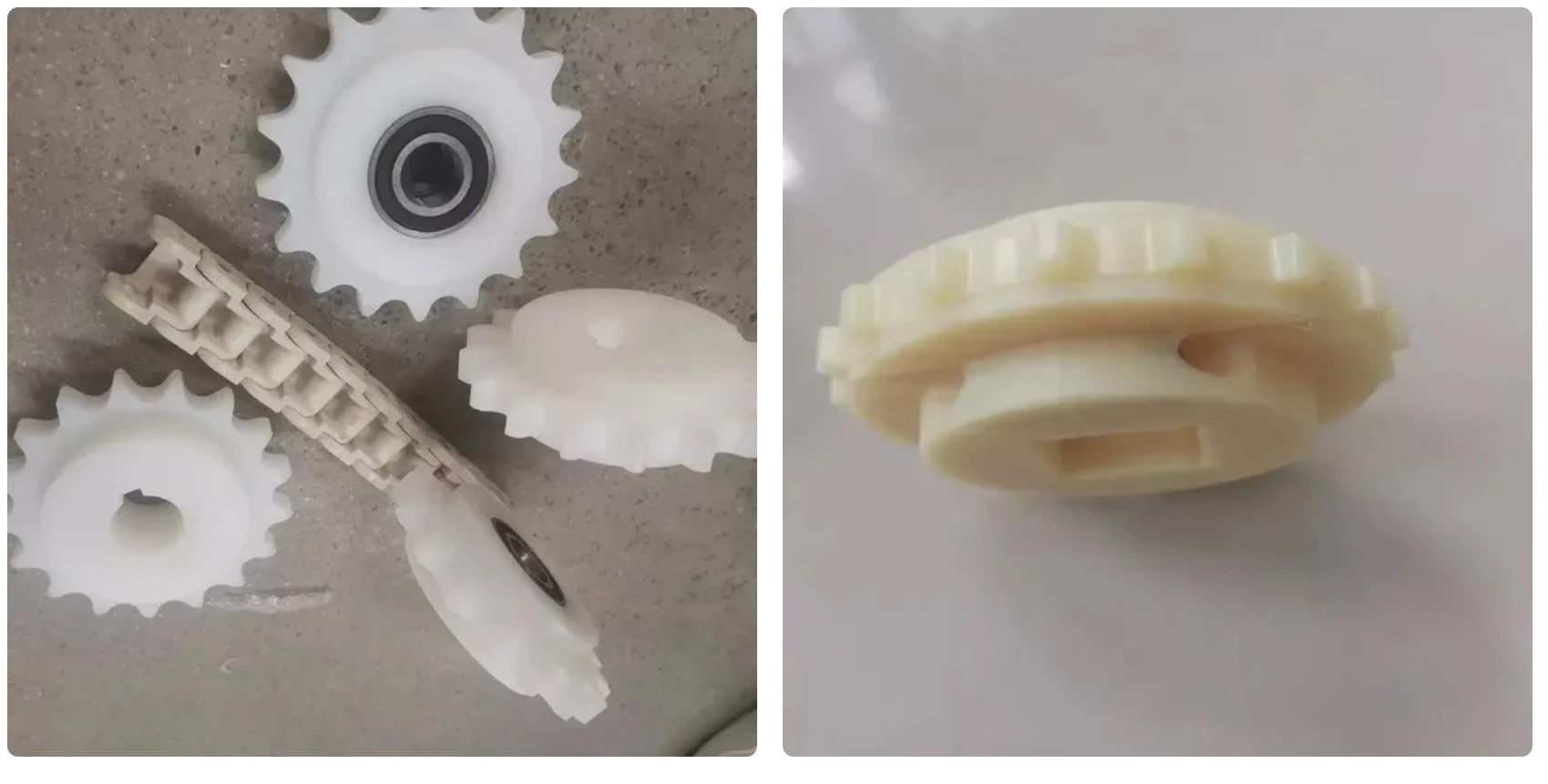
Standard Nylatron B-hub sprockets cover the majority of #25 plastic sprocket applications. For non-standard requirements, Korea Ever-Power provides custom-machined plastic sprockets:
- Non-standard polymer grades — PTFE (Teflon) for chemical resistance beyond Acetal/Nylon; Polypropylene for specific acid environments; Kynar (PVDF) for fluoride and halogen environments; oil-filled nylon for sustained high-cycle duty
- Metric chain sizes — custom plastic sprockets for 06B, 08B, 10B, and other DIN 8187 metric chain sizes in any of the above polymer grades
- Double pitch plastic sprockets — C2040 and C2050 compatible profiles in Acetal or UHMW for food conveyor applications where metal is excluded entirely
- A-plate and C-hub styles — non-stock configurations in any tooth count from 10 to 72 teeth, machined to drawing from solid polymer bar or plate
- Idler plastic sprockets — plain bore or bronze bushed bore for free-running idler positions in fully non-metallic conveyor systems
Custom plastic sprockets typically have a lead time of 2–3 weeks from receipt of confirmed drawing or specification. Provide ANSI chain size, tooth count, hub style, bore diameter, key dimensions, and polymer grade. We will return a drawing for approval before machining.
Where #25 Plastic Sprockets Are Specified in Korean Industry
Why Korea Ever-Power Chain and Sprocket
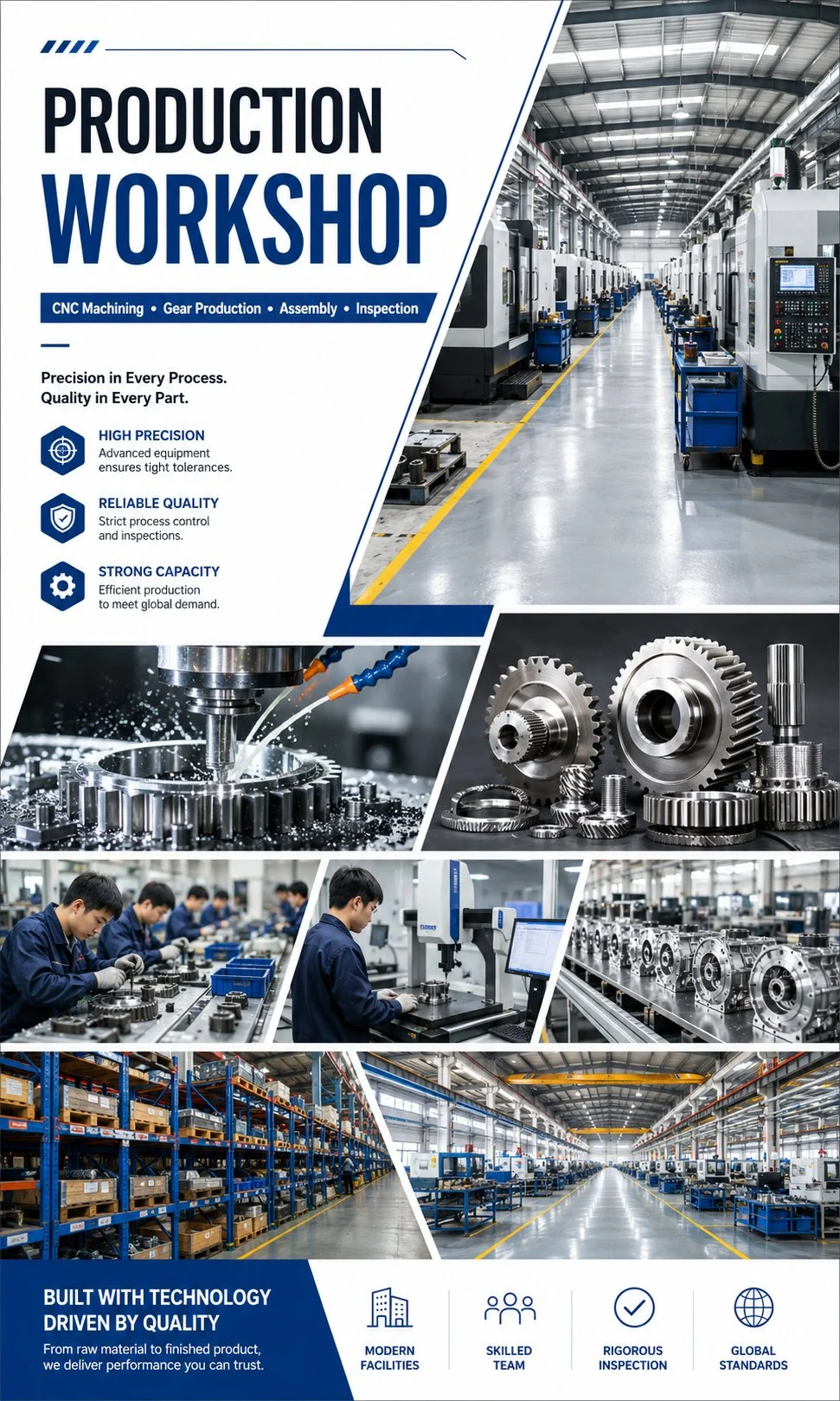
Korea Ever-Power Chain and Sprocket Co., Ltd. supplies the complete #25 plastic sprocket range with material documentation and custom engineering capability:
Frequently Asked Questions
Customer Reviews
Verified feedback from customers in Korea and surrounding markets.
Park Soo-bin, Food Safety Engineer, Instant Noodle Manufacturer, Gyeonggi-do (early 2025)
"We converted our seasoning powder dosing line from steel to Acetal plastic sprockets specifically because HACCP required us to eliminate all lubricant within 600mm of the open product stream. The Acetal 25B20 sprockets from Korea Ever-Power have been running 14 months now without lubrication and without measurable pitch diameter wear. Material compliance certificates were provided on delivery as we require for GMP documentation."
Kim Dong-young, Equipment Engineer, Semiconductor Fab, Gyeonggi-do (Q4 2024)
"Our wafer carrier transport system needed non-magnetic, non-conductive drive components due to ESD sensitivity of the product. Korea Ever-Power supplied Nylatron 25B18 sprockets with finished bores. The MoS₂ content in Nylatron specifically concerns some ESD-sensitive process managers — we tested and confirmed no particle contamination in our clean-room air quality monitoring after six months of operation. Suits the application."
Jeong Hae-jin, Maintenance Engineer, Pharmaceutical Tablet Line, Chungbuk (2025)
"We specify Acetal plastic sprockets for all chain drives in our GMP tablet compression area. FDA 21 CFR certificates are a regulatory requirement for our product dossier. Korea Ever-Power has consistently provided the required documentation with delivery. Lead time for standard sizes is 10 days. We now order annually in batches to maintain a 6-month on-site replacement stock."
Oh Sung-hyun, Design Engineer, Office Automation Equipment OEM, Seoul (early 2025)
"We use #25 Nylatron sprockets in paper feed drives because the noise reduction versus steel is immediately perceptible — and important for office equipment. The tooth deflection characteristic also absorbs paper jam impact loads without tooth cracking, which was a problem with small steel sprockets on the same mechanism. Korea Ever-Power supplies in the exact bore and keyway we specify, with 9-day lead time."
Han Min-seong, Process Engineer, Chemical Plant, Ulsan (2024)
"We needed #25 plastic sprockets for a conveyor inside a chlorine gas handling enclosure — steel corrodes immediately in that atmosphere and stainless steel has a stress corrosion cracking risk with chloride. Korea Ever-Power recommended PVDF (Kynar) for this specific application, custom-machined to our tooth count and bore requirements. Six months in and zero corrosion — the material recommendation was technically sound."
Additional information
| Editor | Cxm |
|---|
Related products
-
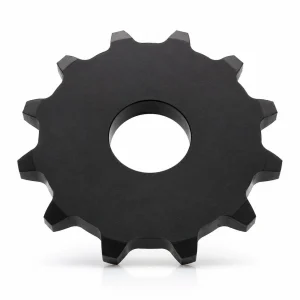
WR78 / WH78 Welded Steel Chain Sprockets | A-Plate 7–20 Teeth — Mild Steel & QT400 Hardened
-
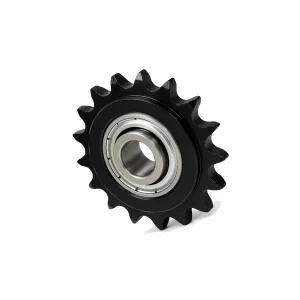
Idler Sprockets | Ball Bearing, Needle Bearing, Bronze & Non-Metallic — Chain Guide and Tensioner
-
Double Pitch Sprockets | C2040 C2050 C2060 C2080 Standard & Carrier Roller Types
-
#240 Roller Chain Sprockets | A-Plate B-Hub C-Hub – 10 to 60 Teeth, 3-Inch Pitch
-
#180 Roller Chain Sprockets | A-Plate B-Hub C-Hub – 11 to 60 Teeth, SAE 1045
-
Roller Chain Sprockets | A-Plate & B-Hub – 18 to 72 Teeth, SAE 1045 Steel
-
Single Strand Roller Chain Sprockets | A-Plate B-Hub C-Hub Taper QD Weld-On
-
Cast Iron Sprocket | DIN 8187 ISO 606