Idler Sprockets | Ball Bearing, Needle Bearing, Bronze & Non-Metallic — Chain Guide and Tensioner
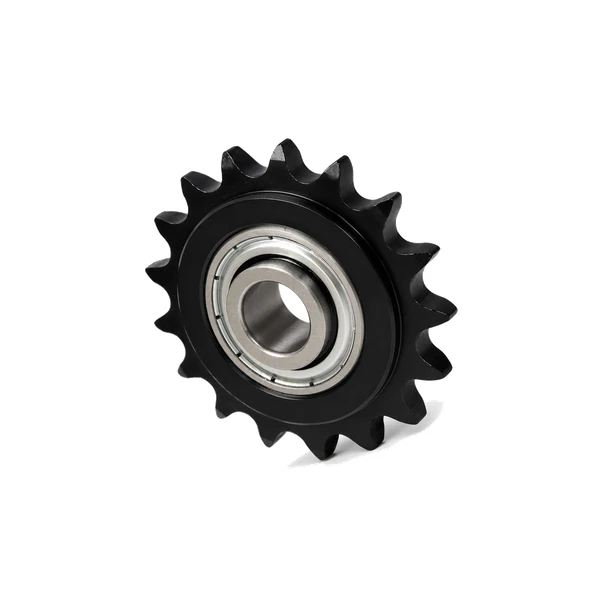
Korea Ever-Power idler sprockets guide and tension roller chain in conveyor and drive systems without transmitting torque. Four internal bearing configurations — ball bearing, needle bearing, bronze bushed, and non-metallic — cover every application from light instrument conveyors to heavy industrial chain guide systems. Teeth are hardened as standard on counts under 30. Ball bearing units use ABEC-3 grade deep-groove bearings with motor-rated grease.
What an Idler Sprocket Does — and Why Failure Is Catastrophic
In most roller chain drive and conveyor systems, the chain runs between exactly two working sprockets — a driver and a driven. But many real installations require the chain to change direction, navigate around obstacles, maintain a specific wrap angle on the drive sprocket, or be tensioned without adjusting shaft centre distance. All of these functions are served by idler sprockets: sprockets that the chain passes over or under without transferring torque to or from a shaft.
Unlike drive sprockets, an idler sprocket does not rotate the shaft it is mounted on — the sprocket rotates freely on a fixed stub shaft, guided by an internal bearing, bushing, or plastic bore. The chain engages the teeth, rotates the sprocket, and continues. The idler's job is purely geometric: redirecting chain path, eliminating sag, or increasing wrap angle on the drive sprocket. None of this sounds critical until an idler fails.
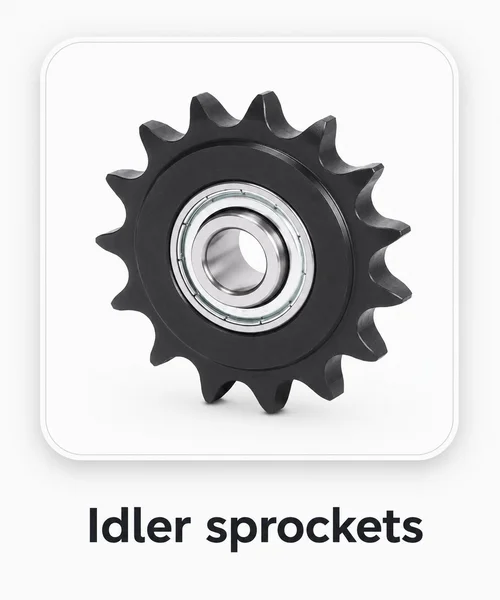
When an idler seizes — its bearing locks, bushing collapses, or bore seizes on the shaft — the chain immediately encounters a stationary obstacle in its path. Depending on chain speed and drive power, the consequence ranges from snapped chain to structural damage to the conveyor frame, and in worst cases to injury from sudden chain whip. This is why idler component quality matters disproportionately to the idler's simple mechanical role.
- ⚙Functions: chain tensioning, sag elimination, wrap angle increase, 180° directional change
- ⚙Bearing types: ball bearing (ABEC-3), needle bearing, bronze bushed, non-metallic plain bore
- ⚙Body materials: 1018 or 1045 carbon steel, 304/316 stainless steel, UHMW or nylon plastic
- ⚙Chain sizes: #25 through #160 standard; custom configurations to drawing
The Four Idler Bearing Configurations — How to Choose the Right One
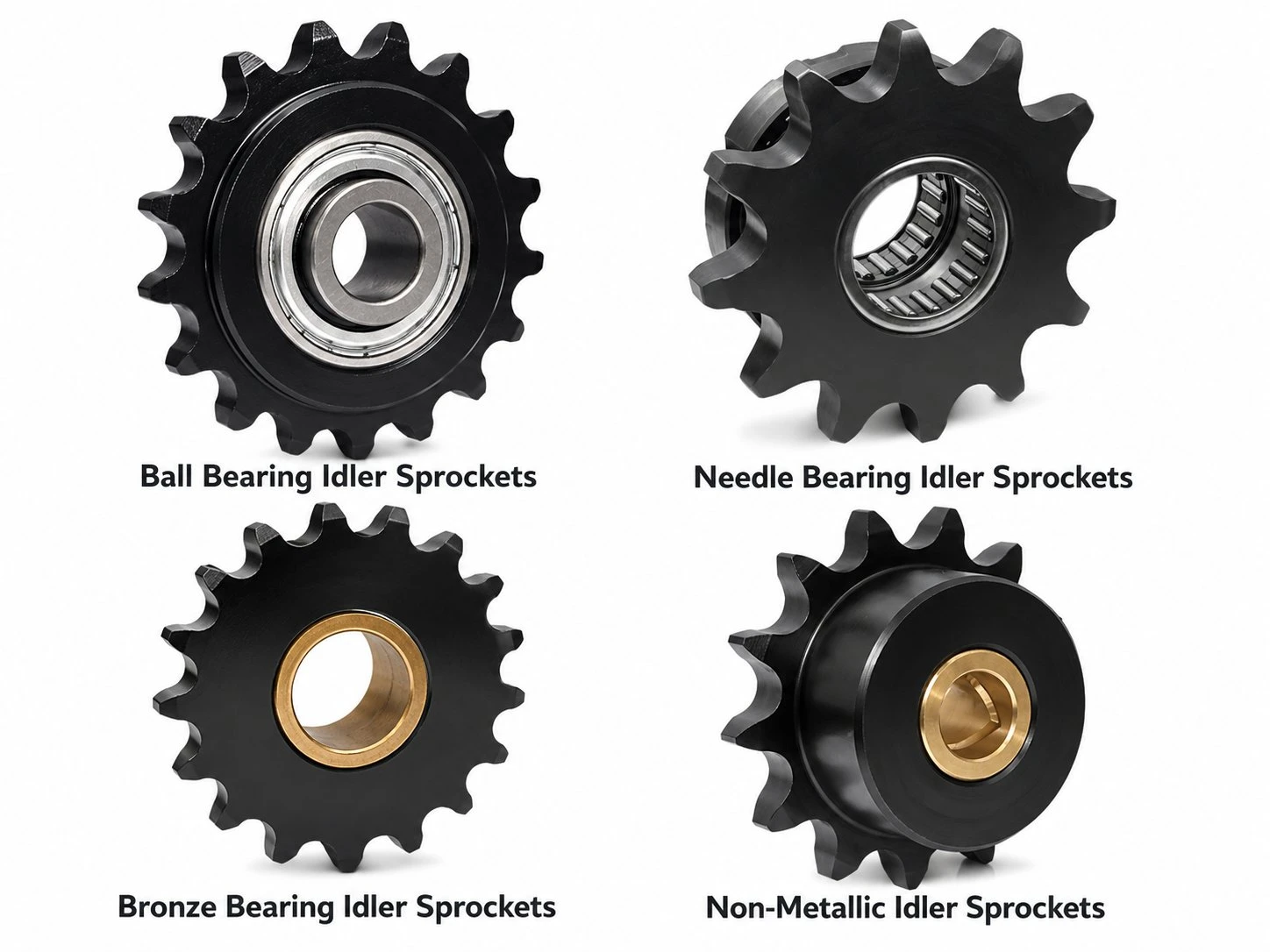
The choice of internal bearing type determines friction, load capacity, maintenance interval, and permissible shaft speed. Each of the four types has a distinct mechanical reason to exist — selecting by price alone leads to premature failure.
Bearing Type Comparison — At a Glance
| Criteria | Ball Bearing | Needle Bearing | Bronze Bushed | Non-Metallic |
|---|---|---|---|---|
| Radial load | Moderate | Highest | Moderate–High | Low–Moderate |
| Friction level | Lowest | Low (under load) | Medium | Low–Medium |
| Contamination resistance | Fair (sealed) | Fair | Excellent | Excellent |
| Corrosion resistance | Low (standard) | Low (standard) | Good | Excellent |
| Maintenance required | Sealed — minimal | Lubricate shaft | Minimal | None |
| Stock availability | In stock | In stock | In stock | 2–4 weeks custom |
| Ideal environment | General indoor, clean | Heavy load, moderate dust | Outdoor, dusty, wet | Food, pharma, chemicals |
Five Ways Idler Sprockets Are Used in Chain Drive Systems
Understanding the mechanical function of each idler position helps select the correct bearing type and load rating. These five configurations account for the majority of idler sprocket applications in Korean industrial installations:
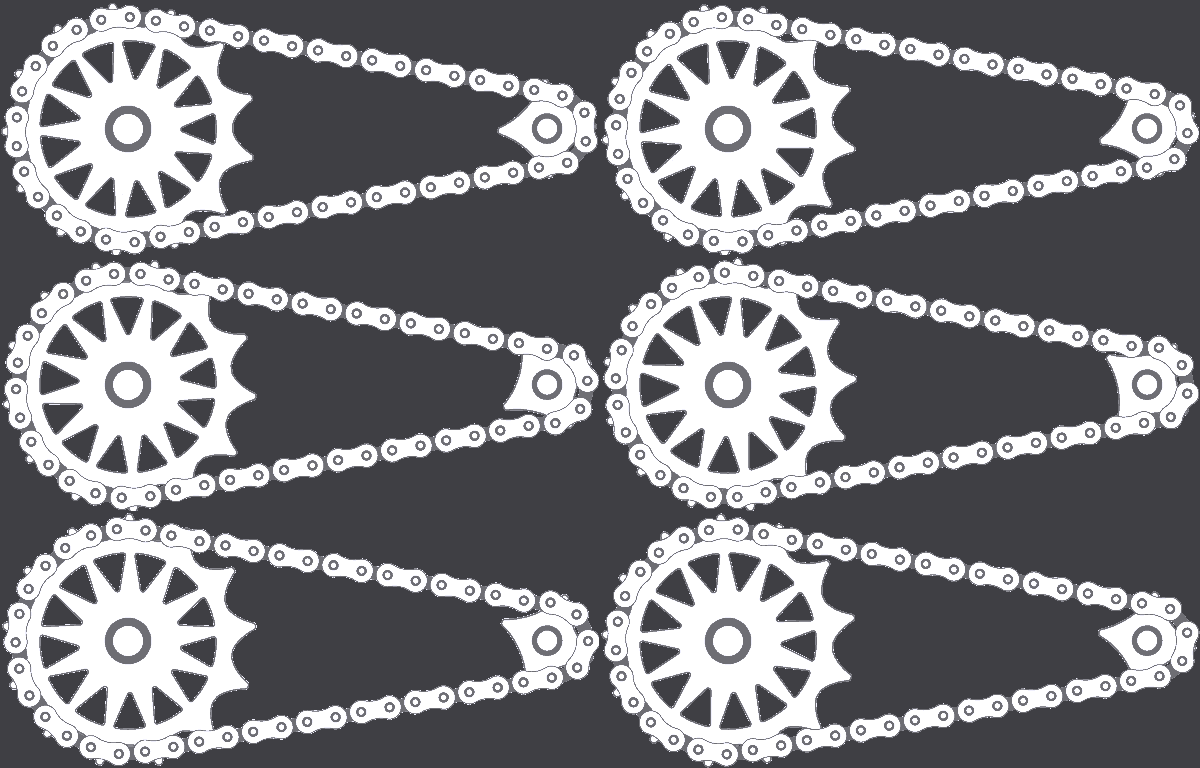
Slack run tensioner (most common). Placed against the slack run of the chain between drive and driven sprockets, pushing inward to remove sag. The idler bears the chain tension from both sides of its contact arc. A ball bearing idler is standard here — load is moderate and friction must be low to avoid adding to chain pull on the slack side.
Wrap angle increaser on drive sprocket. A small idler placed close to the drive sprocket's slack side, increasing chain wrap from a minimal 120° to 150–170°. More wrap means more teeth simultaneously in engagement, increasing torque capacity and reducing load per tooth. Ball bearing, positioned to bear inward against the chain tight side — higher load, so verify ball bearing radial capacity.
180° directional change. Chain enters from one direction and exits in the opposite direction, wrapping 180° around the idler. The idler carries the vector sum of both chain tension forces — potentially double the normal chain tension. A needle bearing idler is the appropriate choice here; this is the highest-load idler configuration.
Chain path deflection around obstacles. When the chain path must navigate around a structural member or machine component, one or more idlers redirect the chain through the required angles. Load depends on the deflection angle — shallow deflections (under 30°) are low-load; sharper deflections approach the 180° case. Select bearing type based on deflection angle and chain tension.
Conveyor chain bottom run support. On long horizontal conveyors, the chain's own weight causes the bottom return run to sag. Support idlers placed at regular intervals beneath the return run prevent sag-induced vibration and noise. Load here is purely the chain's weight per span — typically light, so bronze bushed idlers are standard in this position as the lowest-cost option with adequate capacity for the load.
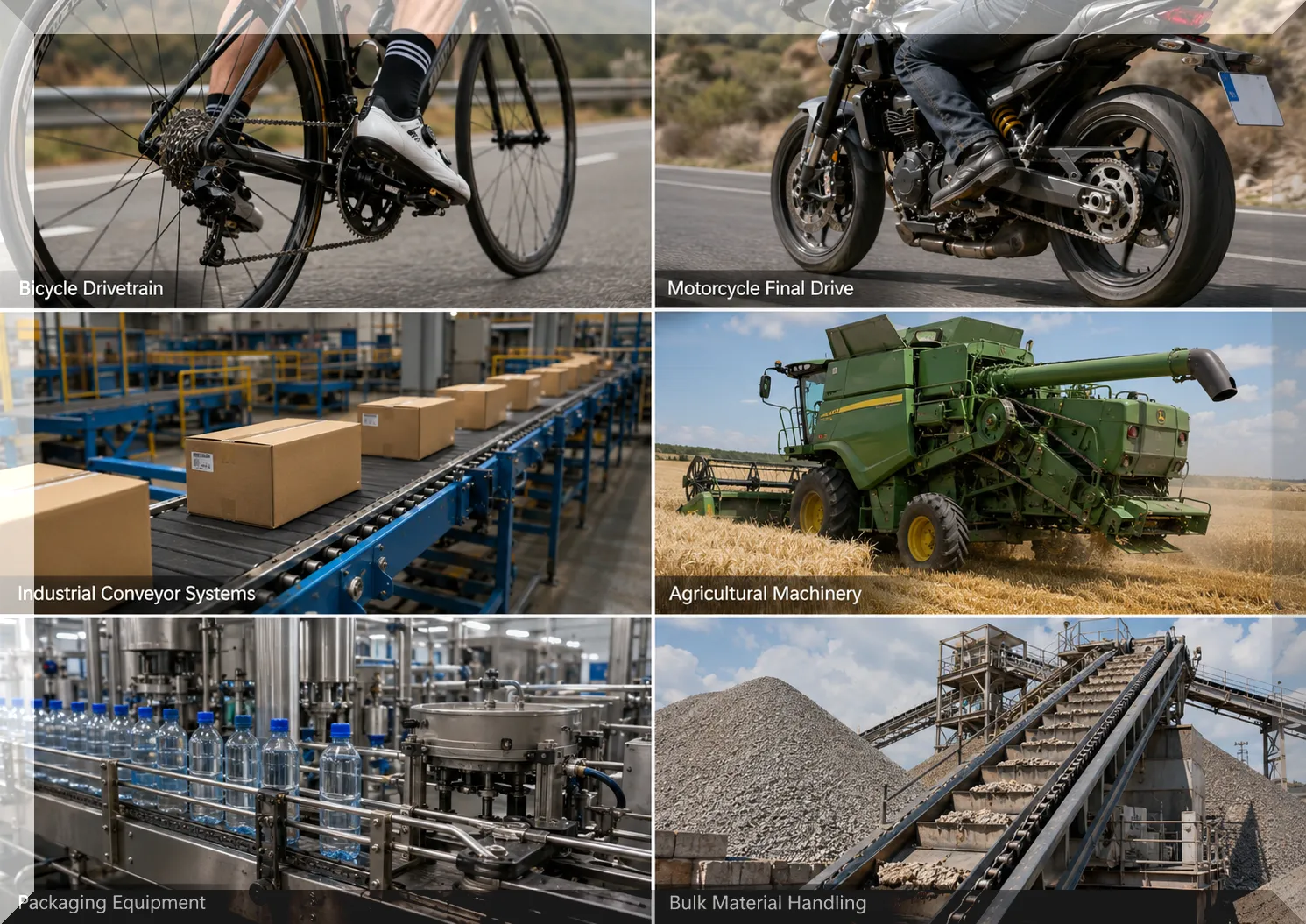
Idler Sprocket Applications Across Korean Industry
Idler Sprocket Selection — Step-by-Step Decision Process
Specifying an idler sprocket requires four decisions in sequence. Each step narrows the specification and avoids common over- or under-specification errors:
Identify chain size and idler position. Note the ANSI chain number (#40, #50, #60 etc.) and whether the idler is on a slack tensioner run, a loaded directional-change position, or a return run support. Position determines the load magnitude — return run support carries chain weight only; 180° wrap carries double the chain tension.
Assess the operating environment. Is the location dry and clean (ball bearing); moderately dusty or wet with no chemical exposure (bronze bushed); heavily contaminated with abrasives (bronze or needle); or food-grade with wash-down (non-metallic stainless)? Environment is the primary filter — do not select by load capacity alone.
Select tooth count. Idler sprockets should have enough teeth to provide smooth chain engagement without polygon effect vibration. Minimum 13 teeth for chain speeds above 0.5 m/s; 17 teeth or more for speeds above 1.5 m/s. Teeth are hardened as standard for counts under 30 — specified this for all idlers in high-cycle duty.
Specify shaft diameter and mounting. Idler sprockets are typically supplied with a plain bore for press-fit onto a fixed stub shaft, or with a through-bore for a shoulder bolt or threaded shaft. Provide the stub shaft diameter — idler bores are not keyed (the sprocket must rotate freely). For non-standard stub shaft diameters, specify the exact dimension and we machine to fit.
Matching Roller Chain for Idler Applications
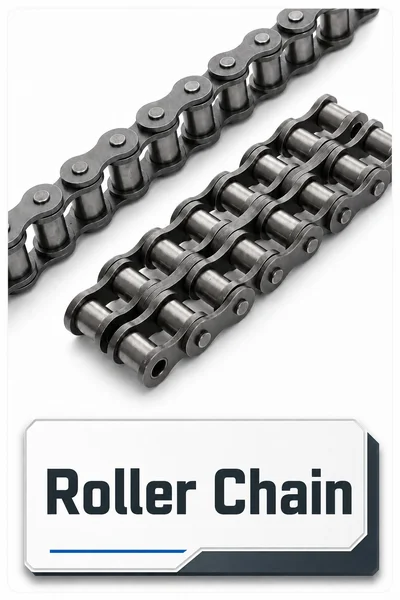
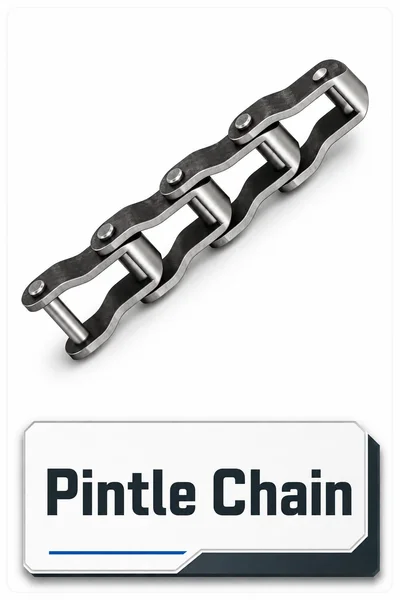
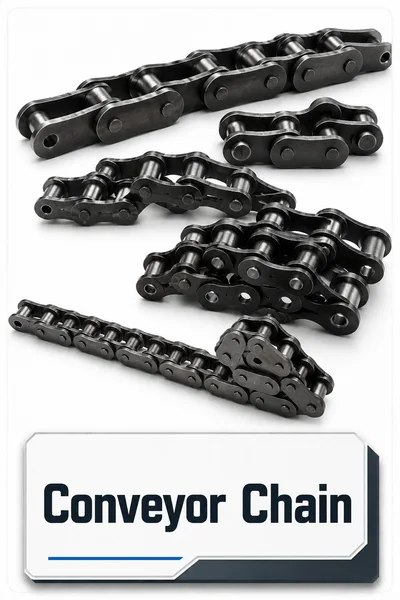
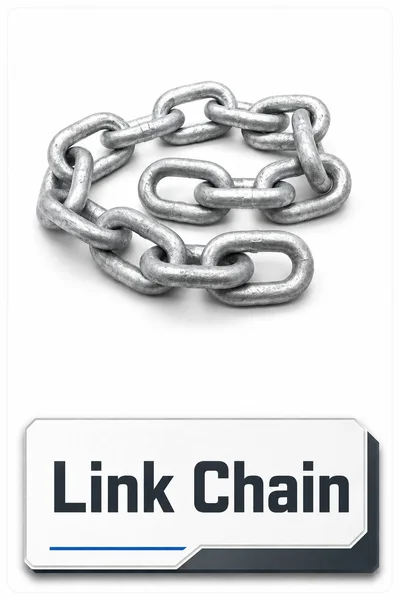
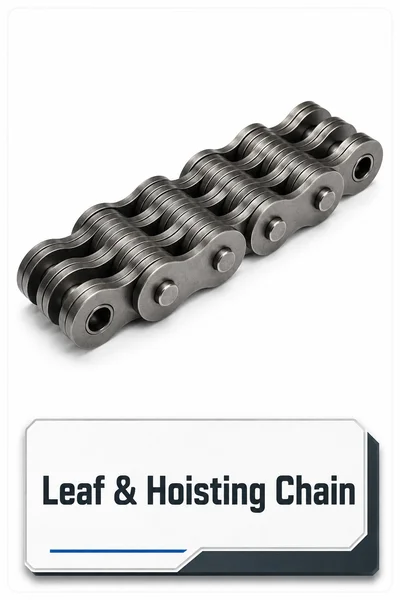
Idler sprocket tooth geometry is identical to drive sprocket geometry for the same chain size — a #40 idler sprocket uses the same tooth profile as a #40 drive sprocket. Korea Ever-Power stocks ANSI roller chain from #25 through #160 to complete conveyor and drive system specifications alongside the idler sprockets above. When specifying a complete system — drive sprocket, driven sprocket, idler tensioner, and chain — sourcing from the same supplier simplifies the dimensional verification that confirms all tooth profiles are correct for the chain specified.
For chain tensioner and idler system design assistance — including idler placement to achieve a target chain tension without excessive sag — our technical team provides engineering consultation before order placement. Describe your conveyor length, chain speed, and load, and we will recommend idler positions, bearing types, and minimum tooth counts.
 |
 |
 |
 |
 |
 |
Why Korea Ever-Power Chain and Sprocket
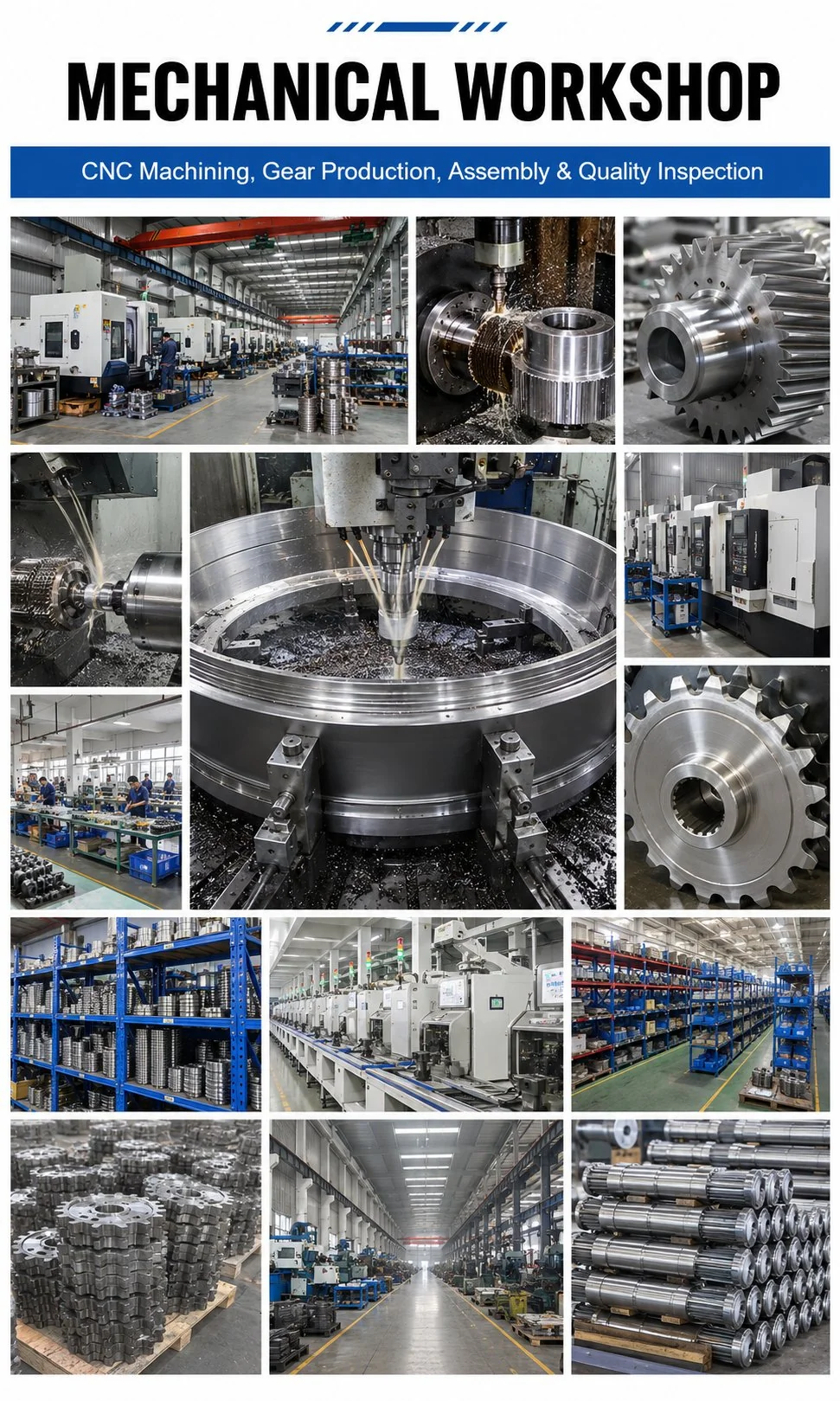
Korea Ever-Power stocks all four idler bearing types across the ANSI chain size range with technical selection support:
Frequently Asked Questions
Customer Reviews
Verified feedback from customers in Korea and surrounding markets.
Yoo Sang-won, Conveyor Systems Engineer, Automotive Assembly Plant, Ulsan (early 2025)
"We had repeated ball bearing failures on our overhead conveyor idlers in the paint shop — about 4–6 months per bearing on average. Korea Ever-Power identified that the standard ABEC-1 bearings in the previous idlers were the issue and supplied ABEC-3 replacements with the same body size. We are now at 11 months on the new set without failure. The motor-rated grease specification also mattered — the paint shop temperature fluctuates and standard grease was weeping out at operating temperature."
Kim Hye-soo, Food Safety Manager, Seafood Processing Company, Busan (2024)
"We switched our conveyor idlers to non-metallic stainless shaft type from Korea Ever-Power to meet our HACCP requirements — the inspector had flagged our old carbon steel idlers as a contamination risk during the annual audit. The non-metallic units took three weeks to produce but the technical team kept us informed throughout. Two lines converted so far, no corrosion issues after eight months of daily wash-down."
Park Dong-joon, Maintenance Engineer, Stone Quarry, Gyeonggi-do (Q4 2024)
"Ball bearing idlers were lasting 3 months in our stone dust environment — the seals were failing from abrasive ingress. Korea Ever-Power recommended bronze bushed idlers for the return run support positions. Been running six months now with no failures. Lower friction than I expected — the conveyor motor current actually dropped 4% when we replaced the seized ball bearing units."
Lim Jae-young, System Integrator, Conveyor and Handling Equipment Company, Seoul (2025)
"We build custom conveyor systems and use Korea Ever-Power as our standard idler supplier across ball bearing, needle bearing, and bronze bushed types. What matters for us is consistent catalogue availability and correct bore dimensions on arrival — we cannot individually inspect every idler on a 200-unit conveyor project. In 18 months of ordering, we have not had a dimensional non-conformance. That consistency is worth more than the cheapest possible price."
Choi Ji-eun, Operations Manager, Pharmaceutical Packaging Company, Daejeon (early 2025)
"Our FDA-registered blister pack line needed idler sprockets that could withstand isopropanol and hydrogen peroxide wash-down without any metal contamination risk. Korea Ever-Power supplied custom non-metallic idlers with 316 stainless shafts. The three-week lead time was acceptable given our validation timeline. Documentation confirming material grades was provided without additional charge."
Additional information
| Editor | Cxm |
|---|
Related products
-
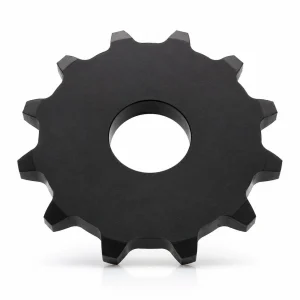
WR78 / WH78 Welded Steel Chain Sprockets | A-Plate 7–20 Teeth — Mild Steel & QT400 Hardened
-
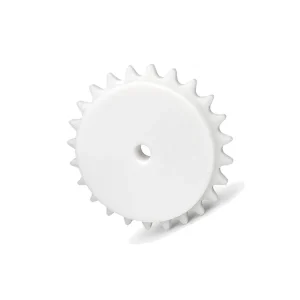
Plastic Sprockets | Nylatron, Acetal, Nylon — FDA-Approved, Self-Lubricating, Corrosion-Free
-
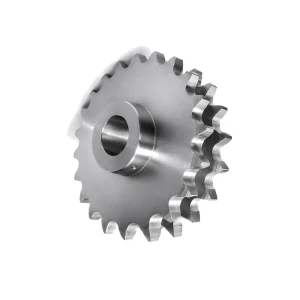
Double Pitch Sprockets | C2040 C2050 C2060 C2080 Standard & Carrier Roller Types
-
#240 Roller Chain Sprockets | A-Plate B-Hub C-Hub – 10 to 60 Teeth, 3-Inch Pitch
-
Roller Chain Sprockets | A-Plate & B-Hub – 18 to 72 Teeth, SAE 1045 Steel
-
Single Strand Roller Chain Sprockets | A-Plate B-Hub C-Hub Taper QD Weld-On
-
Plate Wheel Sprocket 081B-1 | DIN 8187 ISO 606 – 8 to 125 Teeth
-
Cast Iron Sprocket | DIN 8187 ISO 606