Single Strand Roller Chain Sprockets — Six Hub Styles, Full Chain Range
A sprocket is a toothed wheel whose radial teeth engage a roller chain to transmit rotational motion and torque between shafts. Unlike gears, sprockets never mesh directly with each other — the chain serves as the intermediary, connecting the driver and driven sprockets across a centre distance that can range from a few centimetres to several metres. This distinguishes chain drives from gear drives (direct tooth contact) and belt drives (smooth pulley surface).

The ANSI B29.1 standard defines the roller chain and sprocket dimensions used across North America, Korea, Japan, and much of Asia. All Korea Ever-Power single strand sprockets are manufactured to this standard, ensuring direct interchangeability with equivalent sprockets from Martin, Tsubaki, Browning, and Rexnord catalogues. SAE 1045 medium-carbon steel provides good machinability for bore customisation while offering sufficient surface hardness on the tooth profiles when induction-hardened — a process applied to all sprockets with under 30 teeth where impact loading at tooth engagement is highest.
- ⚙Chain standard: ANSI B29.1 — sizes #25 through #240
- ⚙Hub styles: A-plate, B-hub, C-hub, taper bushed, QD-bushed, weld-on
- ⚙Material: SAE 1045 steel; induction-hardened teeth (Z < 30)
- ⚙Finish: black oxide coating for corrosion resistance
The Six Standard Hub Configurations — Full Guide
Selecting the correct hub style is the first decision when specifying a sprocket. The tooth profile and chain engagement are identical across all six types for the same ANSI chain size and tooth count — what differs is how the sprocket attaches to the shaft, and this determines installation speed, torque capacity, and ease of removal.
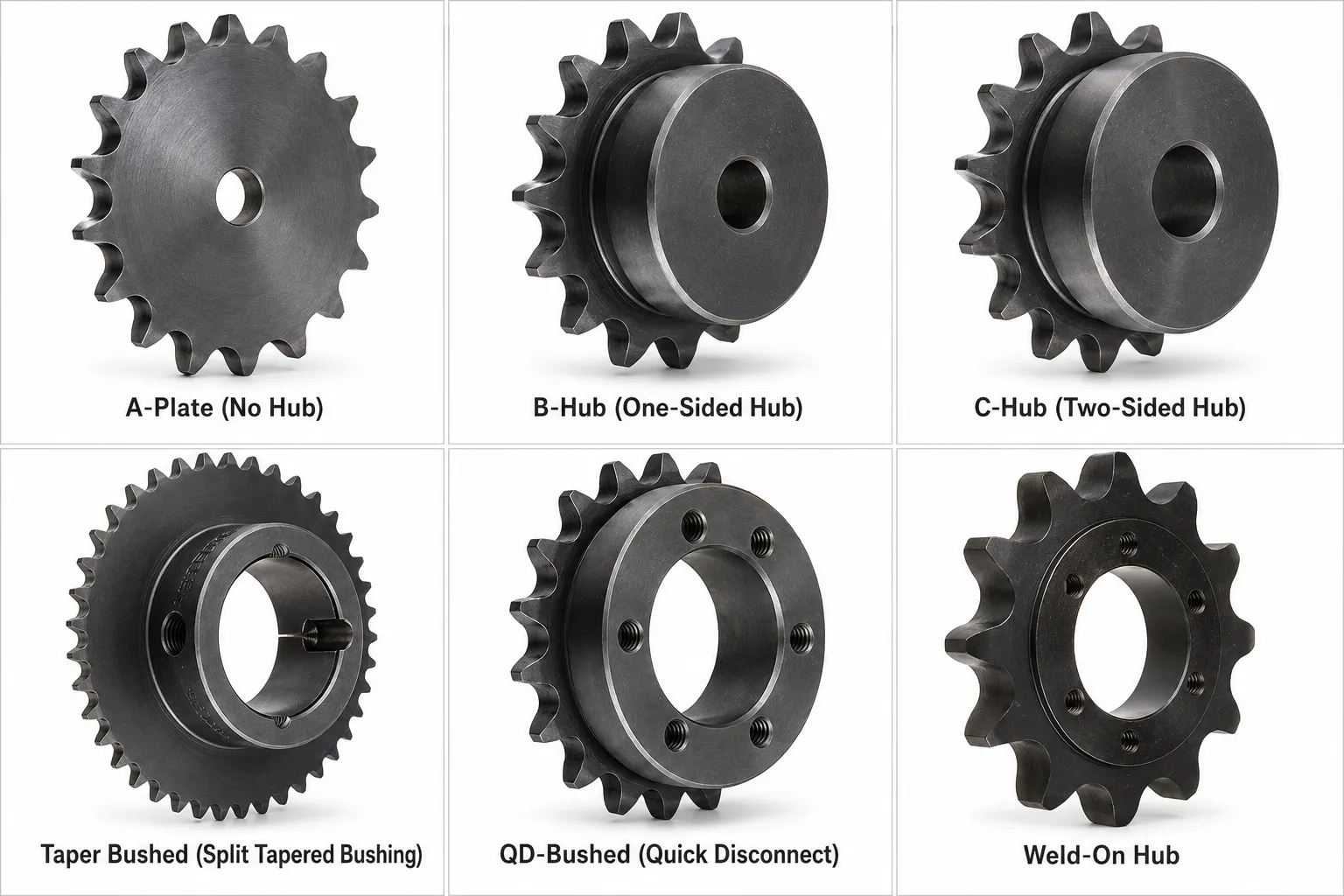
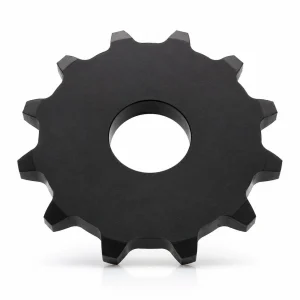
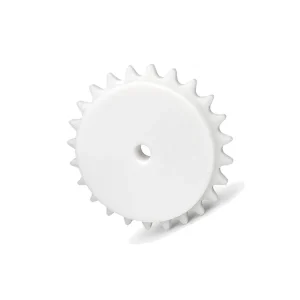
A-Plate (No Hub)
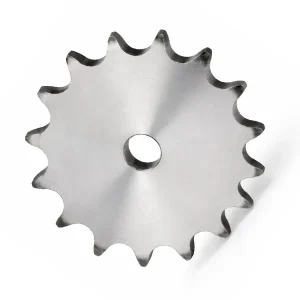
The A-plate sprocket is a flat disc with teeth around the circumference and a plain bore through the centre. There is no hub projection on either face. Axial thickness is the minimum of all six types, making A-plate the correct choice when shaft protrusion is limited, or when the sprocket needs to sit flush against a bearing housing or frame face. A-plate sprockets are typically drilled for mounting bolts or welded to a shaft flange. They are also used where the sprocket is sandwiched between two components and there is no space for a hub on either side. Not suitable for heavy torque transmission via key alone — torque capacity limited by plate thickness and bore size.
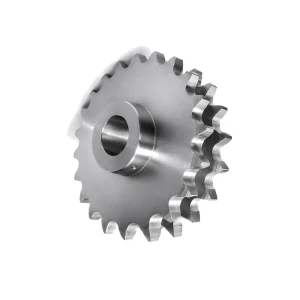
B-Hub (One-Sided Hub)
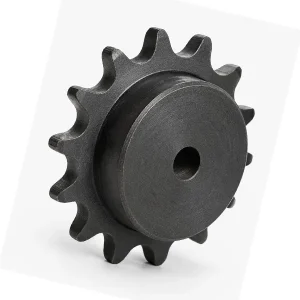
The B-hub sprocket has a cylindrical hub projecting from one face only. This hub extends the shaft engagement length beyond what is possible with the plate body alone, providing greater torque-carrying capacity through a longer key. The B-hub is the most common sprocket type in general industrial use. It is the default specification for most conveyor drive, machine tool, and agricultural power transmission applications where the shaft projects from one side and the sprocket needs to be positioned close to the bearing. Keyway and set screw are standard; tapered bore options are available for specific sizes.
C-Hub (Two-Sided Hub)
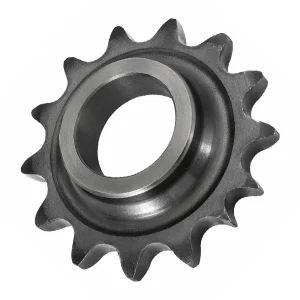
The C-hub sprocket carries hub projections on both faces of the plate, providing maximum shaft engagement length and the highest torque capacity of the fixed-bore types. C-hub is specified for large chain sizes (#80 and above) and high tooth counts where the transmitted torque is substantial. The double hub also provides better concentricity stability on long overhanging shaft installations where cantilever bending moments are present. C-hub sprockets are standard for large conveyor drives, mining equipment, and heavy-duty agricultural final drives. They are heavier and more expensive than B-hub equivalents but justified by the additional shaft support they provide.
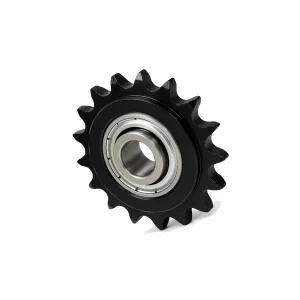
Taper Bushed (Split Tapered Bushing)
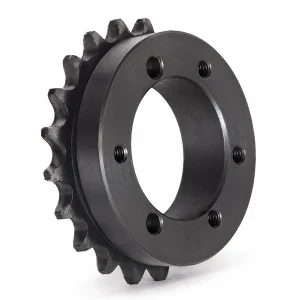
Taper bushed sprockets use a separate split taper lock bushing that is drawn into a matching tapered bore in the sprocket hub by tightening two or three bolts. This creates a self-centralising, zero-clearance fit on the shaft that can be installed and removed without access to the shaft end. The taper bushing system allows a single standard sprocket to fit a range of shaft diameters simply by changing the bushing — rather than stocking different bore sprockets. Taper bushed sprockets are preferred in maintenance-intensive environments where sprocket removal and replacement must be fast. The withdrawal force required to remove the sprocket is generated by reversing the tightening bolts into the withdrawal thread holes, making them quick and reliable in confined spaces. Available in standard taper lock bushing series (1108, 1210, 1310, 1610, etc.).
QD-Bushed (Quick Disconnect)
The QD (Quick Disconnect) system uses a flanged split bushing that is drawn into the sprocket hub by cap screws. Like taper bushed, QD allows one sprocket to accept multiple shaft sizes via bushing interchange. The QD system uses a flange-mount bolt pattern where the cap screws can be relocated into withdrawal holes to push the bushing back out of the sprocket — a feature that makes QD particularly fast for planned maintenance on production lines where downtime cost is high. QD is the dominant quick-removal system on larger sprockets in the US market and is widely used in Korean heavy industries that follow US equipment standards. Available in QD bushing series (JA, SH, SK, SF, E, F, J, M, N, P, W, etc.).
Weld-On Hub
A weld-on hub sprocket is supplied with an A-plate body and a separate weldable hub. The installer welds the hub to the shaft or to a fabricated mounting boss. This configuration is used where the shaft is non-standard, part of a fabricated assembly, or where it is not possible to remove the shaft end to slide a fixed-bore sprocket onto it. Weld-on sprockets are common in custom conveyor fabrication, agricultural implement manufacture, and OEM equipment where standard shaft sizes do not apply. The weld-on hub also allows precise axial positioning of the sprocket that cannot be achieved with a fixed-bore arrangement. Weld quality and concentricity after welding are critical — always check runout after welding and before chain fitting.
Material, Hardening, and Surface Treatment
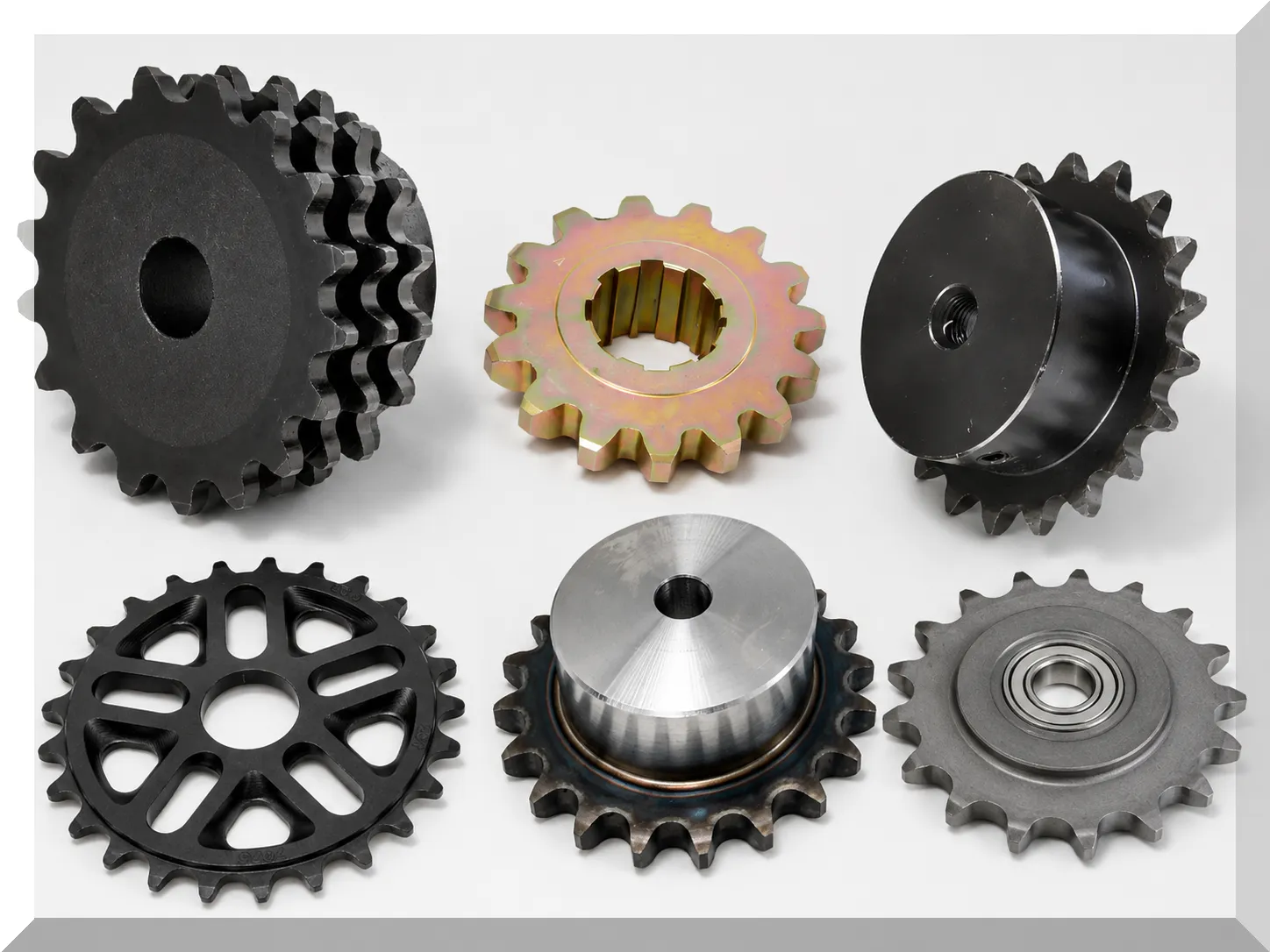
SAE 1045 medium-carbon steel (0.43–0.50% carbon) is the industry standard for roller chain sprockets in the ANSI range. This grade machines cleanly for bore customisation while providing sufficient carbon content for effective surface hardening. Three material and surface treatment points are worth understanding when selecting sprockets for specific environments:
🔬 Induction Hardening (Z < 30)
Sprockets with under 30 teeth are induction-hardened at the tooth surfaces. The induction process heats only the outer skin of each tooth to above the steel's austenitising temperature, then rapidly quenches it, producing a hard martensitic surface layer (typically 50–58 HRC) over a tough unhardened core. This combination resists the surface fatigue and impact wear that occurs when chain rollers engage small-diameter sprockets at high velocity. Sprockets with 30 or more teeth do not require induction hardening because the larger pitch circle distributes impact loading over a longer engagement arc, reducing tooth surface stress to manageable levels.
🛡 Black Oxide Finish
Black oxide (magnetite conversion coating) applied to all sprockets provides a thin, dimensionally neutral corrosion-resistant layer. It adds no measurable thickness (typically 1–2 micrometres) so bore tolerances and tooth dimensions are unaffected by the finish. Black oxide's corrosion resistance is adequate for dry indoor environments and light oil-lubricated chain drives. For outdoor, wet, or salt-air environments, specify our stainless steel sprocket range — black oxide alone is not sufficient for prolonged moisture exposure.
✅ Dimensional Inspection
All Korea Ever-Power ANSI sprockets are checked for pitch diameter tolerance and tooth spacing error before dispatch. Pitch diameter is the most critical functional dimension — an error here means the chain will not engage at the correct depth, producing accelerated wear at the tooth root or tip. Our inspection process uses master gauges traceable to ANSI B29.1 reference values. Dimensional inspection reports are available on request for OEM and industrial procurement accounts.
Hub Style Quick-Reference Comparison
| Hub Style |
Axial Space |
Torque Capacity |
Shaft Removal Needed? |
Best For |
| A-Plate |
Minimum |
Low–moderate |
Often yes |
Tight clearances, weld-on, custom mounts |
| B-Hub |
Moderate |
Moderate–high |
Usually yes |
General industrial drives (most common) |
| C-Hub |
Large |
Highest |
Yes |
Heavy duty, large chains (#80+), long overhangs |
| Taper Bushed |
Moderate |
High |
No |
Maintenance-heavy environments, multi-shaft-size |
| QD-Bushed |
Moderate–large |
High |
No |
Production lines, fast planned maintenance |
| Weld-On Hub |
Variable |
As welded |
No (permanent) |
Custom fabrication, non-standard shafts |
Where Single Strand Sprockets Are Installed
🏭 Conveyors and Material Handling
B-hub and C-hub sprockets on drive shafts power conveyor belts, roller conveyors, and incline conveyors across Korean warehousing, logistics, and manufacturing. Chain sizes #40 through #80 are the most common in this sector. Taper bushed variants are preferred on longer production lines where the ability to remove and reposition sprockets without dismantling the conveyor frame reduces planned maintenance time significantly.
🌾 Agricultural Equipment
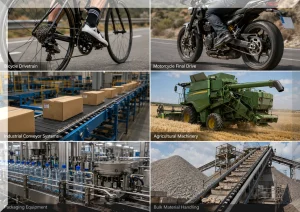
Korean rice combines, grain dryers, and vegetable processing machines use #35, #40, and #50 single strand chain drives extensively. Weld-on hub sprockets are common in agricultural OEM production where shafts are fabricated rather than standardised. B-hub types in #40 and #50 serve as cost-effective replacement parts for worn sprockets on existing machines. Induction-hardened teeth are particularly valuable on high-cycle thresher and conveyor drives where sprocket tooth wear is the limiting factor in service life.
⚙ Industrial Machinery
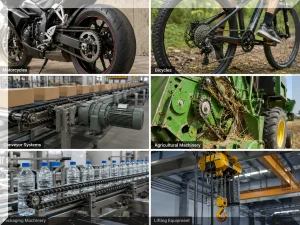
Machine tools, textile machinery, and printing equipment operating in Korean industrial facilities commonly use #25, #35, and #40 single strand chain drives on auxiliary mechanisms and feed drives. QD-bushed sprockets are specified on production machinery where quarterly sprocket changes are planned maintenance events — the QD withdrawal system reduces changeover time to minutes per sprocket, minimising production downtime during scheduled service intervals.
Matching ANSI Roller Chain for Single Strand Sprockets
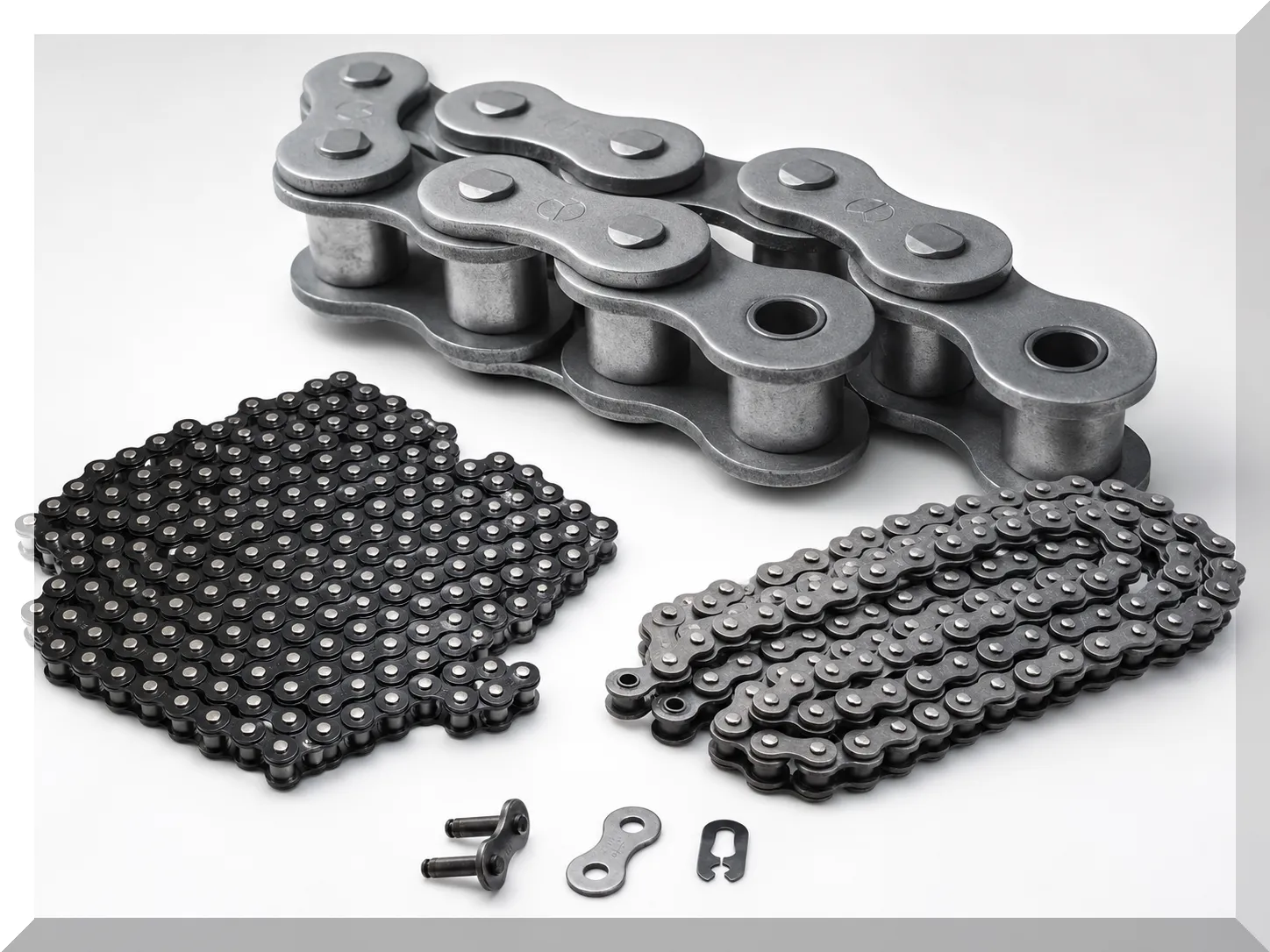
Every Korea Ever-Power single strand sprocket is designed and dimensioned to pair with the corresponding ANSI roller chain — #25, #35, #40, #50, #60, #80, #100, #120, #140, #160, #180, #200, or #240. The sprocket tooth form, pitch diameter calculation, and tooth width are all co-defined within ANSI B29.1, meaning a #40 sprocket from any compliant manufacturer will mesh correctly with #40 chain from any compliant chain manufacturer.
Sourcing matched chain and sprockets from the same supplier eliminates the small dimensional differences that can arise when chain from one manufacturer is used with sprockets from another. All Korea Ever-Power ANSI chain and sprockets are produced to the same standard tolerances, and our technical team can confirm correct pairing — including recommending whether simplex, duplex, or triplex chain is appropriate for the power level you need to transmit. For a complete reference on chain and sprocket systems selection, our technical catalogue covers all ANSI chain sizes and sprocket configurations.
Why Korea Ever-Power Chain and Sprocket
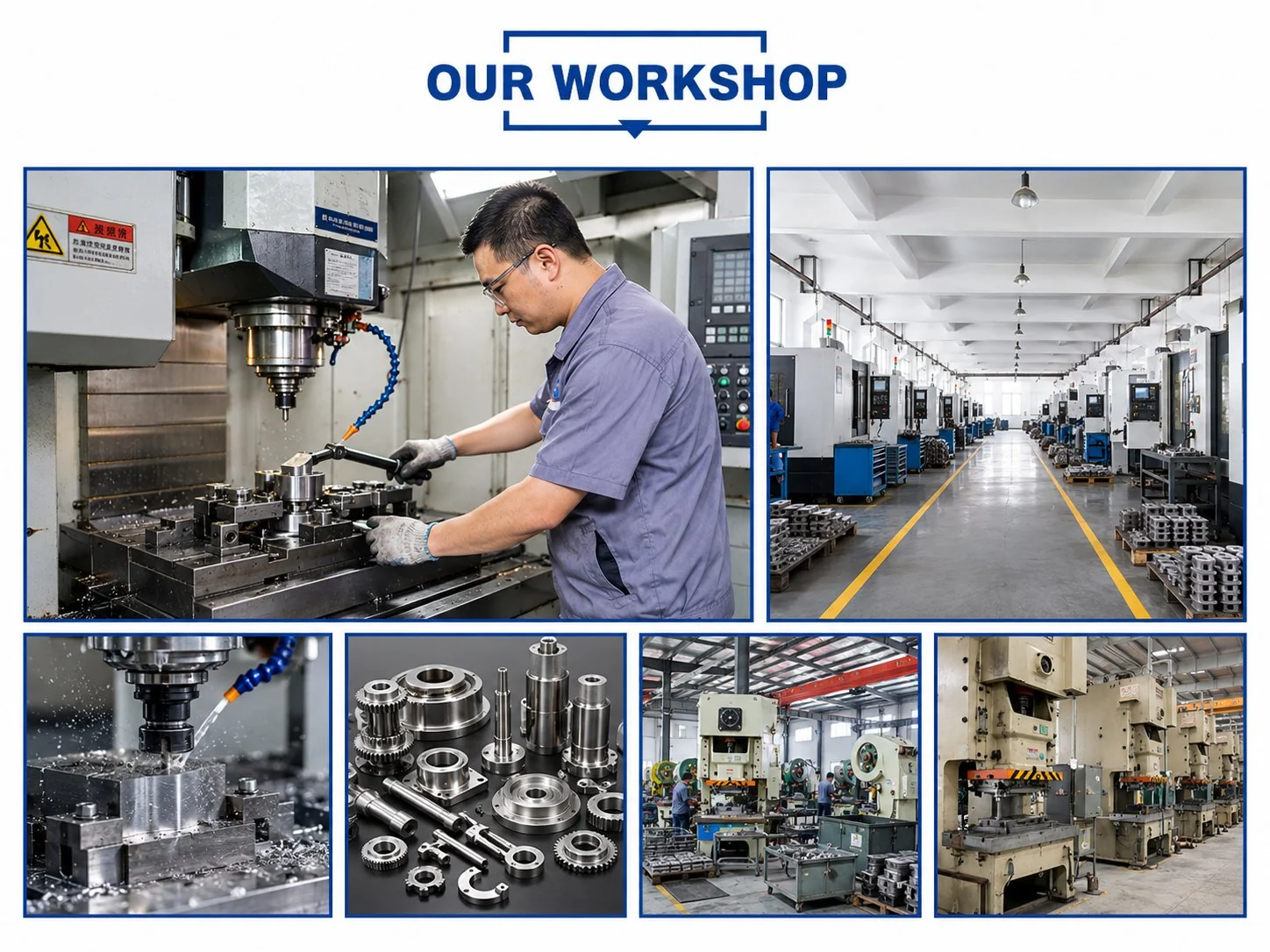
Korea Ever-Power Chain and Sprocket Co., Ltd. supplies the full ANSI single strand sprocket range across all six hub types with stocked inventory in Korea:
✦All six hub types stocked — A-plate, B-hub, C-hub, taper bushed, QD-bushed, and weld-on across chain sizes #25 to #240
✦SAE 1045 steel with induction-hardened teeth (Z<30) and black oxide finish as standard — no extra charge for standard heat treatment
✦ANSI B29.1 verified dimensions — pitch diameter and tooth spacing checked to standard before dispatch
✦Custom bore machining — keyways, set screws, special bores machined to customer drawings; 5–10 day turnaround
✦Cross-reference support — Martin, Tsubaki, Browning, Rexnord catalogue number cross-referencing before order placement
✦Korea-stocked, 7–14 day delivery — no import wait from Europe or the US for standard ANSI sizes
Frequently Asked Questions
What does "single strand" mean — can these sprockets run double or triple strand chain?
Single strand sprockets are designed with a tooth width matched to one strand of chain. They cannot run double or triple strand chain. For multi-strand chain you need a corresponding multi-strand sprocket, which has a wider tooth body with multiple sets of teeth spaced to match the strand spacing. Single strand is the most common configuration for light to medium-duty drives. Multi-strand drives are used when the required torque exceeds what is practical with a single strand at the available speed.
Why do sprockets with fewer than 30 teeth need induction hardening?
On a small sprocket (fewer than 30 teeth), the pitch circle diameter is small and the chain approaches each tooth at a steeper angle, creating a higher impact force per tooth engagement. This surface impact wears the tooth face rapidly on unhardened steel. Induction hardening creates a martensitic surface layer (50–58 HRC) that resists this wear. On larger sprockets (30+ teeth), the impact angle and force per tooth are lower because the chain wraps around a larger radius, and the surface hardness from standard SAE 1045 normalised condition is adequate for the wear rate.
How do I choose between taper bushed and QD-bushed for my application?
Both allow sprocket removal without removing the shaft. The practical difference is the removal mechanism. Taper lock is removed by unscrewing the clamping bolts and reinstalling them in the withdrawal threads, which pushes the bushing free. QD uses a similar bolt-reversal method but with a flanged bushing that provides a more positive extraction force. For most industrial applications, either system works equally well. QD is more common on larger sprockets (#60 and above) in US-standard equipment. Taper lock is more common in European and Asian machinery. Korea Ever-Power stocks both — specify which bushing series your existing equipment uses and we will confirm the correct replacement.
What is the minimum tooth count I should use for a drive sprocket?
ANSI B29.1 recommends a minimum of 9 teeth on the smaller sprocket in a drive. Fewer than 9 teeth creates excessive polygon effect (speed fluctuation), very high impact loads per tooth, and rapid wear. In practice, 13–17 teeth is a more common minimum for industrial drives where chain life matters. The polygon effect becomes insignificant above approximately 25 teeth — this is why high-speed precision drives always use large tooth counts on both sprockets.
Can I use an odd or even tooth count — does it matter?
For optimal wear distribution, use an odd number of teeth on the driver sprocket combined with an even number of chain links. This ensures every chain link contacts every tooth over the life of the drive, distributing wear uniformly. Using an even tooth count on both sprockets with an even link count means the same chain link always contacts the same tooth, creating localised wear on both. This matters more on high-cycle drives — for slow conveyors running at a few rpm, the effect is negligible.
What chain size should I use for a given power requirement?
Chain size selection is based on transmitted horsepower (or kW), the speed of the small sprocket (rpm), and the service factor for the type of loading (smooth, moderate shock, or heavy shock). ANSI B29.1 publishes horsepower rating tables for each chain size and driver sprocket tooth count. A rough starting point: #40 chain handles approximately 2–3 kW at 500 rpm with a 17-tooth sprocket; #60 handles approximately 5–8 kW at 500 rpm. Contact our technical team with your power, speed, and centre distance requirements and we will select the correct chain and sprocket combination.
How do I cross-reference a Martin or Tsubaki sprocket catalogue number?
Provide us with the full catalogue number from your original sprocket — for example, a Martin 40BS17 or Tsubaki 40B17H. The ANSI chain size (40 = #40), hub style (BS = B-hub with set screws), and tooth count (17) are typically encoded in the catalogue number. We will confirm the Korea Ever-Power equivalent before your order is placed, and supply dimensional drawings on request if you need to verify bore and hub dimensions before committing to a purchase.
Customer Reviews
Verified feedback from customers in Korea and surrounding markets.
Lee Jin-woo, Maintenance Manager, Logistics Centre, Incheon (early 2025)
"We standardised on taper bushed #50 sprockets for all our conveyor drives two years ago. Korea Ever-Power supplies the B-hub taper bushed type in the specific bushing series we need. The quality has been consistent and the changeover time on our conveyors has dropped from about 45 minutes per sprocket to under 10 minutes. That is a meaningful difference when we have a 6-hour maintenance window."
Kwon Hyun-ju, Agricultural Machinery OEM, Chungcheong Province (2024)
"We build grain dryers and buy weld-on hub sprockets in #40 and #50 for our conveyor shafts. Korea Ever-Power machines the bore to our drawing spec and supplies the hubs separately from the A-plate bodies when needed. The dimensional accuracy on the custom bores has been reliable over 12 months of production runs. No assembly issues reported from our manufacturing floor."
Shin Byung-ho, Machine Tool Distributor, Seoul (Q3 2024)
"We stock B-hub #35 and #40 sprockets as service parts for the machine tools we distribute. Needed to cross-reference from Tsubaki catalogue numbers — Korea Ever-Power confirmed equivalence and sent dimensional drawings within one day. Have been ordering from them for about eight months now. Lead time is consistently 8–10 days and the sprockets arrive with the black oxide finish intact, which matters for our customers."
Kim So-yeon, Production Engineer, Food Processing Equipment Manufacturer, Busan (2025)
"We needed C-hub #60 sprockets with an unusually large bore for a new machine design. Korea Ever-Power machined the custom bore (52 mm) with keyway and two set screws as specified. The runout measurement we did on arrival was within our tolerance. Custom bore sprockets are often a long lead item from other suppliers — getting them in 10 days was a real advantage during our prototype build phase."
Yoo Chan-ho, Facilities Maintenance, Textile Manufacturing Group, Daegu (early 2025)
"We maintain a large number of #25 and #35 chain drives across our weaving and winding departments. Small sprocket drives with under 30 teeth — the induction-hardened type — wear noticeably slower than the plain steel sprockets we used previously from a different supplier. Changed to Korea Ever-Power about 14 months ago and the inspection interval between replacements has extended from 6 months to over 10 months on the high-cycle drives."