Product Description
Detailed Photos
Product Description
| Item Name | Standrad transmission Roller Chains | Model | Series A, Series B |
| Row | Simplex Duplex Triplrex |
Application | Machinery Parts |
| Suiface Treament | netural/sand-blasted/shot-peening | Certification | ISO, ANSI, DIN, BS |
| Packing | Packaged in boxes and wooden cases, or packaged in reels and then on pallets | Port | Any sea port or airport in china |
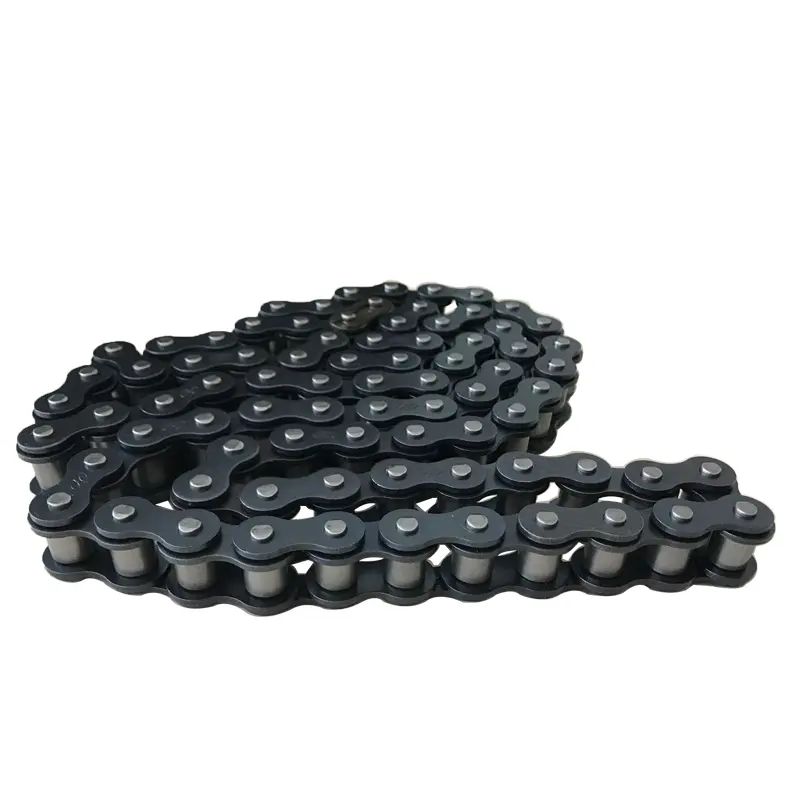
Standard roller chains are a type of industrial chain that is commonly used in power transmission
applications. They consist of a series of cylindrical rollers that are linked together by side plates.
The rollers rotate within the links, transmitting power from 1 sprocket to another.
Standard roller chains are available in a range of sizes and configurations to fit different industrial
applications. They are made from high-quality materials, such as carbon steel or stainless steel,
which are resistant to wear, corrosion, and fatigue.
These chains are designed to provide smooth and efficient power transmission, with minimal energy
loss. They have a high load-bearing capacity, making them suitable for use in heavy-duty machinery,
such as conveyors, elevators, and industrial equipment.
Standard roller chains are also easy to install and maintain, with simple lubrication requirements to
ensure long-lasting performance. Overall, they offer a reliable and cost-effective solution for power
transmission in a wide range of industrial applications.
Other Products
Company Profile
Packaging & Shipping
After Sales Service
/* March 10, 2571 17:59:20 */!function(){function s(e,r){var a,o={};try{e&&e.split(“,”).forEach(function(e,t){e&&(a=e.match(/(.*?):(.*)$/))&&1
| Standard or Nonstandard: | Standard |
|---|---|
| Application: | Textile Machinery, Garment Machinery, Conveyer Equipment, Packaging Machinery, Electric Cars, Motorcycle, Food Machinery, Mining Equipment, Agricultural Machinery |
| Surface Treatment: | Netural/Sand-Blasted/Shot-Peening |
| Material: | Carbon Steel |
| Type: | Short Pitch Chain |
| Surface: | Shot Peening, Black, Blue or Original |
| Samples: |
US$ 1.28/Meter
1 Meter(Min.Order) | |
|---|
| Customization: |
Available
| Customized Request |
|---|
What are the benefits of using a low-noise transmission chain?
Using a low-noise transmission chain in industrial applications offers several advantages. Here’s a detailed answer to the question:
1. Noise Reduction: One of the primary benefits of using a low-noise transmission chain is the reduction in noise levels. These chains are designed with special features and materials to minimize vibrations, impact, and friction-induced noise during operation. This is particularly important in environments where noise reduction is critical, such as in residential areas, offices, or noise-sensitive industries.
2. Improved Workplace Environment: By reducing noise levels, low-noise transmission chains contribute to a more comfortable and productive workplace environment. Excessive noise can lead to employee fatigue, decreased concentration, and increased stress levels. Using low-noise chains helps create a quieter workspace, promoting better working conditions and overall well-being.
3. Compliance with Noise Regulations: In certain industries or regions, there are specific regulations or guidelines regarding acceptable noise levels. Using low-noise transmission chains can help ensure compliance with these regulations, avoiding potential fines or legal issues related to excessive noise emissions.
4. Enhanced Equipment Performance: Low-noise transmission chains are designed to provide smooth and efficient power transmission while minimizing noise generation. The reduction in vibration and impact noise not only improves the comfort of the workplace but also enhances the overall performance of the equipment. It can contribute to better precision, accuracy, and reliability of the machinery, leading to improved product quality and operational efficiency.
5. Extended Equipment Lifespan: Excessive noise and vibration can accelerate wear and tear on machinery components, leading to increased maintenance and premature failure. By using a low-noise transmission chain, the impact on the equipment’s mechanical parts is reduced, resulting in less wear, lower maintenance costs, and extended equipment lifespan.
6. Customer Satisfaction: In industries where noise can affect the end-user experience, such as automotive, consumer electronics, or precision engineering, using low-noise transmission chains can contribute to higher customer satisfaction. Products that operate quietly are often perceived as higher quality and can lead to a positive brand image and customer loy alty.
It’s important to note that the benefits of low-noise transmission chains may vary depending on the specific application and operating conditions. Manufacturers and equipment designers should consider factors such as load capacity, speed, lubrication, and environmental requirements when selecting and implementing low-noise transmission chains.
Can transmission chains be used in conveyor systems?
Yes, transmission chains can be used in conveyor systems. Here’s a detailed answer to the question:
Conveyor systems are widely used in various industries for efficient material handling and transportation. Transmission chains are one of the key components used to drive and support the movement of conveyor belts or rollers.
Transmission chains offer several advantages in conveyor systems:
1. Power Transmission: Transmission chains are designed to transmit power effectively, allowing them to drive the movement of the conveyor belt or rollers. They can handle high loads and provide reliable power transfer, ensuring smooth and consistent operation of the conveyor system.
2. Versatility: Transmission chains are available in various sizes, types, and configurations, making them suitable for a wide range of conveyor applications. They can be customized to fit different conveyor system designs and requirements, including straight conveyors, curved conveyors, inclined conveyors, and more.
3. Durability: Transmission chains are built to withstand rigorous operating conditions in conveyor systems. They are made from high-quality materials such as steel, which offers excellent strength and durability. This ensures that the chains can withstand heavy loads, frequent starts and stops, and abrasive environments commonly encountered in conveyor applications.
4. Flexibility: Transmission chains allow for flexibility in conveyor system layout and configuration. They can accommodate different conveyor lengths, widths, and angles, enabling the system to adapt to space constraints and specific material handling needs. Additionally, they can be easily modified or extended as the conveyor system requirements evolve.
5. Low Maintenance: Transmission chains require regular maintenance to ensure optimal performance and longevity. However, compared to other types of power transmission systems, such as belts or gears, transmission chains generally have lower maintenance requirements. Proper lubrication, tensioning, and periodic inspections are essential to minimize wear and ensure reliable operation of the conveyor system.
Overall, transmission chains are a reliable and efficient solution for powering conveyor systems. They provide robust power transmission, versatility in system design, durability in demanding environments, flexibility in layout, and relatively low maintenance requirements. When properly selected and maintained, transmission chains can contribute to the smooth and efficient operation of conveyor systems in various industries.

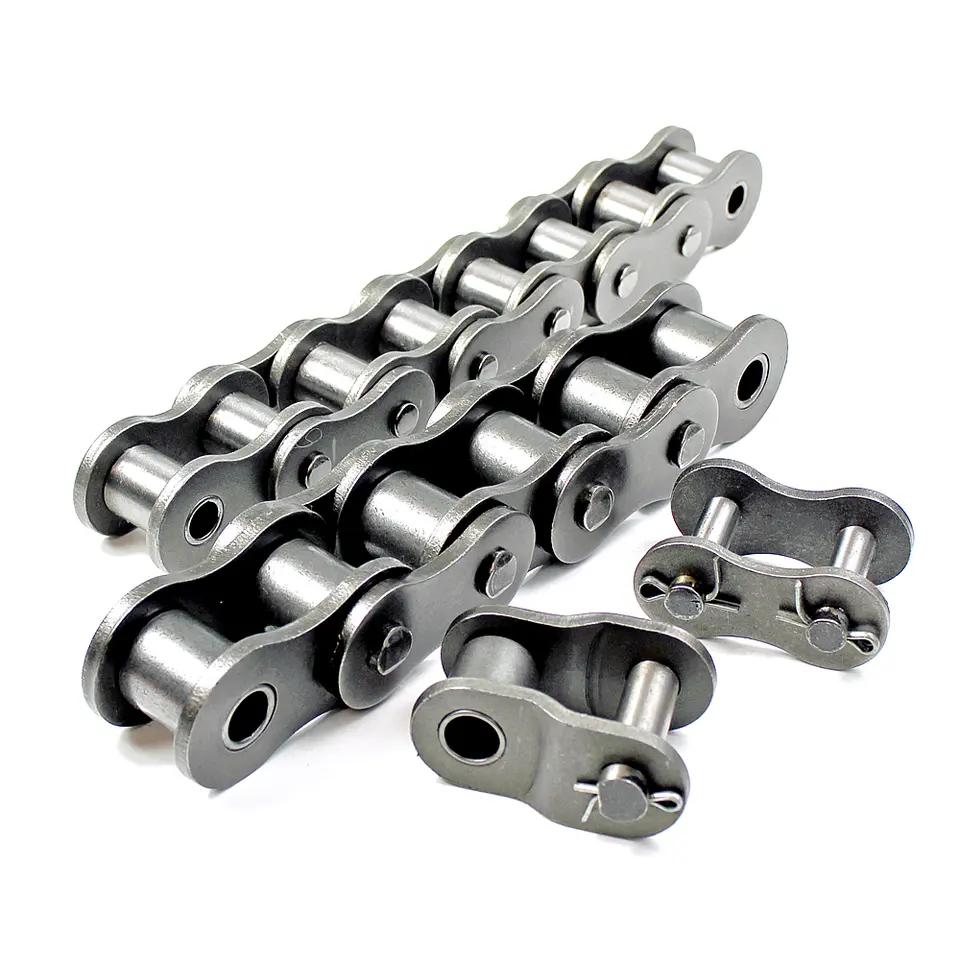
What are the key components of a transmission chain?
A transmission chain consists of several key components that work together to transmit power and motion efficiently. The main components of a transmission chain include:
- Inner Plates: These are flat metal plates with holes or slots for connecting the other components of the chain.
- Outer Plates: Similar to inner plates, outer plates provide additional strength and support to the chain.
- Pins: The pins hold the inner and outer plates together, creating a flexible link between them. They play a crucial role in maintaining the integrity and functionality of the chain.
- Bushings: Bushings are cylindrical components that fit into the holes of the inner and outer plates. They provide a smooth surface for the chain to rotate around the pins.
- Rollers: Rollers are cylindrical elements that fit between the inner plates and the bushings. They reduce friction and enable smooth movement as the chain engages with the sprockets.
- Solid Bushings (optional): In some transmission chains, solid bushings may be used instead of bushings with holes. Solid bushings provide additional strength and stability to the chain.
- Sprockets: Sprockets are toothed wheels that engage with the rollers of the transmission chain. They transfer power and motion to the chain, enabling it to drive various machinery and equipment.
These components work together to form a continuous loop that transmits power from the driving sprocket to the driven sprocket, allowing the chain to transfer rotational motion and drive various mechanical systems.


editor by CX 2023-12-25