A maintenance engineer in a Korean cement plant replaced a worn roller chain last year using what looked like an identical part from a different supplier. The pitch matched. The width looked right. Six weeks later the chain had stretched unevenly, the sprocket teeth had begun to hook, and a planned two-hour maintenance window had turned into a 14-hour shutdown. The root cause was simple: the replacement chain used a different roller diameter — one that did not seat correctly in the sprocket tooth root. The part was dimensionally close but not specification-correct.
This kind of mistake happens more often than most procurement teams want to admit, and it nearly always comes from treating the roller chain as a single interchangeable commodity rather than as an assembly of five distinct components, each with its own material specification, dimensional tolerance, and failure mode. Once you understand what each component actually does, wrong-part purchases become much harder to make.
The Five Core Components of a Roller Chain
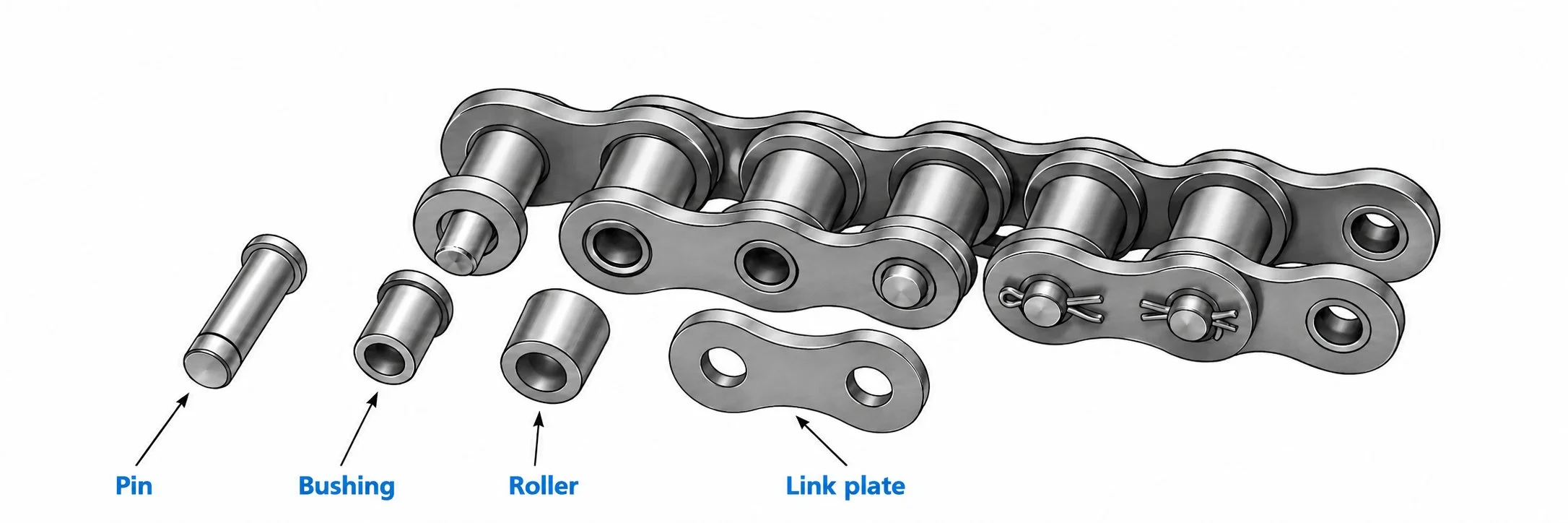
| Component | Function | Typical Material | Primary Failure Mode |
|---|---|---|---|
| Inner Link Plate | Carries tensile load between bushings | Medium carbon steel, HRC 38–45 | Fatigue crack at pin hole radius |
| Outer Link Plate | Connects adjacent links via press-fit pins | Medium carbon steel, black oxide | Fatigue crack at pin hole; lateral impact fracture |
| Connecting Pin | Pivot point between inner and outer links | Case-hardened steel, 55–60 HRC surface | Pin-bushing wear; torsional shear under shock |
| Roller Bushing | Bearing surface for pin articulation | Sintered steel, oil-impregnated bore | Inner bore wear (primary elongation cause) |
| Free Roller | Engages sprocket tooth root with rolling contact | Case-hardened steel, 55–62 HRC | Surface spalling; roller fracture under shock load |
How Each Component Carries Load — and Why It Wears
The inner link plate is punched from cold-rolled medium carbon steel strip. The two holes punched for the bushings are the stress concentration points — under cyclic tensile loading, fatigue cracks propagate from the edge of these holes. This is why quality chain manufacturers use controlled-radius hole edges and shot-peen the plates after punching: the compressive residual stress at the hole surface resists fatigue crack initiation.
The outer link plate serves a structurally similar purpose but is press-fit onto the connecting pins rather than onto bushings. The press-fit interference is specified to ANSI B29.1 tolerances — typically 0.010–0.025 mm for standard pitch sizes — and it is this interference that prevents the pin from rotating within the outer plate. If the press-fit is insufficient (a common quality defect in budget chain), the pin rotates in the outer plate hole and accelerates wear at both contact surfaces simultaneously.
The connecting pin is the most critically heat-treated component in the chain assembly. It must be hard enough at the surface (55–60 HRC) to resist the abrasive wear from the rotating bushing bore, yet tough enough in the core to resist the torsional shear loads imposed by shock loading. Through-hardened pins are inadequate for this application — a through-hard pin will shatter under shock load rather than absorb the energy elastically. Case-carburized pins with a 0.5–1.2 mm case depth are the standard approach for pins in chains rated above #40.
The roller bushing is the single component most responsible for what is commonly called “chain stretch.” This term is technically misleading. The metal does not stretch. What actually happens is that the inner bore of the bushing wears against the pin surface over millions of articulation cycles, increasing the effective diameter of the pin-bushing clearance. Each pin-bushing joint that wears by 0.05 mm adds 0.05 mm to that link’s effective pitch. In an ANSI #60 chain with a nominal 19.05 mm pitch, a chain of 100 links that has worn 0.08 mm per joint is now measuring as if it had a pitch of 19.13 mm — which is exactly the condition that causes a chain to ride up the sprocket teeth and accelerate tooth wear.
The free roller is the component that distinguishes a roller chain from a bush chain. It rotates freely on the bushing outer surface as the chain engages the sprocket tooth. This rolling contact — rather than sliding contact — is what gives roller chain its efficiency advantage over plain bush chain. The roller absorbs the impact of engagement against the sprocket tooth root, spreading the contact stress over the roller’s curved surface rather than concentrating it at a point. Under heavy shock loading, however, the roller can fracture if its surface hardness exceeds the material’s fracture toughness — another reason why the case depth and core toughness specifications for rollers matter as much as surface hardness.
ANSI vs ISO: How the Standards Differ and Why It Matters for Replacement
The most common cross-standard substitution error occurs between ANSI B29.1 and ISO 606 chains of equivalent pitch. The pitch dimensions are defined identically — an ANSI #40 chain and an ISO 08A chain both have a 12.70 mm pitch. This is why the chains appear interchangeable in a catalogue. They are not. The roller diameters differ: ANSI #40 specifies a 7.92 mm roller, while ISO 08A specifies a 7.95 mm roller. The inner link width also differs slightly. When an ISO 08A chain runs on a sprocket cut for ANSI #40 geometry, the roller does not seat at the correct depth in the tooth root, and the sprocket teeth begin wearing asymmetrically within a few hundred operating hours.
| ANSI No. | ISO Equiv. | Pitch (mm) | ANSI Roller Dia. (mm) | ISO Roller Dia. (mm) | Inner Width (mm) | Min Break Load ANSI (kN) |
|---|---|---|---|---|---|---|
| #25 | — | 6.35 | 3.30 | N/A | 3.18 | 3.6 |
| #35 | — | 9.525 | 5.08 | N/A | 4.78 | 7.8 |
| #40 | 08A | 12.70 | 7.92 | 7.95 | 7.85 | 14.1 |
| #50 | 10A | 15.875 | 10.16 | 10.16 | 9.53 | 22.2 |
| #60 | 12A | 19.05 | 11.91 | 11.91 | 12.57 | 31.8 |
| #80 | 16A | 25.40 | 15.88 | 15.88 | 15.75 | 56.7 |
| #100 | 20A | 31.75 | 19.05 | 19.05 | 18.90 | 88.5 |
| #120 | 24A | 38.10 | 22.23 | 22.23 | 25.22 | 127.0 |
The practical takeaway from this table is that for #50 and above, the ANSI and ISO roller diameters converge. Below #50, the differences are large enough to cause noticeable misfit. For ANSI #35 (9.525 mm pitch), there is no ISO equivalent at all — this pitch size is purely an American standard, and substituting a metrically-close DIN 8187 chain in its place will result in immediate sprocket incompatibility.
Where Roller Chain Component Knowledge Directly Affects Operational Cost
Agricultural Equipment. Combine harvesters, rice threshers, and grain elevator drives run chains in dusty, abrasive environments where lubrication intervals are difficult to maintain. In these conditions, the bushing bore wears faster than in any clean industrial environment. Sealed chain (O-ring or X-ring type) uses elastomeric seals at each pin-bushing joint to retain factory-applied grease permanently — the seals prevent abrasive particles from entering the pin-bushing clearance. Specifying sealed chain for combine feeder house drives can extend service life by 3 to 5 times compared with standard open roller chain in the same application.
Conveyor and Material Handling Systems. Flat-top conveyor systems and attachment chains require that the outer link plate dimensions are held to tight tolerances because attachments are welded or bolted directly to the outer plate. If the outer plate thickness varies, attachment alignment goes out of specification and the chain sideloads the sprocket. For these applications, standard ANSI roller chain in the A2 or K1 attachment configuration should be specified with a confirmed outer plate thickness tolerance — not simply ordered by pitch size alone.
Food and Beverage Processing. Stainless steel chain uses 304 or 316 stainless for the link plates and pins, but the bushing and roller are typically still made from carbon steel because stainless sintered bushings are not widely available. This is why stainless chain is not truly “all stainless” — the internal wear components remain carbon steel. In truly corrosive wash-down environments, the solution is not all-stainless chain (which does not exist in standard form) but UHMW plastic idler sprockets that eliminate lubrication entirely at idler positions, combined with a sealed stainless outer-plate chain for the drive positions.
Mining and Cement. Engineer class chains (55-series, 67-series, 81X-series) are structurally different from standard roller chain — the barrel (bushing) is much larger in proportion to pitch, specifically to increase the pin-bearing area and resist the shock loads from drag conveyors. Ordering standard ANSI roller chain as a substitute for engineer class chain in a mining drag conveyor will result in pin shear failure, typically within 200–400 hours of operation.
Automation and Packaging. At speeds above 600 rpm on the small sprocket, roller noise becomes significant and the polygon effect (velocity variation caused by the chain’s angular engagement pattern) begins to cause vibration in precision indexing systems. For these applications, reducing the chain pitch and increasing the tooth count on the small sprocket — rather than using a single large-pitch chain — is the correct engineering approach. A #35 chain at 25 teeth will run more smoothly and with less velocity ripple than a #60 chain at 11 teeth, even if the two configurations transmit identical power.
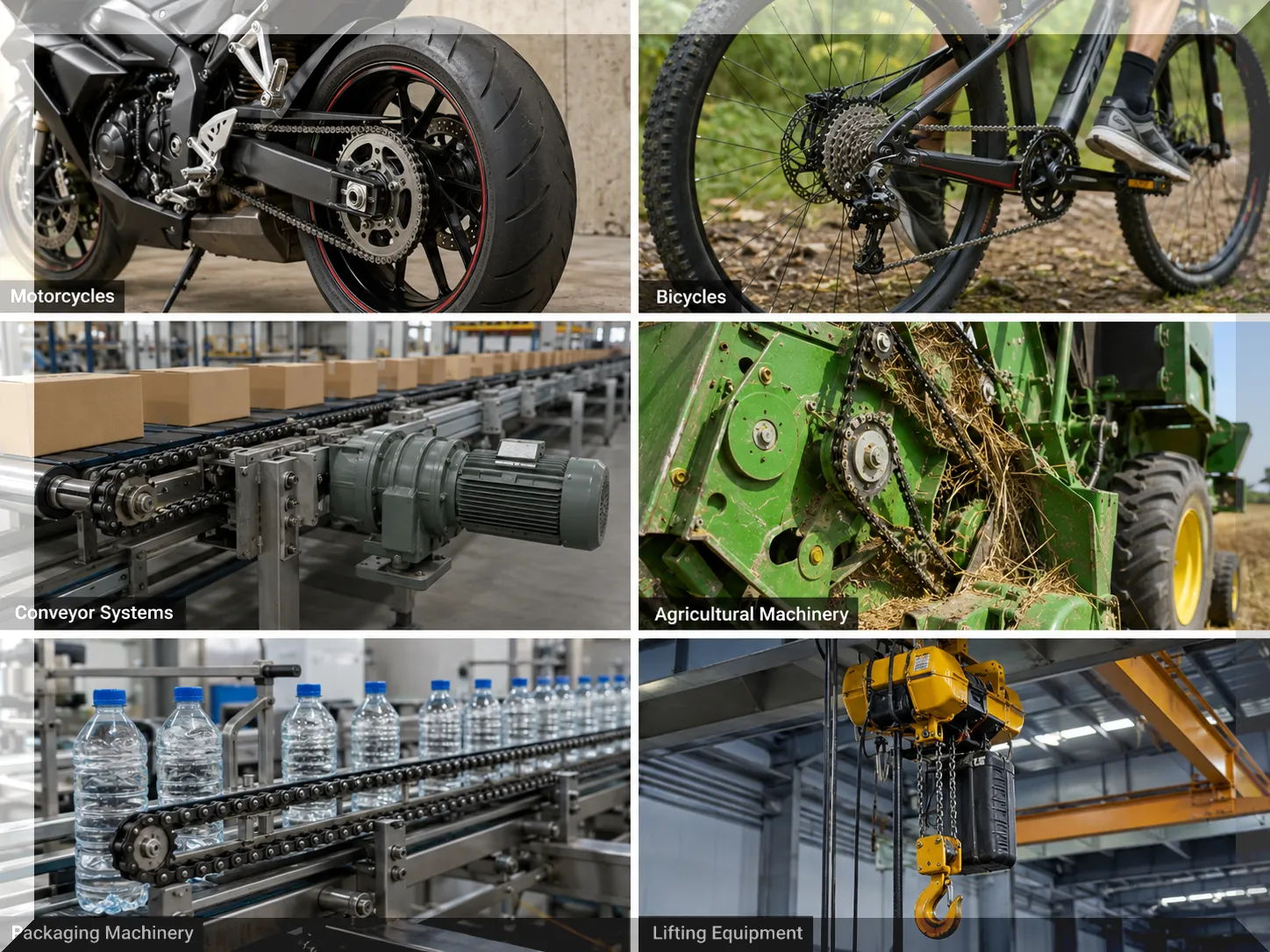
Roller chain drives in material handling and conveyor applications — where chain component specifications directly determine system uptime.
How to Correctly Identify a Roller Chain for Replacement
The pitch alone is not sufficient to specify a replacement chain. These three measurements, taken from the worn chain using a vernier calliper, uniquely identify the chain series:
- Pin-to-pin pitch: Measure across exactly 10 links and divide by 10. This averages out any individual joint wear and gives a more accurate nominal pitch than a single-link measurement. Compare to the ANSI B29.1 or ISO 606 pitch table.
- Roller (barrel) outer diameter: Measure the roller’s outer diameter with callipers, not the bushing. This is the measurement that separates ANSI #40 from ISO 08A and prevents the most common substitution error. Measure multiple rollers — if they vary by more than 0.15 mm, the chain has experienced uneven wear and should be replaced entirely rather than spliced.
- Inner link width: The clear distance between the two inner link plates at mid-span. This confirms the correct sprocket face width compatibility. An inner width that is too narrow for the sprocket face will cause the chain to sideload the inner plates against the sprocket teeth on every engagement cycle.
Once the three measurements confirm the chain series, the material specification is the final decision. Standard carbon steel chain covers the majority of applications operating below 100°C with periodic lubrication access. Stainless or nickel-plated roller chain variants are specified for corrosive environments, not for high-temperature applications — stainless steel loses significant tensile strength above 300°C, and the published break load ratings for stainless chain are typically 15–20% lower than carbon steel equivalents of the same pitch.
Frequently Asked Questions
Need the Right Roller Chain for Your Application?
Identifying your exact chain series by pitch, roller diameter, and inner width before ordering prevents the kind of specification errors that cause premature failures. Our engineers will confirm your chain series and check stock availability before any order is placed.
Editor: Cxm