A Taiwanese packaging machinery OEM switched from a belt drive to a roller chain and sprocket system on their new case-sealing line in 2023. The decision was driven by a single requirement: the drive needed to maintain exact timing under a 4:1 load variation between empty and full cases. The belt drive they had tested showed 1.5–2% speed variation under load — acceptable for many applications but not for a glue-application station where timing accuracy directly affects seal quality. The chain drive, once correctly sized, ran at constant velocity regardless of load variation. That is not a marketing claim — it is a consequence of how a positive-engagement drive works.
Understanding what a chain and sprocket system actually does — mechanically, not just descriptively — makes the difference between selecting one correctly the first time and spending three months troubleshooting a drive that was never right for the application.
What a Chain and Sprocket System Actually Does
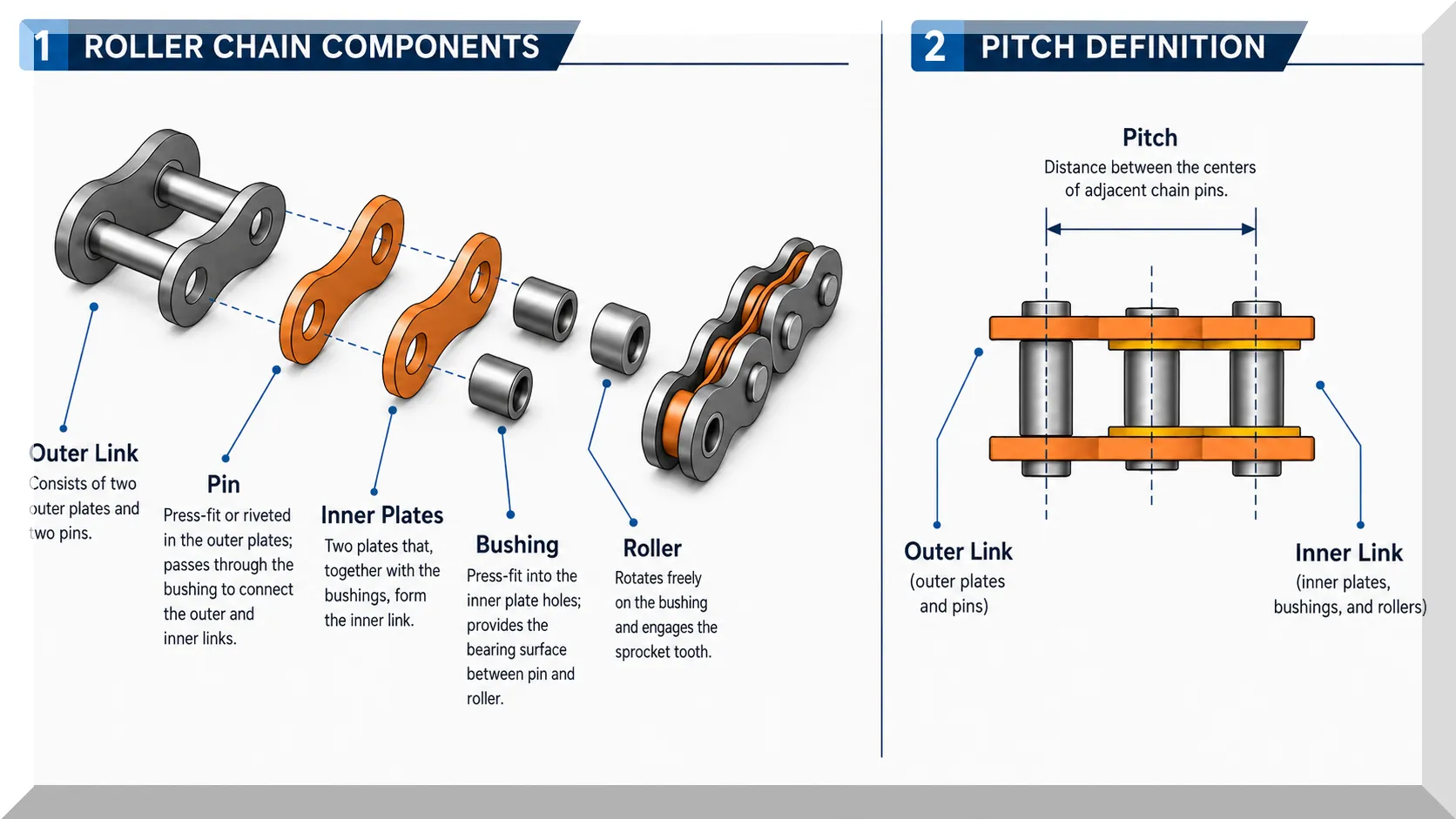
The transmission ratio formula is straightforward and worth understanding precisely because it governs every design decision in a chain drive:
If the driver sprocket has 19 teeth and the driven sprocket has 57 teeth, the transmission ratio is 3:1. The output shaft turns at one-third of the input shaft speed, and the output torque (before transmission losses) is three times the input torque. This relationship holds exactly, at all loads, with no slippage — which is what makes chain and sprocket the correct choice for any application where precise speed ratio or synchronisation is required.
| Drive Type | Typical Efficiency | Slip Under Load | Shock Load Capacity | Centre Distance Flexibility | Lubrication Required |
|---|---|---|---|---|---|
| Roller Chain Drive | 97–98.5% | Zero (positive engagement) | Excellent | High — adjustable | Yes — periodic to continuous |
| V-Belt Drive | 93–96% | 1–3% at rated load | Moderate (belt absorbs some shock) | Moderate — fixed | No |
| Synchronous Belt | 97–98% | Zero (toothed engagement) | Poor (belt can skip or break) | Low — fixed | No |
| Gear Drive | 96–99% | Zero | Good | Very low — fixed centre distance | Yes — continuous |
How the Chain Engages the Sprocket — The Mechanics in Detail
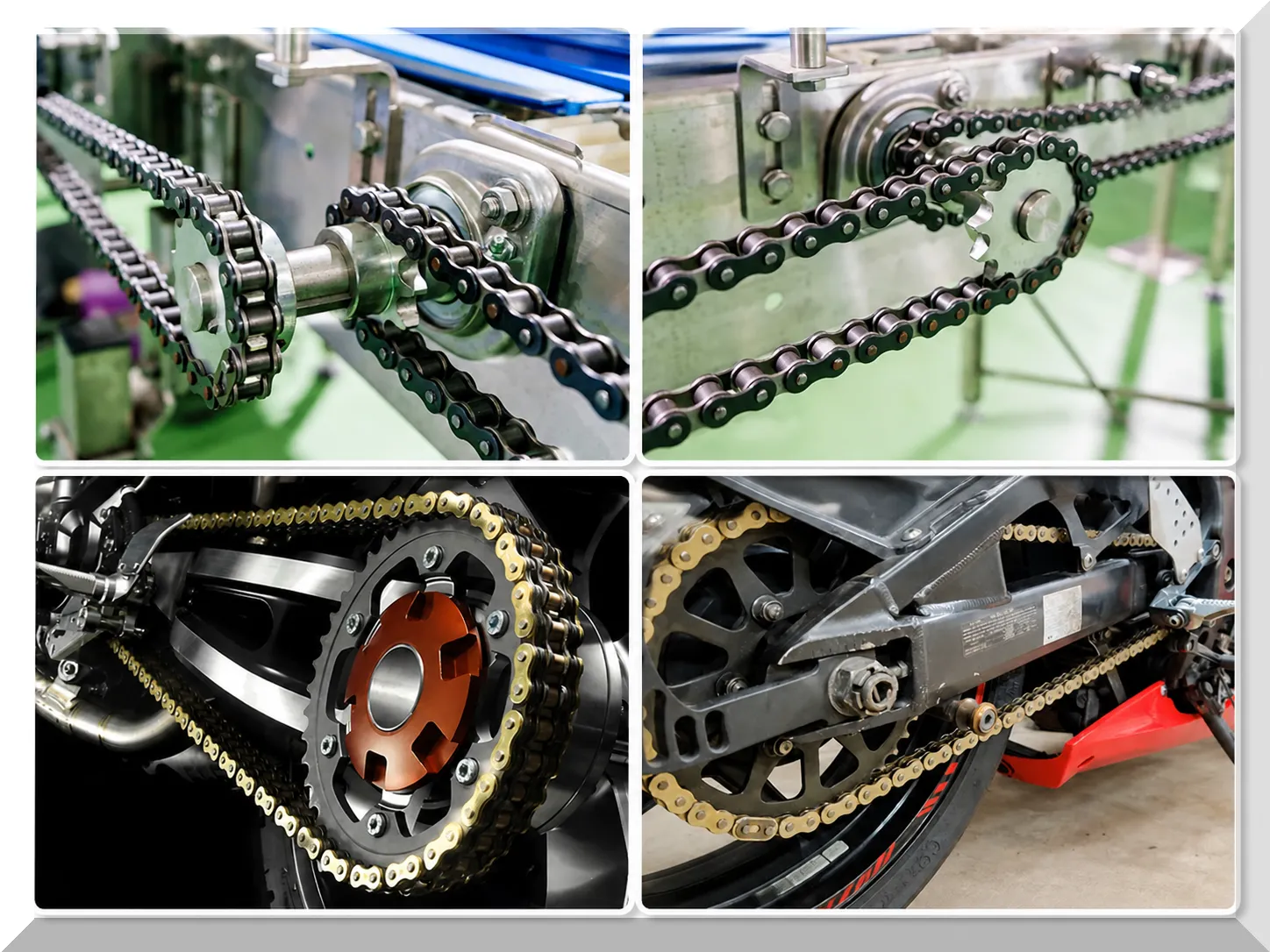
The engagement process is less simple than it appears. As the chain approaches the driver sprocket, each incoming roller does not slide smoothly into a tooth root — it arrives at an angle and drops into the seating curve with a small impact velocity. This impact is what generates the characteristic noise of a chain drive and is responsible for a portion of the fatigue loading on the roller and the sprocket tooth.
The ANSI B29.1 tooth form is designed to minimise this impact by allowing the roller to make initial contact on the tooth face slightly above the seating curve, then roll down into the root as the chain wrap angle increases. This rolling-into-seat geometry spreads the engagement load over the first 15–20 degrees of sprocket rotation, reducing the peak impact force compared with a chain that simply drops directly into the root.
The polygon effect is the most important dynamic characteristic that buyers and specifiers consistently misunderstand. Because the chain is made of rigid links of discrete pitch length, the tight-side of the chain does not travel in a straight line — it moves in a series of small chords as each link successively engages the sprocket. This produces a sinusoidal velocity variation in the driven shaft even when the driver shaft rotates at perfectly constant speed. The amplitude of this velocity variation depends on the sprocket tooth count:
| Driver Sprocket Teeth | Max Velocity Variation (%) | Practical Effect |
|---|---|---|
| 9 teeth | ±6.1% | Audible chatter, significant vibration in driven machine |
| 11 teeth | ±4.1% | Noticeable vibration, reduced bearing life on driven shaft |
| 17 teeth | ±1.7% | Minimal — ANSI recommended minimum for smooth operation |
| 21 teeth | ±1.1% | Effectively smooth for most industrial applications |
| 25 teeth | ±0.79% | Negligible — suitable for precision indexing and measurement drives |
Chain Drive Configuration Options: Single Strand, Multiple Strand, and Double Pitch
When a single-strand drive chain reaches the upper limit of its published power rating for the given speed, the two options are to increase the chain pitch (moving to the next larger ANSI size) or to add a second strand (duplex chain). These are not equivalent choices — they have different effects on the drive system.
Increasing the pitch increases the chain’s minimum break load and fatigue rating, but it also increases the polygon effect for a given tooth count, and it requires replacing the sprockets. Moving from #60 to #80 chain on a 19-tooth driver sprocket increases the velocity variation from 1.74% to 1.74% (unchanged, because the tooth count drives this, not the pitch) — but the larger pitch chain requires larger sprockets to maintain the same speed ratio, which increases the outer diameter of the drive system and may create clearance problems.
Adding a second strand (simplex to duplex) doubles the rated working load without changing the pitch or the sprocket outer diameter. The sprockets must be replaced with duplex versions (same pitch circle, double tooth width), but the shaft centres remain the same and the installation envelope does not change. For drives where increasing the sprocket diameter is not feasible — constrained by frame geometry or guard clearances — the duplex upgrade is typically the better option.
Double-pitch chain is a different concept from duplex chain and is frequently confused with it. Double-pitch chain has the same roller diameter and inner link width as its equivalent standard pitch chain — it is the link spacing that is doubled. ANSI #2060 (double-pitch equivalent of #60) has a pitch of 38.10 mm instead of 19.05 mm, but uses the same 11.91 mm roller as standard #60. Double-pitch chain is used exclusively for slow conveyor drives — it weighs less and costs less per metre than standard chain for the same roller diameter, but it cannot be used at speeds above about 100 metres per minute without excessive polygon effect and noise. Double-pitch chain on a high-speed drive is a maintenance problem, not a cost saving.
Where Sprocket and Chain Systems Are the Right Choice
Agricultural machinery. Chain drives dominate in combine harvesters, rice threshers, and seeding machinery for a combination of reasons: they tolerate the shock loading from irregular feeding of crop material, they maintain exact timing between feeder, threshing, and separation systems, and they operate reliably in dusty, wet, and abrasive conditions that would rapidly deteriorate belt surfaces. Roller chain in ANSI and ISO pitch sizes forms the backbone of most Korean agricultural machinery drive systems, from #40 feeder chains to large-pitch #100 elevator drives.
Industrial conveyors and material handling. Conveyor chain drives must maintain constant chain velocity while handling variable loads — a requirement that chain handles better than belt due to the zero-slip characteristic. Engineer class chains in drag conveyors, bucket elevators, and scraper conveyors carry loads that would exceed any standard roller chain’s rated break load, using purpose-designed barrel diameters and plate thicknesses that provide 5:1 safety factors at rated operating loads.
Motorcycle and powersport drives. The motorcycle chain and sprocket system is one of the most performance-critical and maintenance-sensitive chain drive applications. The chain must transmit peak engine torque under dynamic acceleration loads while weighing as little as possible and withstanding road contamination. 520, 530, and 630 pitch designations indicate inner width — not pitch — in motorcycle chain nomenclature (actual pitch for all three is 5/8 inch, 15.875 mm). The correct interpretation of these numbers prevents incorrect replacement orders.
Automation and packaging lines. Servo-driven chain indexing systems require sprockets with minimum tooth counts of 21 or above to reduce polygon-effect velocity ripple below the servo controller’s feedback tolerance. Standard bore and finished-bore sprockets in aluminum or carbon steel provide the combination of light rotational inertia and dimensional precision that servo drive systems need.
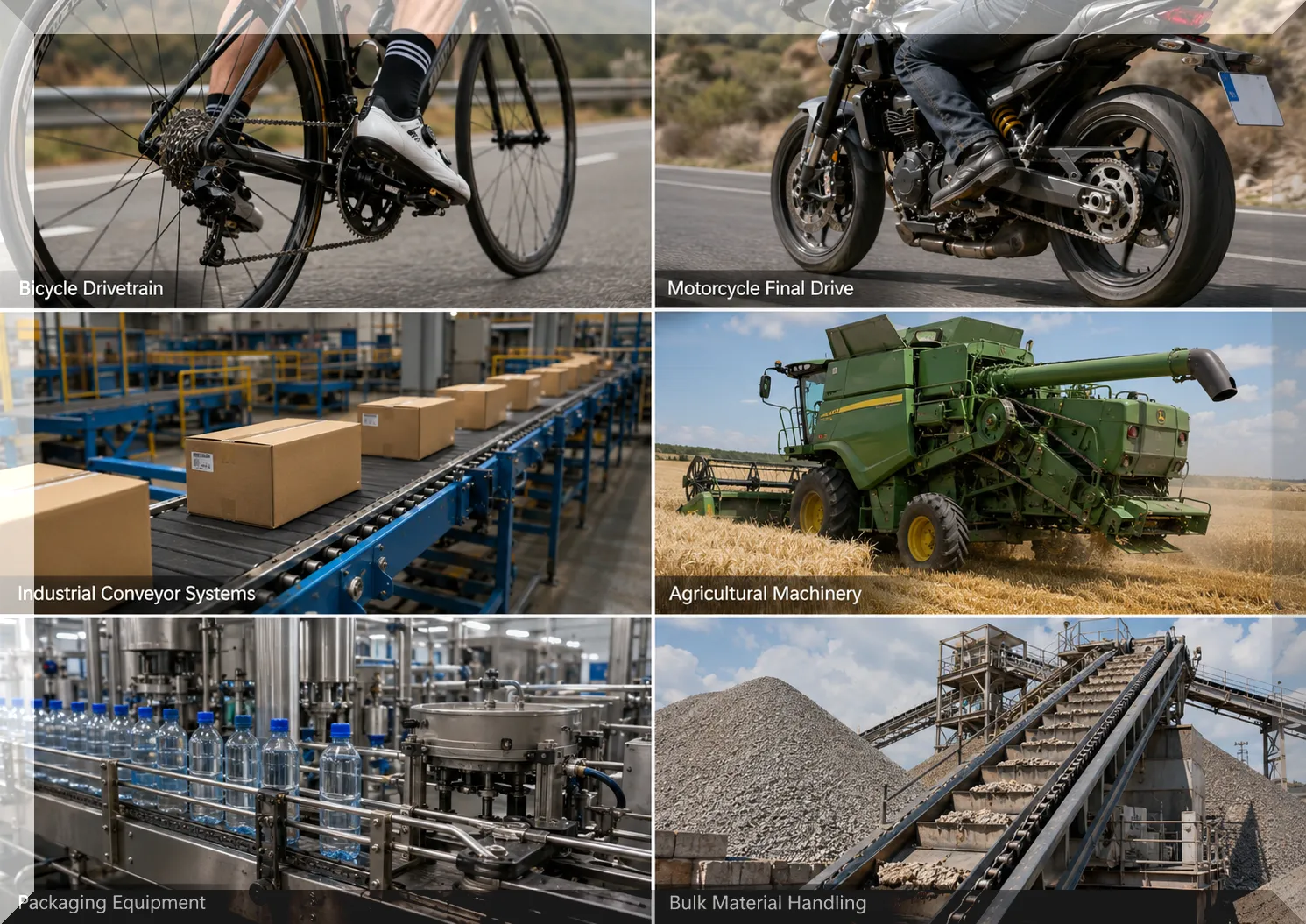
Chain and sprocket systems in agricultural applications — where positive engagement, shock tolerance, and reliable timing under variable loads are all required simultaneously.
Selecting a Chain and Sprocket Drive: The Four-Step Method
ANSI B29.1 provides a graphical power rating chart that maps any combination of design power and small sprocket speed to a recommended chain pitch. The process works as follows:
- Determine the design power. Start with the motor nameplate power and multiply by the service factor for your load type: 1.0 for uniform load (compressors, centrifugal pumps), 1.3 for moderate shock (conveyors with non-uniform feed, mixers), and 1.7 for heavy shock (presses, bucket elevators, rock crushers). The design power is always higher than the motor nameplate power — this is intentional.
- Select the chain pitch from the rating chart. Using the design power and the small sprocket speed (RPM of the faster shaft), locate the intersection on the ANSI power rating chart. The region this point falls in indicates the recommended chain pitch. If the point falls near a boundary between two pitch zones, select the smaller pitch with multiple strands in preference to the larger pitch with a single strand.
- Choose sprocket tooth counts. The small sprocket should have a minimum of 17 teeth. The tooth count ratio sets the speed ratio. For the smoothest operation, use odd tooth counts on one sprocket so that each tooth contacts a different roller on successive revolutions, distributing wear more evenly across the sprocket teeth.
- Set the centre distance and chain length. The recommended centre distance is 30–50 times the chain pitch for most standard drives, with a minimum of 1.5 times the large sprocket pitch diameter. Chain length in links is calculated from the centre distance, the two sprocket pitch diameters, and the chain pitch. The result should be rounded to an even number of links to allow a standard connecting link — half links (offset links) are weaker than full links and should be avoided in high-load applications.
Frequently Asked Questions
Need Chain and Sprocket Components for Your Drive System?
Whether you are sizing a new drive from scratch or replacing worn components in an existing system, getting the chain series, sprocket tooth geometry, and bore specification confirmed before ordering prevents the failures that come from dimensionally close but specification-incorrect parts.
Editor: Cxm