A cement plant in Gyeonggi Province, Korea ran into a recurring chain failure on its clinker drag conveyor in late 2023. The plant had been ordering standard ANSI #80 roller chain as a replacement, and the drives were failing at pin shear within 180–250 hours. The specification looked right on paper — the pitch matched, the chain fit the sprockets, and the catalogue breaking load appeared sufficient for the calculated drive load. What the purchasing team had missed was that the original chain was an 81XH engineer class chain, not ANSI #80. The “H” is not a grading suffix here — it is a completely different chain series, with a barrel diameter nearly double that of standard roller chain and a working load several times higher. The cost of each chain failure, including labour and downtime, exceeded the price of the correct chain by a factor of eight.
This kind of error is specific to conveyor chain applications because conveyor drives span a broader range of load conditions, chain types, and engineering standards than any other category of chain drive. Understanding how the various conveyor chain types differ — structurally, dimensionally, and in terms of the applications they are designed for — is the foundation of correct selection.
Why Conveyor Chain Is Not Simply a Longer Roller Chain
Standard roller chain — the kind used in motorcycle drives, gearbox timing drives, and general power transmission — is designed primarily to transmit rotational torque between two shafts. Its geometry optimises the pin-bushing contact area and roller engagement mechanics for that purpose. Conveyor chain has different priorities: it must carry a distributed load along its entire length, withstand continuous contact with abrasive or corrosive materials, and operate reliably for years with minimal access for maintenance.
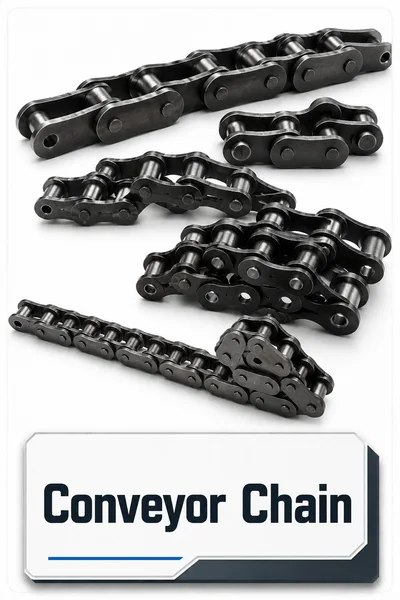
Three structural characteristics set conveyor chain apart from standard drive chain:
In engineer class conveyor chains, the barrel (roller bushing) outer diameter is disproportionately large relative to the pitch. This increases the bearing area against the sprocket tooth root and distributes the contact stress over a wider surface — critical when drag loads produce sustained high side-loading on the chain.
Most conveyor chains are designed to accept welded or bolted attachments — extended link plates (K1, K2), bent attachments (A1, A2), or pusher bars — that carry the conveyed material. The attachment geometry must be specified along with the chain series, not treated as an afterthought.
Food-grade conveyor systems require stainless steel outer plates with carbon steel internals, or all-stainless in wash-down zones. Cement and mining applications use heat-treated carbon steel with hardened barrel surfaces. The correct material depends on what the chain contacts, not on the power transmission requirement.
Six Conveyor Chain Types: Structure, Pitch Range and Correct Use
Each conveyor chain type is designed for a specific load character, operating environment, and material-handling geometry. Selecting the wrong type does not simply reduce service life — it can produce systemic failures that damage the entire conveyor structure, not just the chain.
| Chain Type | Typical Pitch Range | Structural Feature | Primary Application | Key Limitation |
|---|---|---|---|---|
| Double-Pitch Roller Chain | 38.10–76.20 mm | Standard roller, 2× pitch | Light conveyor, slow overhead, parts accumulation | Max ~60 m/min; polygon effect above this speed |
| Flat-Top Chain (843/845/1843) | 25.40–50.80 mm | Flat plate upper surface; no rollers | Bottling, canning, automotive assembly sliding conveyor | High friction on bottom surface; requires lubricated guide rail |
| Engineer Class Chain (55/67/81X/88K) | 63.5–228.6 mm | Large barrel, solid bushing, heavy plate | Drag conveyors, scraper conveyors, mining, cement | Cannot substitute across sub-series (94 vs 95 error risk) |
| Bucket Elevator Chain | 76.20–203.2 mm | Welded attachment for bucket bolt flanges | Grain elevators, cement bucket elevators, mining | High shock load at fill point — must specify heavy series |
| Pintle Chain (662/667/88K) | 50.80–101.60 mm | Cast iron or steel, open barrel | Agriculture, wood chip conveyors, paper mill waste | Cast iron brittle under shock; steel type preferred for impact loads |
| Leaf / Hoist Chain (AL/BL Series) | 12.70–50.80 mm | No rollers; pure tensile load | Forklift mast, crane hoist, vertical lift | Not for horizontal conveyors; lateral loading not designed for |
How Double-Pitch Chain and Engineer Class Chain Carry Load Differently

Double-pitch transmission chain — note the extended link pitch with standard roller diameter
Double-pitch conveyor chain carries load in the same way as standard roller chain — through tensile force in the link plates and rolling contact between the roller and sprocket tooth root. The doubled pitch simply reduces the number of links per metre of chain, lowering weight and chain cost. What it does not do is increase the load capacity proportionally — the link plates are the same cross-section as the equivalent standard pitch chain, so the break load is essentially the same as the standard pitch version.
Engineer class chain works on a fundamentally different load-carrying principle. The barrel (the combined bushing and roller assembly in engineer class) has a much larger outer diameter than would be implied by the pitch alone. In a 67-series chain with a 63.5 mm pitch, the barrel diameter is 44.45 mm — a ratio of 0.70 barrel-to-pitch, compared with the 0.60 typical of standard ANSI roller chain. This larger barrel dramatically increases the projected bearing area between chain and sprocket tooth, allowing the chain to carry much higher drag loads per unit of chain weight. The trade-off is that engineer class sprockets must be made to match the specific barrel diameter of the chain series — and the series must be confirmed before any order is placed.
The load calculation for conveyor chains also differs from drive chain sizing. A drive chain is sized from the transmitted power and shaft speed. A drag conveyor chain is sized from the total drag load — the sum of material weight on the chain multiplied by the chain-to-trough coefficient of friction, plus the weight of the chain itself multiplied by the same coefficient. For a 30-metre horizontal scraper conveyor with 2,000 kg/hr of bulk density material and a chain-to-steel trough friction coefficient of 0.35, the drag load can easily reach 8–12 kN on the loaded side. The chain working load limit at the required service factor (typically 8:1 for shock-loaded conveyors per industry practice) determines the minimum chain specification — not the installed motor power.
How to Select Conveyor Chain Pitch: A Practical Method
There is no universally applicable formula for selecting conveyor chain pitch — the correct approach depends on whether the application is a drag conveyor, a flight conveyor, a bucket elevator, or a flat-top sliding system. The following method applies to the most common case: the horizontal or mildly inclined drag or scraper conveyor.
- Calculate total chain pull (Fc) in kN. For a horizontal drag conveyor: Fc = (Wm + Wc) × μ × g / 1000, where Wm is the mass of material on the conveyor (kg), Wc is the chain and flight mass (kg), μ is the chain-to-trough friction coefficient (0.25–0.40 for steel on steel), and g = 9.81 m/s². For inclined conveyors, add the gravitational component: Wm × sin(θ) × g / 1000, where θ is the incline angle.
- Apply the service factor. For uniform, continuous loads: multiply Fc by 5.0 (minimum safety factor for working load). For moderate shock (bulk material with occasional lumps): multiply by 8.0. For heavy shock (rock, ore, large lump material): multiply by 10.0 or higher. This gives the required minimum break load for the chain.
- Select the chain type and pitch from break load tables. Using the required break load, identify the engineer class or heavy-duty conveyor chain series that meets or exceeds this value. Confirm that the selected chain’s barrel diameter is compatible with available sprockets for the required centre distance and shaft configuration.
- Check chain speed against the maximum for the selected type. Double-pitch conveyor chain: maximum practical speed is approximately 60 m/min. Standard roller chain on a conveyor application: 50–150 m/min depending on pitch. Engineer class: generally below 30 m/min — these chains are designed for high load at low speed, not for high-speed conveying.
Conveyor Chain in Specific Industries: What Actually Gets Specified
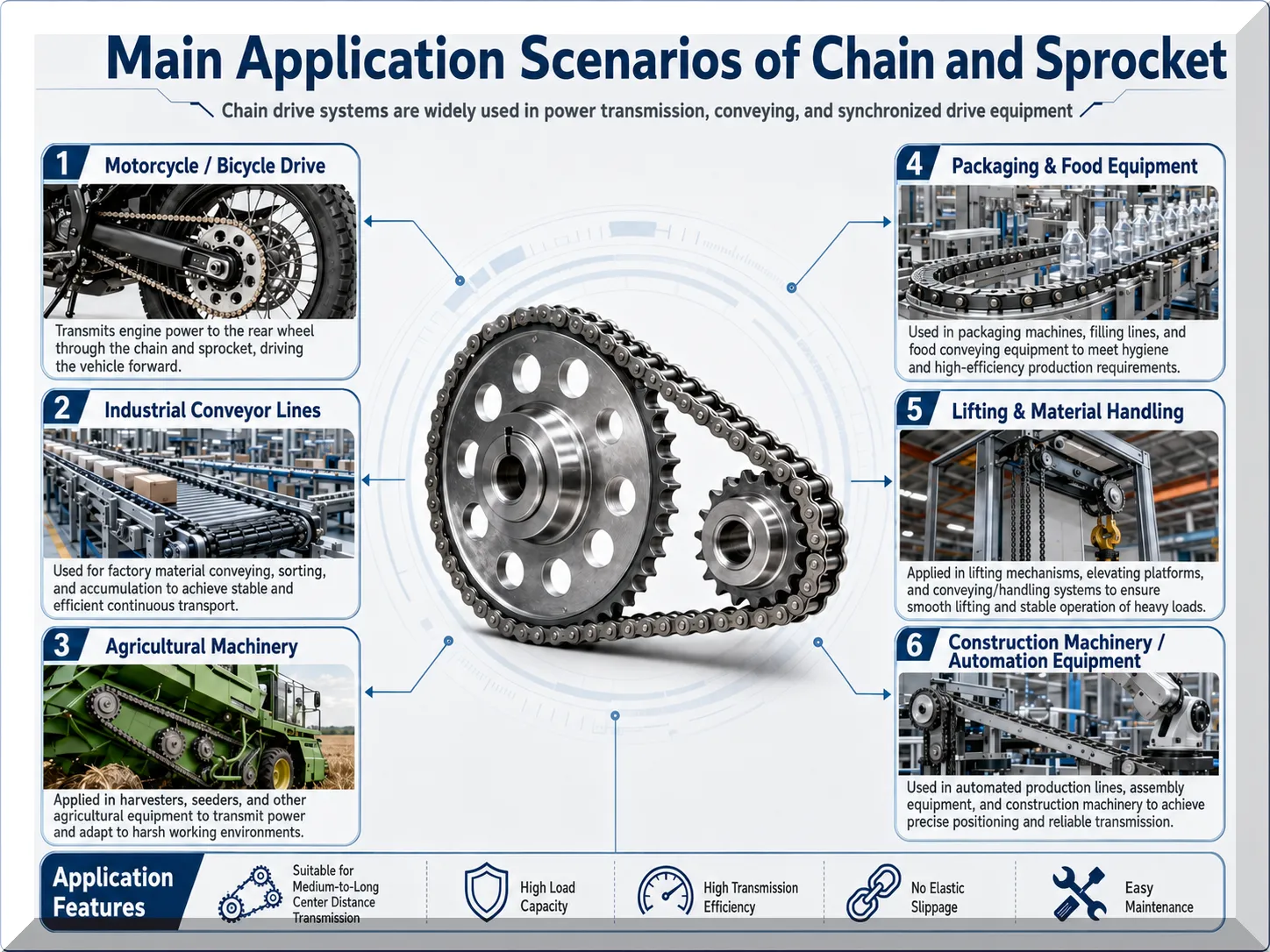
Industrial conveyor systems demand chain selections matched to material weight, abrasion level, and shock character — not simply to installed motor power.
Cement and mineral processing. Clinker drag conveyors, raw mill feed conveyors, and kiln inlet conveyors all operate in extremely abrasive conditions at elevated temperatures. The standard specification here is 81XH or 88K engineer class conveyor chain with heat-treated barrels (typically 55–60 HRC on the barrel surface). The critical failure mode in cement environments is barrel abrasion from dust particles entering the barrel-sprocket contact zone — not chain fatigue. Sealed engineer class chains, where available, dramatically extend service life in cement applications by excluding dust from the barrel-plate interface.
Grain and agricultural elevators. Bucket elevator chains in grain handling use double-pitch or heavy roller chain with welded bucket attachment plates at regular intervals. The pitch spacing between bucket attachment links must be an exact multiple of the chain pitch to maintain bucket alignment on the head and boot sprockets. For Korean rice processing facilities, #2060 and #2080 double-pitch chain with K1 attachments is the standard configuration for vertical paddy elevator legs operating at 45–80 m/min.
Food and beverage production. Flat-top chain conveyors for bottles, cans, and packaging are among the most technically demanding conveyor applications — not for load reasons, but for hygiene and dimensional precision. The flat top surface must be held to tight flatness tolerances so that containers do not tip during transfer between conveyors. Stainless flat-top sprockets with UHMW guide rail strips are the standard food-zone specification, eliminating both corrosion and lubricant contamination risks simultaneously.
Automotive assembly. Overhead power-and-free conveyors in automobile assembly plants use specially profiled trolley chain with encoded carrier spacing to maintain programmed assembly time windows. The chain in these systems is typically 4-inch or 6-inch pitch drop-forged chain — a category that is entirely distinct from both roller chain and engineer class chain, using forged steel links with solid pins rather than the press-fit plate-and-pin construction of standard roller chain.
Waste and recycling facilities. Reciprocating grate and moving floor conveyors in waste-to-energy plants and recycling centres require chain with very high resistance to side loading from bulky, irregularly shaped waste material. Pintle chain (cast or malleable iron) with welded flight bars is the conventional solution, though steel pintle chain is increasingly preferred over cast iron because the steel variant absorbs shock loads elastically rather than fracturing under impact from hard objects in the waste stream.
Material and Surface Treatment Options for Conveyor Chain
| Material / Treatment | Corrosion Performance | Wear Resistance | Best Suited Environment | Relative Cost |
|---|---|---|---|---|
| Carbon steel, black oxide | Low | Good (with lubrication) | Dry indoor; mineral handling with lubrication | Baseline |
| Nickel-plated carbon steel | Moderate | Good | Mildly corrosive; general food-adjacent handling | +25–40% |
| Stainless 304, mixed internals | Good | Moderate (softer tooth face) | Food processing, mild acid wash zones | +80–120% |
| Stainless 316L, all external | Excellent | Moderate | Seafood, chemical, chlorinated washdown | +140–180% |
| Case-hardened barrel, carbon plate | Low–Moderate | Excellent | Cement, mining, abrasive bulk handling | +30–60% |
Measuring Conveyor Chain Wear and Planning Replacement
Conveyor chains are replaced at elongation limits similar to drive chains — 2% for most light conveyor applications, 1.5% for precision pitch-critical applications like flat-top conveyors where product tipping is a risk at higher elongation. The measurement method is identical: count 12–20 links on the tight side, measure pin-to-pin across the span, compare against the nominal value.
The additional maintenance check specific to engineer class drag conveyor chain is barrel wear. As the barrel outer surface wears from contact with abrasive material, the effective chain height reduces and the chain begins to sit lower in the trough than designed. When barrel wear reduces the original barrel diameter by more than 15%, the chain’s ability to clear the trough floor diminishes and flight bar scraping inefficiency increases. This check requires a calliper measurement of several barrel diameters along the chain, compared against the nominal value for the series.

Engineer class chain — the large barrel diameter is visible; barrel wear monitoring is mandatory in abrasive environments.
One common planning error in conveyor chain replacement: replacing the chain without inspecting the sprocket tooth geometry. A worn conveyor chain running on a correctly profiled sprocket will wear the sprocket tooth root to match the elongated chain pitch. When the new chain is installed, its correctly-spaced rollers do not match the worn sprocket root geometry — they contact the tooth at a point higher on the profile, increasing the contact stress and accelerating early elongation in the new chain. If the conveyor’s annual chain cost is significant, replacing sprockets simultaneously with the chain is always the correct economic decision.
Frequently Asked Questions
Need Conveyor Chain Specified for Your Application?
Providing the chain series, attachment type, barrel diameter, and operating environment before ordering ensures the correct specification — preventing the kind of series substitution errors that account for most conveyor chain premature failures. Our engineers confirm compatibility before any order is committed.
Editor: Cxm