A mining equipment OEM in Gyeongbuk ordered what appeared to be an adequate drive chain for a new transfer conveyor serving an underground ore crusher. The specified chain — ANSI #120 single strand — carried a catalogue breaking load of 127 kN, and the calculated steady-state drive load was 14 kN, giving a theoretical safety factor of 9:1. The drive failed at pin fracture after 340 hours. Post-failure analysis revealed that the crusher was feeding material in discrete batches, producing shock loads estimated at 85–110 kN peak — a peak-to-mean ratio of approximately 7:1. The 9:1 safety factor applied to the mean load was irrelevant; it was the 1.4:1 safety factor at peak shock load that determined the failure timeline. This is the central problem in specifying heavy duty chain and sprocket systems: the service factor must be matched to the peak load character, not the average power demand.
What “Heavy Duty” Means in Chain Drive Engineering — and What It Does Not
The term “heavy duty” is used for two quite different product categories in the chain industry, and confusing them produces expensive specification errors. The first category is heavy series roller chain — designated with the H suffix in ANSI numbering (e.g., #80H, #100H, #120H). Heavy series chains have the same pitch as their standard counterparts but use thicker link plates and larger pin diameters, increasing the minimum break load by approximately 20–25% at equivalent pitch. The sprocket pitch circle is identical to the standard series — the same sprockets accept both standard and H-series chain.
- Same pitch as standard ANSI chain
- Thicker plates: approx. +20% plate cross-section
- Larger pin diameter: +10–15%
- Break load: +20–25% vs standard equivalent
- Compatible with standard pitch sprockets
- Best for: high-load drives with moderate shock
- Fundamentally different pitch-to-barrel-diameter ratio
- Designed for drag loads, not purely tensile
- Barrel (bushing) diameter proportionally much larger
- Requires dedicated sprockets — not interchangeable
- Series-specific: 55/67/81X/88K/94/95/132
- Best for: conveyor drag loads, mining, cement
The second category — engineer class chain — is structurally different from roller chain and is not selected by breaking load comparisons to standard ANSI chain. Its selection is governed by barrel bearing area, drag load capacity, and the specific series compatibility with available sprockets. Both categories are often called “heavy duty” commercially, but they are not interchangeable and are not used for the same applications.
Service Factors for Heavy Duty Chain Drives: Getting This Right Is Everything
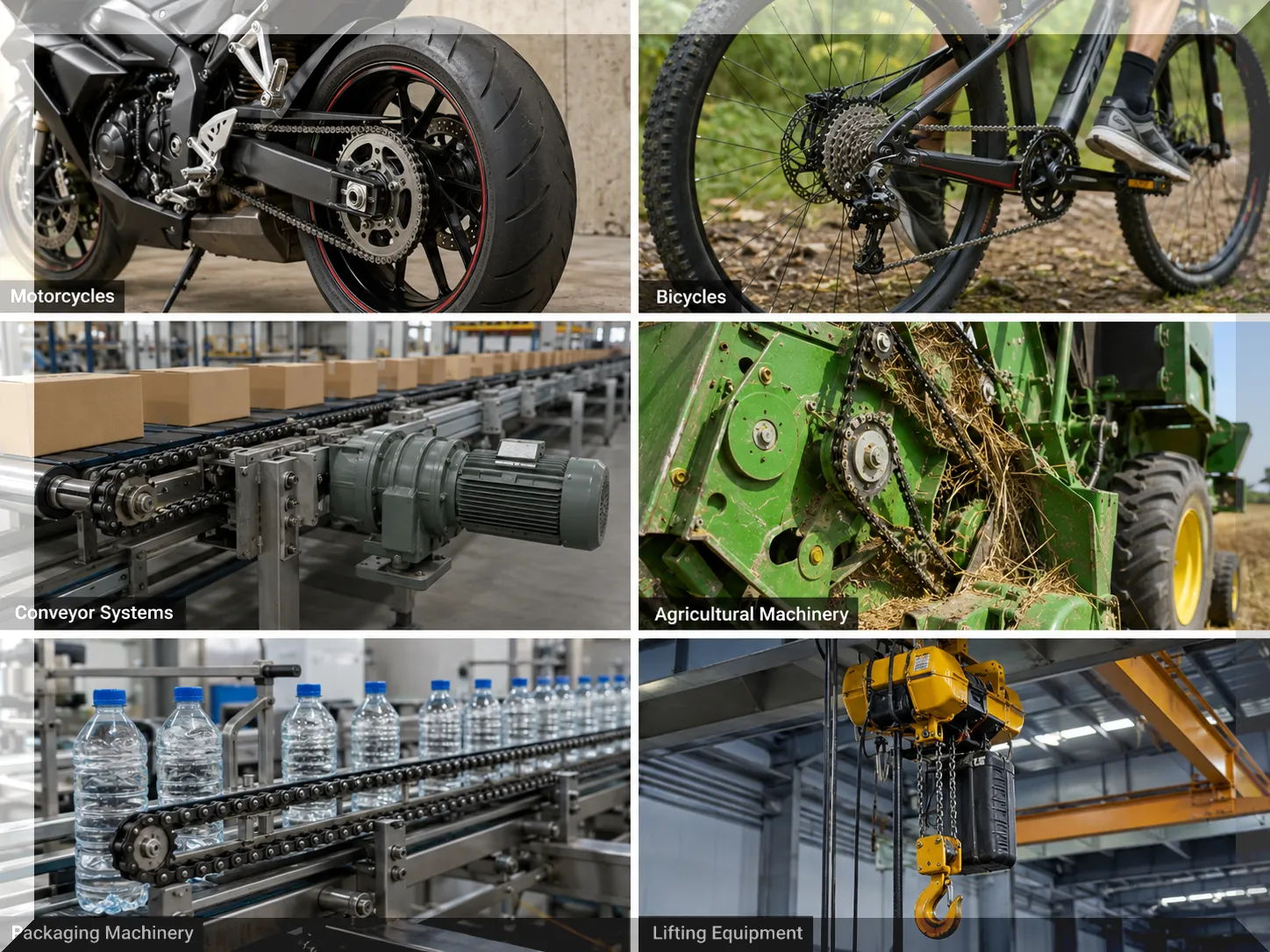
The ANSI B29.1 service factor methodology uses a single multiplier applied to the steady-state design power to account for load variation. This approach is adequate for drives with relatively stable loads — centrifugal pumps, compressors with smooth delivery, fans. For applications with true shock loading, it is systematically inadequate because the service factor multiplies the mean load, not the peak load. The shock energy is contained in brief high-intensity pulses that the mean-load service factor cannot capture.
| Application Type | ANSI B29.1 Service Factor | Recommended Heavy Duty Factor | Reason for Increase |
|---|---|---|---|
| Ore crushers, rock breakers | 1.7 | 3.0–4.0 | Peak:mean ratio up to 8:1 on hard material impact |
| Steel mill roll drives | 1.5 | 2.5–3.5 | Entry shock when billet contacts rolls |
| Bucket elevators (coarse material) | 1.5 | 2.0–3.0 | Fill shock at boot; impact from large lumps |
| Timber saws, log debarkers | 1.7 | 2.5–3.5 | Node/knot impact produces instantaneous load spikes |
| Presses, forging machines | 1.5–2.0 | 3.0–5.0 | Die contact produces very high instantaneous torque |
| Heavy conveyors, uniform load | 1.3–1.5 | 1.8–2.5 | Start-up inertia and occasional jam clearing |
Specifying the Sprocket for Heavy Duty Drives
The sprocket is often the overlooked component in heavy duty drive specification — most engineering effort goes into chain selection while the sprocket is treated as a standard catalogue item. For high-shock drives, this approach produces sprockets that fail before the chain does.
The two sprocket specifications that matter most in heavy duty applications are tooth hardness and hub configuration. Standard commercial sprockets from most catalogues are through-hardened to HRC 28–32. For mining and construction applications with hard abrasive material contacting the sprocket teeth (through the chain), this hardness is insufficient — the tooth tips wear and develop the hooked profile characteristic of severe tooth wear within 1,000–2,000 hours in abrasive service. Case-hardened sprockets with a 55–60 HRC tooth surface and a 1.0–1.5 mm case depth outlast standard sprockets by a factor of 3 to 5 in the same abrasive environment.
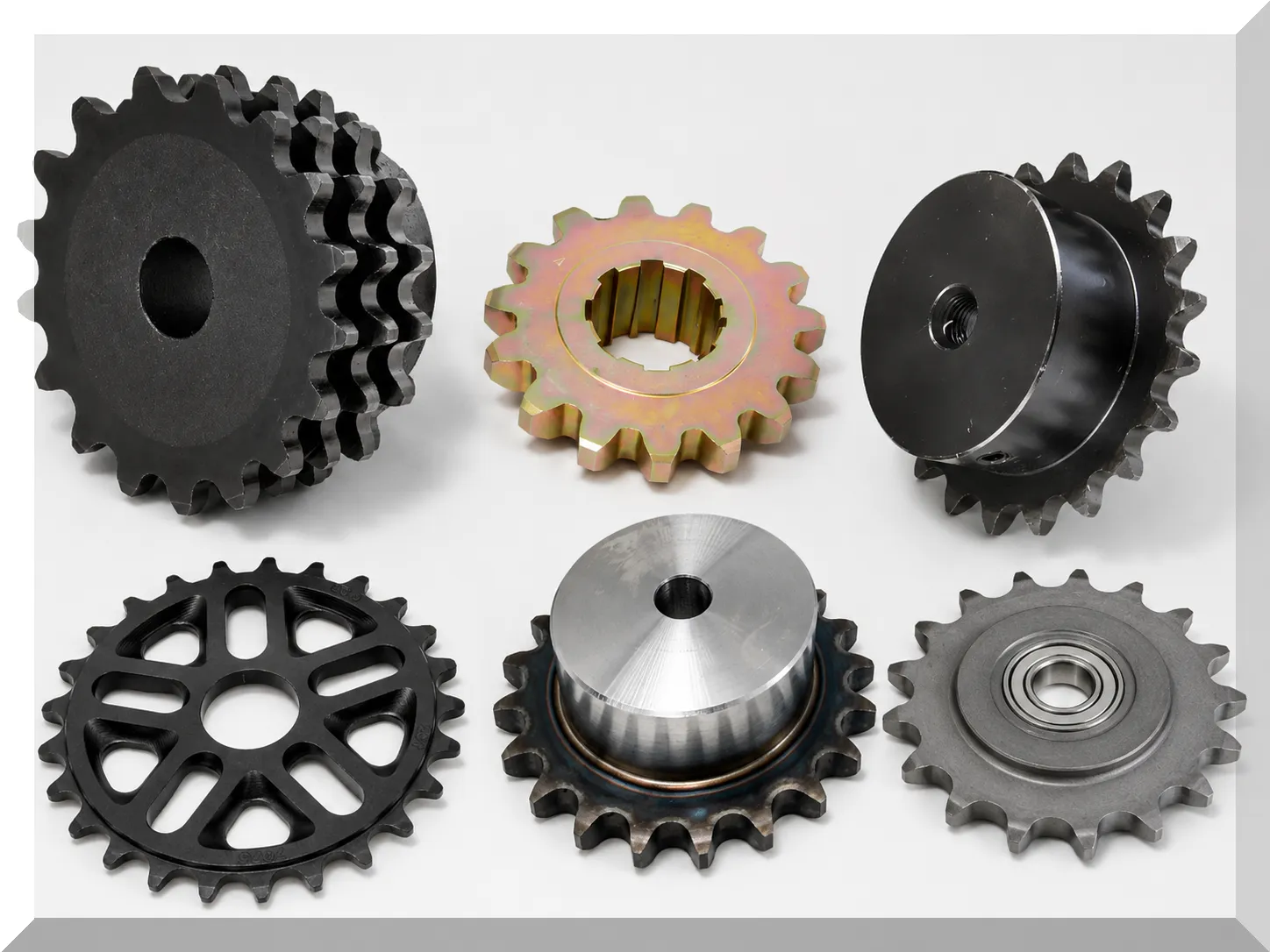
Heavy duty sprocket — hub configuration and tooth case depth are as critical as tooth count in high-load applications.
Hub configuration in heavy duty drives deserves specific attention. The C-Hub (hub projecting symmetrically from both faces) is preferred for heavy duty applications because it provides the greatest bearing area on the shaft, distributing the overhung chain load over a longer hub length and reducing the bending moment on the shaft key. A B-Hub sprocket of the same bore size has a shorter key engagement length and a higher shaft bending stress at the hub face. On drives where the chain pull exceeds 30 kN, specifying C-Hub or a taper lock mounting (which distributes the clamping force over a longer shaft engagement length) is engineering best practice rather than an optional upgrade.
For taper lock and QD-bushed heavy duty sprockets, the bushing installation torque is specified in the manufacturer’s data sheet and must be followed precisely. Under-torqued bushings in high-shock drives can slip on the shaft under peak loads, producing fretting wear between the bushing bore and the shaft that rapidly progresses to shaft damage. The installation torque for the 3535 bushing on an ANSI #120 drive, for example, is typically 270–310 Nm — a value that requires a torque wrench to achieve reliably and cannot be replicated by feel alone.
Heavy Series Chain Performance Data: Key Dimensions and Load Ratings
| Chain No. | Pitch (mm) | Plate Thickness (mm) | Pin Dia. (mm) | Min Break Load (kN) | Std Break Load (kN) | Increase vs Standard |
|---|---|---|---|---|---|---|
| #60H | 19.05 | 3.25 | 12.19 | 40.0 | 31.8 | +26% |
| #80H | 25.40 | 4.00 | 15.88 | 68.0 | 56.7 | +20% |
| #100H | 31.75 | 4.80 | 19.85 | 109.0 | 88.5 | +23% |
| #120H | 38.10 | 5.60 | 23.01 | 159.0 | 127.0 | +25% |
| #140H | 44.45 | 6.40 | 27.94 | 214.0 | 172.4 | +24% |
| #160H | 50.80 | 7.10 | 31.75 | 280.0 | 226.8 | +23% |
Lubrication in Heavy Duty Chain Drives: The Factor That Overrides Specification
The service life difference between correctly lubricated and poorly lubricated heavy duty chain is not incremental — it is an order-of-magnitude difference. A correctly specified #120H chain under continuous oil bath lubrication in a covered housing can deliver 12,000–18,000 hours before reaching 3% elongation. The same chain in an open, unlubricated environment on a mining conveyor may fail at 800–1,200 hours regardless of how conservatively it was selected. Lubrication for heavy duty chain drives is not a maintenance consideration — it is a core design parameter that must be specified before the chain size is finalised.
Periodic brush or squeeze-bottle application to the chain slack side. Suitable only for drives below 150 RPM on the small sprocket. In practice, manual lubrication intervals are often missed — any chain drive dependent on this method in an industrial setting is under-lubricated more often than not.
A reservoir delivers measured oil drops onto the inside of the chain via a metered nozzle. Minimum for all heavy duty drives operating above 100 RPM. The flow rate must be calibrated to the chain speed — too little oil starves the pin-bushing interface; too much oil flings off and contaminates the environment.
The chain passes through an oil sump in the bottom of the drive housing. This is the recommended minimum for all high-load heavy duty drives. The oil level must be maintained at the centre of the lowest link during operation — above this level, oil churning generates heat rather than cooling. Below it, the chain runs partially dry.
An oil pump delivers a continuous stream to the chain, with a filter and cooler in the circuit. This is the correct specification for drives running above 600 RPM, for drives in high ambient temperature environments, or for any drive where access for maintenance is restricted and extended service life is required.
Heavy Duty Chain Drives in Practice: Industry-Specific Configurations
Mining and underground extraction. Armoured face conveyor (AFC) drives, longwall shearer haulage drives, and surface conveyor transfer points all use heavy duty chain operating at high loads and low speeds in environments with continuous abrasive material contact. The chain for underground coal mining drives is typically round-link calibrated chain (a different product category from roller chain) rather than roller or engineer class chain — but the surface transfer conveyors often use heavy series ANSI roller chain with cast iron sprockets in the #120H to #160H range. The critical specification point for mining drives is sealed chain — O-ring or X-ring sealed heavy series roller chain prevents coal dust from entering the pin-bushing clearance and provides lubrication retention over extended service without access.
Steel mill and metals processing. Hot strip mill roller table drives, bloom conveyor drives, and coil transfer systems require chain that tolerates elevated ambient temperature (often 80–150°C at the chain surface from radiated heat) as well as high shock loads from billet impact on roller tables. For these applications, case-hardened heavy duty roller chain with high-temperature lubricant (synthetic PAO or perfluorinated ether-based oil, rated to 200°C) is specified. The chain housing must include a positive cooling system — oil circulation with heat exchanger — because chain life in radiated-heat environments is primarily limited by lubricant oxidation, not by mechanical fatigue.
Construction equipment and cranes. Crane hoist chains, dozer track pitch adjuster drives, and piling rig feed drives all operate under high static loads with infrequent but severe shock during work cycles. For crane hoist applications, leaf chain (AL/BL series) rather than roller chain is the correct specification — it is designed purely for tensile load with no rolling engagement components. For drive chain in construction equipment, heavy series roller chain with a minimum 8:1 working load safety factor and stainless or nickel-plated treatment for outdoor corrosion resistance provides the correct combination of load capacity and environmental protection.
Cement and bulk material handling. Vertical clinker bucket elevators and horizontal kiln inlet conveyors require engineer class chain, as discussed, but the head and drive sprockets for these systems are equally subject to the specification requirements outlined above. The taper lock sprockets for high-load mining and cement drives should be ordered with confirmed tooth hardness certificates and surface hardness test reports, not simply assumed to be case-hardened based on the catalogue description.
Reading Heavy Duty Chain Failures: What the Fracture Surface Tells You
Examining a failed chain sample before ordering the replacement is one of the most valuable diagnostics available in heavy duty drive maintenance. The failure mode determines whether the correct response is to replace like-for-like, upsize the chain, or address a system problem that will destroy the replacement chain at the same interval.
| Failure Observation | Most Likely Cause | Correct Response |
|---|---|---|
| Pin shear fracture, clean break | Single overload event exceeding break load; seizure then shock | Identify and remove the overload source; consider heavy series upgrade |
| Pin fracture with beach marks (fatigue striations) | Cyclic fatigue under shock loads below single break load | Apply higher shock service factor; consider double-strand or H-series |
| Inner plate crack at pin hole | Cyclic tensile fatigue; possibly under-spec plate or excessive RPM | Confirm plate hardness spec; check chain speed vs rated maximum |
| Roller spalling or fracture | Roller over-hardened or impact load from debris on sprocket | Check roller hardness spec; add debris guard upstream of drive |
| Rapid elongation (500–1,000 hrs) | Lubrication deficiency — pin-bushing bore abrasion | Upgrade to continuous drip or oil bath lubrication before replacing chain |
| Side plate impact fracture | Lateral interference — misalignment, debris, or guide clearance failure | Check sprocket alignment (±0.5 mm max for heavy drives); remove debris source |
Frequently Asked Questions
Ready to Specify Your Heavy Duty Chain Drive?
Send your application details — peak load, shock character, lubrication access, and environment — and our engineers will confirm chain series, service factor, sprocket specification, and bushing configuration before any commitment is made.
Editor: Cxm