A procurement engineer at a Vietnamese food processing plant ordered replacement sprockets in mid-2024, specifying them by pitch and tooth count — both correct. What she did not specify was the hub projection dimension. The new sprockets arrived with a Type B hub where the original had a Type C, shifting the sprocket face position by 22 mm relative to the frame. The chain ran at an angle for three weeks before the maintenance team diagnosed the problem. The cost was a prematurely worn chain and a set of sprockets that could not be used. This outcome is preventable by understanding what the hub configuration actually controls and why it matters.
A sprocket has four distinct structural zones — the tooth profile, the disc or rim, the hub, and the bore — and each one is specified independently. The pitch and tooth count get the most attention, but the hub type and bore preparation are where the majority of installation errors and premature failures originate. Working through each zone systematically removes the ambiguity that leads to wrong-part ordering.
The Tooth Profile: Where the Sprocket and Chain Actually Meet

Tooth hardness is the other half of the tooth profile story. Standard commercial-grade sprockets (typically AISI 1045 steel) are through-hardened to approximately HRC 28–32 — adequate for standard loads. Sprockets for high-cycle or high-load applications are cut from carburizing grade steel (AISI 1018 or 8620) and case-hardened to HRC 55–60 on the tooth faces after cutting. The case depth needs to be sufficient to outlast the expected wear depth — typically 0.8–1.5 mm for standard industrial applications. A case depth below 0.5 mm on a heavily loaded sprocket will wear through rapidly and expose the soft core, after which tooth wear accelerates exponentially.
| Tooth Count Range | Heat Treatment Recommendation | Typical Application | Wear Mechanism |
|---|---|---|---|
| 9 – 15T | Case-hardened, 55–60 HRC, 1.0–1.5 mm case depth | High-speed drive sprockets, motorcycle front sprockets | Impact wear at tooth tip and seating curve |
| 16 – 30T | Tooth hardening or through-hardened 28–32 HRC | Standard industrial drives, general conveyor head sprockets | Progressive seating curve wear from roller engagement |
| 31 – 65T | Tooth hardening sufficient; core toughness more critical | Driven sprockets in reduction drives, slow conveyors | Abrasive wear from elongated chain pitch mismatch |
| 66T and above | Normalised or as-cut; through-hardening often impractical at this size | Large-diameter idler sprockets, slow drag conveyors | Tangential wear from near-straight chain engagement |
Hub Configurations: The Six Standard Types and When to Use Each
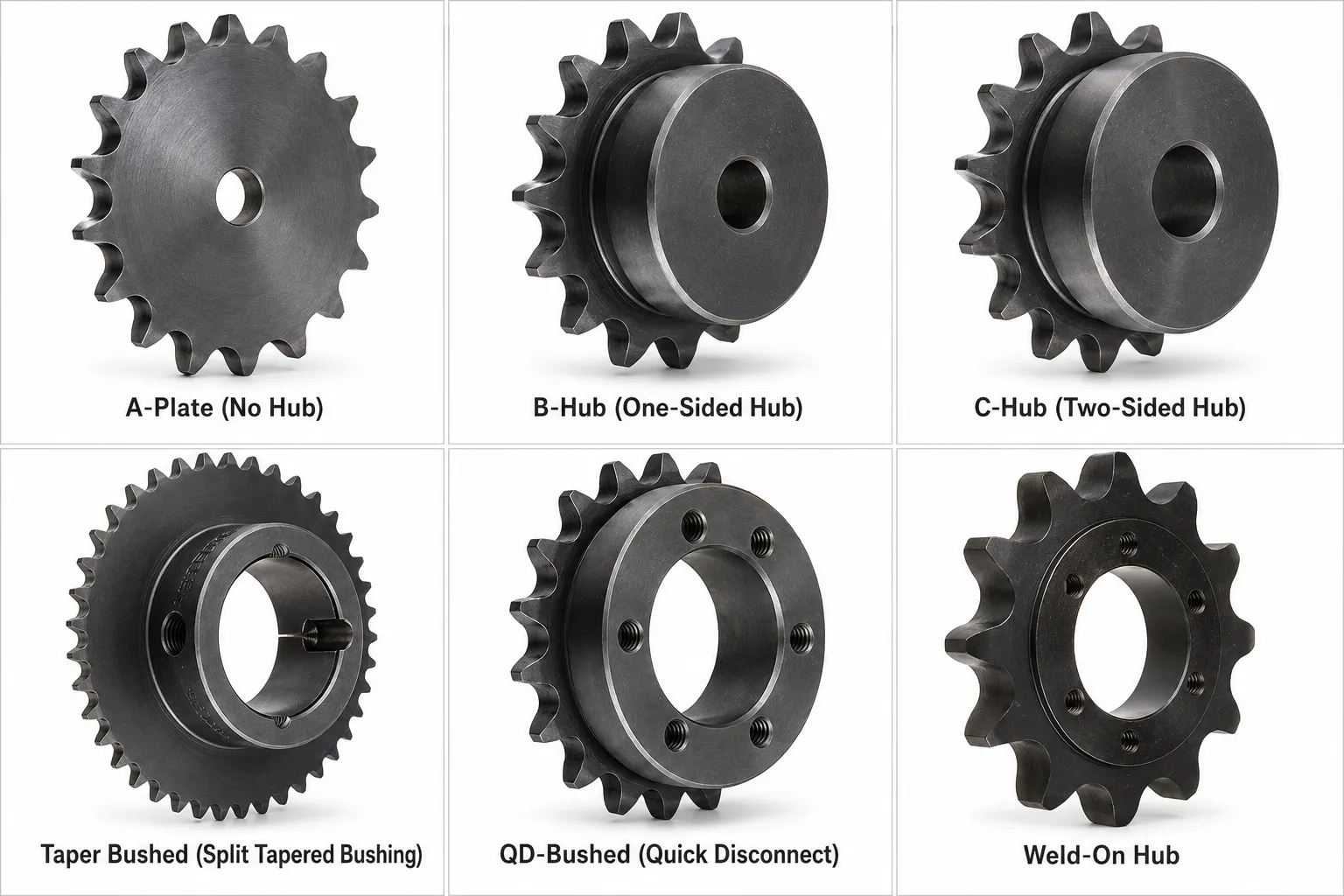
ANSI B29.1 defines six standard sprocket hub styles, designated Type A through Type F (though the market commonly refers to these as A-Plate, B-Hub, C-Hub, Taper-Bushed, QD-Bushed, and Split). Each one controls a different aspect of the shaft-mounting relationship, and selecting the wrong one leads to either installation problems or maintenance inefficiency.
The A-Plate sprocket (also called a plate wheel in European nomenclature) has no hub extension at all — it is a flat disc with the bore passing straight through the rim. This is the correct choice when the sprocket must fit within a tight axial space and the shaft bearing is close to the sprocket face. The bore is bored and keyed directly in the disc web. A-Plate sprockets are standard for conveyor chain applications where multiple sprockets must be spaced precisely along a shaft.
The B-Hub sprocket has a hub that extends to one side only. The hub length is typically 1.5 to 2 times the bore diameter for standard stock sprockets. This is the most common hub style for general industrial drives — the single-side hub provides adequate bearing support for the shaft key and set screws, while keeping the overall width compact. When ordering a B-Hub sprocket, the specification must state whether the hub extends toward the drive side or the driven side of the installation, because the chain line position changes accordingly.
The C-Hub sprocket has hub material projecting equally from both faces of the sprocket disc. This provides the greatest shaft support area and is specified when the sprocket must carry overhung loads from a long chain span, or when the sprocket is the only bearing support point in that area of the drive. C-Hub sprockets are heavier than B-Hub equivalents and require more axial clearance — they are not interchangeable with B-Hub in confined installations.
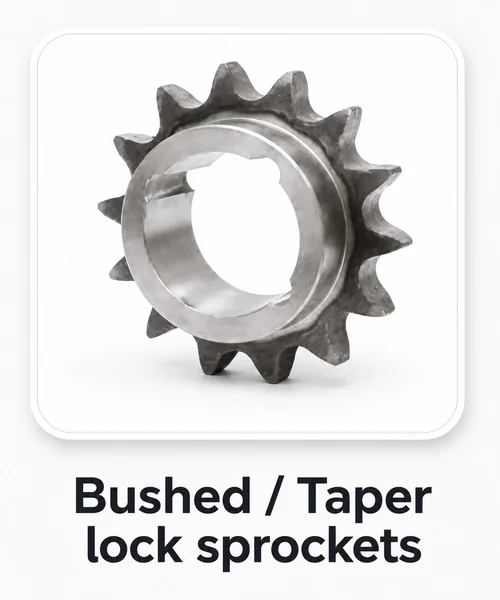
The Taper Lock and QD (Quick-Detachable) bushed sprockets use a removable tapered bushing that grips the shaft by compression rather than by a press-fit bore. The difference between them is primarily in the removal method: Taper Lock bushings require a screw jack to release the taper (three extraction screws are built into the flange), while QD bushings release by threading the same bolts into extraction holes. Both systems allow a sprocket to be transferred to a different shaft diameter simply by changing the bushing — the sprocket itself accepts any bushing in the same series. This is the primary operational advantage over fixed-bore sprockets for maintenance-intensive applications where shaft diameters vary between installations.
Material Selection for Sprockets: Beyond Carbon Steel
The majority of sprockets in general industrial use are made from medium carbon steel (AISI 1045 or equivalent), which gives a good balance of machinability, heat treatability, and cost. But the operating environment often dictates a different material, and the performance difference between a correctly specified material and an incorrect one can be dramatic.
| Material | Typical Hardness | Corrosion Resistance | Best Suited For | Avoid When |
|---|---|---|---|---|
| Carbon Steel 1045 | 28–55 HRC (tooth) | Low — requires oil or paint | General industrial, indoor drives | Washdown, food contact, salt air |
| Cast Iron G25 | 200–240 HB | Moderate (graphite film) | Large engineer-class sprockets, slow drives | Shock loads, high-speed, cyclic reversals |
| Stainless Steel 304 | 28–32 HRC (as machined) | Good — most industrial environments | Food processing, mild washdown | Chloride environments, marine salt |
| Stainless Steel 316L | 25–30 HRC (as machined) | Excellent — chloride resistance | Seafood processing, chemical plant, marine | High-speed drives (lower hardness = faster tooth wear) |
| UHMW Polyethylene | Shore D 60–65 | Excellent — FDA 21 CFR compliant grades available | Idler positions in food processing, zero-lube zones | Drive positions, operating above 80°C, heavy shock |
| Aluminum 6061 | Brinell 95–100 HB | Moderate (oxide layer) | High-speed, low-load drives requiring light weight (packaging, servo) | Abrasive environments, heavy loads, alkaline washdown |
One frequently misunderstood point: stainless steel sprockets are not automatically the correct choice for food processing applications. FDA compliance relates to material composition and surface finish, not merely to the use of stainless steel. A 304 stainless sprocket with a ground and polished bore and no trapped crevices meets the surface hygiene requirement. The more significant food safety issue is lubrication — any sprocket at an idler position above an open food conveyor that requires periodic grease application is a contamination risk regardless of its material. UHMW plastic idler sprockets that run dry eliminate this risk entirely and are the technically correct solution for above-food-line idler positions in most food processing environments.
Where Sprocket Specification Decisions Have the Largest Impact
Agricultural machinery. Combine harvester feeder house drives, grain elevator boot sprockets, and rice thresher chain drives all operate in conditions where abrasive material contacts the sprocket teeth directly. In these applications, tooth hardness specification is more important than tooth count optimisation. A case-hardened 20-tooth sprocket in the feeder house will outlast a through-hardened 24-tooth sprocket running identical chain under the same dusty conditions. Finished-bore sprockets in stock with confirmed tooth hardness certificates are the correct procurement specification for agricultural maintenance purchasing.
Mining and bulk handling. Engineer class sprockets (55-series, 67-series, 81X-series, 94-series, 95-series) are specified for drag chain conveyors, scraper conveyors, and bucket elevator drives. The critical point that causes the most purchasing errors: the 94-series and 95-series sprockets have nearly identical pitch diameter values at the same tooth count, but their roller seat geometry is different because the two series use different roller diameters. A 94-series sprocket running 95-series chain will destroy both components within 200–500 hours. The series designation must be confirmed against the chain’s roller diameter before any engineer class sprocket order is placed.
Packaging and automation. QD-bushed and taper lock sprockets dominate this sector because format changes require frequent shaft configuration modifications. In packaging machinery, the maintenance engineer’s ability to remove and refit a sprocket in under five minutes (versus 45 minutes for a fixed-bore sprocket requiring a puller and press) directly affects production uptime. Aluminum sprockets with anodized tooth surfaces are common in high-speed servo-driven indexing applications where rotational inertia affects acceleration time — the weight saving of an aluminum versus steel sprocket at the same pitch can reduce servo motor torque requirements by 15–30% in high-cycle applications.
Motorcycle and powersport. Front (countershaft) and rear (wheel) sprockets for motorcycle chain drives are specified by pitch, tooth count, and bolt pattern — but the interface between sprocket and carrier (the rubber-cushioned hub on most rear sprockets) is often overlooked when ordering replacements. The cushioned hub absorbs the shock loading from engine power pulses and prevents those pulses from being transmitted directly as impact loads to the chain rollers. A solid-centre rear sprocket without the rubber cushion inserts, installed on a machine that originally used a cushioned carrier, will produce audible chain clatter and accelerated chain elongation under hard acceleration.
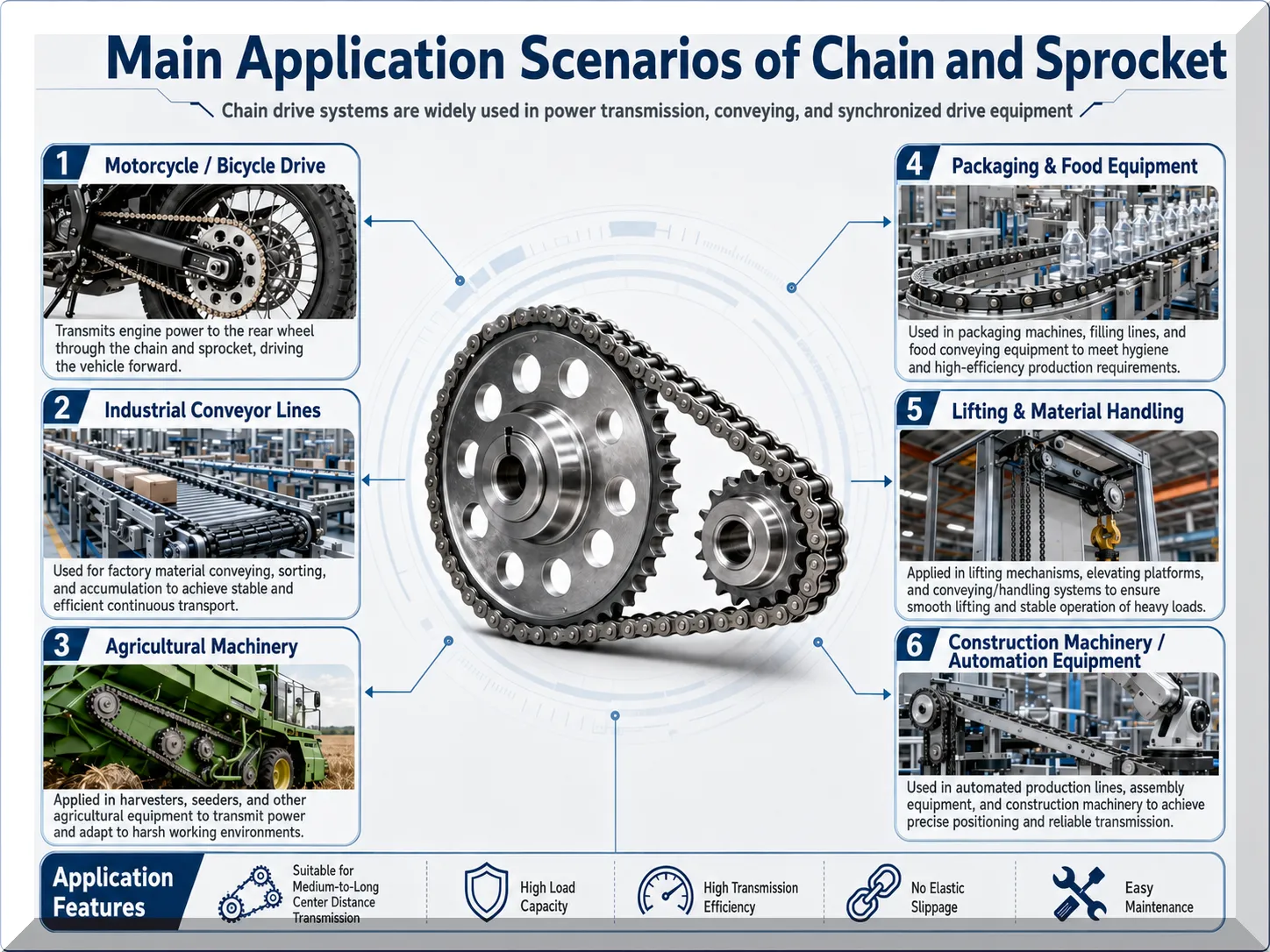
Industrial sprocket and chain drive systems — where correct hub specification and material selection determine operational life in real production environments.
How to Specify a Sprocket Replacement Without Errors
A complete sprocket specification contains seven data points. Providing all seven when ordering eliminates the back-and-forth that delays procurement and prevents receiving a part that fits dimensionally but performs incorrectly:
- Chain series and roller diameter: Not just the pitch — confirm the roller diameter, which identifies the standard (ANSI vs ISO vs engineer class) and prevents tooth profile mismatches.
- Tooth count: Count teeth on the worn sprocket directly. Do not calculate from shaft speed ratios without cross-checking against the physical tooth count — reduction ratios are rarely round numbers.
- Number of chain strands: Simplex, duplex, or triplex. The sprocket face width, tooth spacing, and guide rib dimensions all depend on strand count.
- Hub style and projection: A, B, C, Taper Lock (and bushing series), or QD (and bushing series). For B and C hubs, specify hub-left or hub-right orientation relative to the chain side.
- Bore diameter and keyway: Bore in mm (or inch for ANSI applications), keyway width and depth to DIN 6885 or ASME B17.1 standard, plus set screw requirements.
- Material and surface treatment: Carbon steel, cast iron, stainless grade, plastic type. Surface treatment: plain, black oxide, nickel plate, hot-dip zinc.
- Required certifications: Material test certificate (MTC), FDA compliance declaration (for food applications), third-party inspection report if required for project documentation.
When ordering from Korea Ever-Power, sending the worn sprocket’s three measurements — tooth-to-tooth pitch diameter, roller seat diameter (measured in the tooth root), and hub projection — along with the bore and keyway dimensions allows our team to confirm or correct the specification before machining begins. This pre-order series confirmation is the step that prevents the 94/95-series substitution error and the ANSI/ISO tooth profile mismatch that account for the majority of sprocket replacement failures reported in the first month of installation.
Frequently Asked Questions
Need Sprockets With Confirmed Bore and Hub Specification?
Providing pitch, roller diameter, tooth count, hub type, and bore dimensions before ordering allows us to confirm the exact specification — including whether the chain series and sprocket tooth geometry are compatible — before any material is committed.
Editor: Cxm