A Korean automotive parts conveyor operating at a body-in-white plant was replaced in 2023 after an accelerated chain wear investigation found the chain at 3% elongation in only 14 months, against a designed 30-month replacement interval. The root cause was a spring-type automatic tensioner that had reached the end of its take-up range 8 months prior, leaving the chain slack by approximately 6% above the designed sag allowance. The operator had noticed the increased chain noise but attributed it to the chain “breaking in” after a format change. In the 8 months of insufficient tension, the chain slack had caused impact loading at the drive sprocket — each time the slack chain length was suddenly arrested by the sprocket pulling it taut, a shock load was generated that was 2.5× the steady-state chain tension. This shock cycling had elevated the elongation rate by a factor of 3.2 over the period of under-tension operation. The tensioner’s take-up scale indicator — which shows remaining travel — had been obscured by a guarding panel and was never checked.
Correct chain tension is not a one-time adjustment at installation — it is a parameter that drifts over the service life of the chain and requires periodic monitoring and re-adjustment. The mechanisms of that drift, and the measurable consequences of insufficient or excessive tension, are the subject of this article.
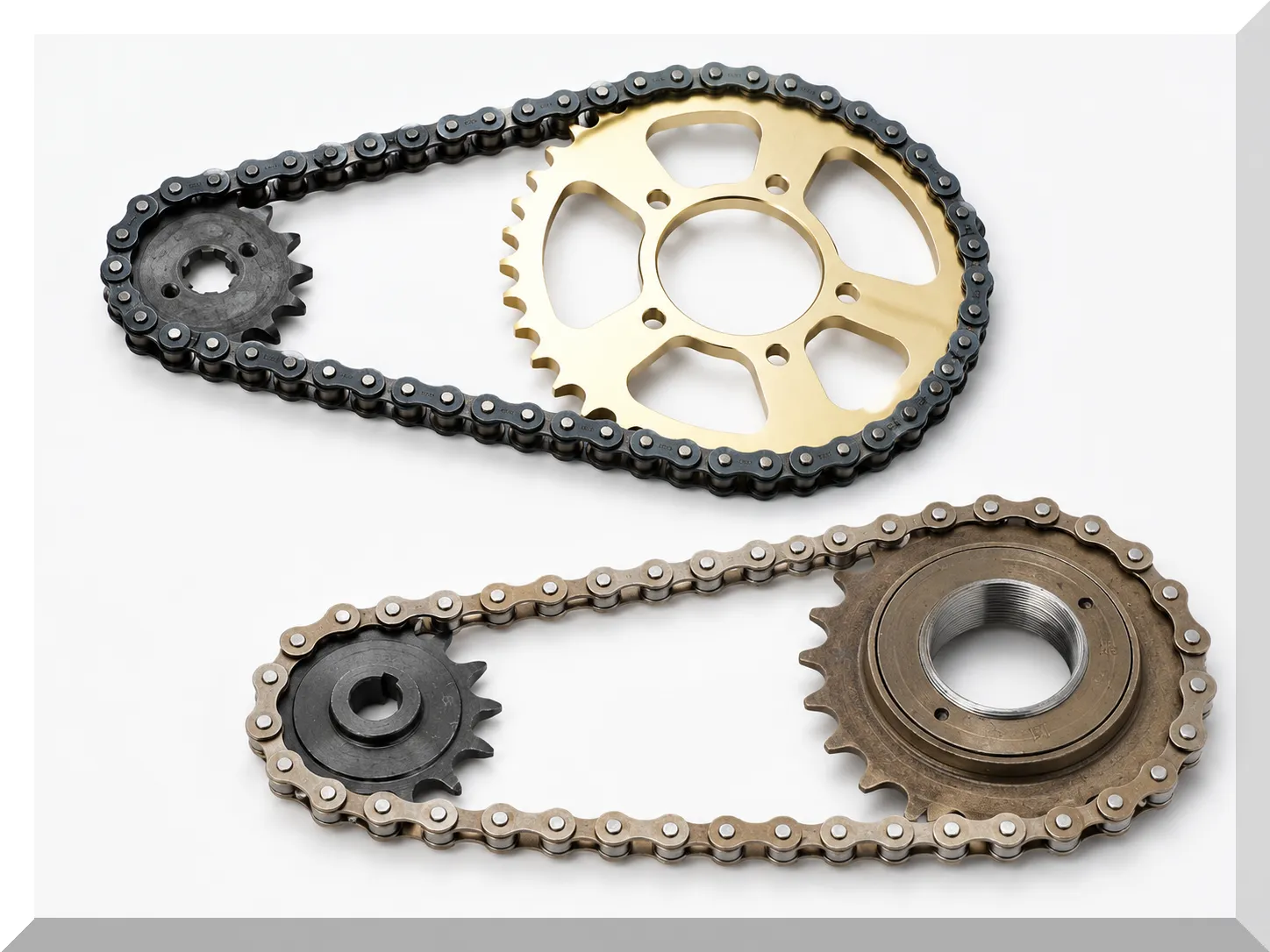
The Consequences of Incorrect Chain Tension
- Chain sag whips into sprocket teeth — shock loads 2–4× steady-state tension
- Accelerated elongation from cyclic impact loading at engagement point
- Chain derailment on small-pitch or high-speed drives
- Increased noise — rattling on drive guides and guard interiors
- Chain skipping teeth on driver sprocket during load peaks
- Increased vibration transmitted to adjacent components and structure
- Slack side sag = 2–3% of the span length between sprockets
- Smooth roller engagement with designed seating arc on sprocket tooth
- Bearing loads on driver and driven shaft at design values
- Noise at design level — no rattling, no whipping
- Tensioner within its adjustment range with reserve take-up available
- Chain and sprocket wear at designed service life rates
- Elevated static chain tension increases bearing loads by 30–80%
- Accelerated pin-bushing wear from permanent high contact pressure
- Drive motor overloaded — measured current increase of 5–20%
- Shaft and bearing fatigue life reduced proportionally to bearing load increase
- Chain does not have slack-side sag to absorb vibration — high-frequency noise
- Most common cause: manual over-tightening “to reduce noise” at installation
Counter-intuitive: over-tensioning a chain drive produces more bearing wear than under-tensioning at the same load level. A chain running too slack generates shock loads at the sprocket — damaging the chain and sprocket but not the shaft bearings directly (the shock is absorbed by the chain elasticity and plastic deformation). A chain running over-tight applies a permanent high radial load to the driver and driven shaft bearings continuously — loading the bearings at 30–80% above the design value at every moment of operation. Bearing L10 fatigue life scales with the inverse cube of the radial load — a 40% load increase from over-tensioning reduces bearing life to approximately (1/1.4)³ = 36% of the designed life. Bearing failures on drives that were recently “properly maintained” are frequently attributable to over-tensioning applied at the last adjustment interval.
The Correct Tension Specification: 2–3% Sag Rule and Where It Applies
ANSI B29.1 specifies the correct slack-side tension for a chain drive as producing a sag of approximately 2–3% of the unsupported span length on the slack side. For a horizontal drive with a 600 mm span between sprockets on the slack side, the correct sag is 12–18 mm measured at the mid-span of the slack run. This specification — often called the “2% sag rule” — applies to horizontal drives with spans between 30 and 50 times the chain pitch.
| Drive Configuration |
Correct Sag |
Reason for Adjustment |
Measurement method |
| Horizontal, centre distance 30–50× pitch |
2–3% of span |
Standard ANSI B29.1 reference condition |
Ruler + straight-edge at mid-span slack side |
| Inclined (centre line >45° to horizontal) |
1–1.5% of span |
Gravity assists chain onto sprocket — less slack needed; excess slack allows derailment on inclines |
Same — measure sag on lower strand |
| Vertical drive (shafts stacked) |
Minimum — near-taut |
No gravity sagging — set tension so chain is firm but not over-tensioned. No visible lateral deflection under hand pressure. |
Lateral deflection under 10 N push: 5–15 mm acceptable |
| High-speed (chain speed >5 m/s) |
1.5–2% of span |
Centrifugal tension in chain reduces effective sag — less static sag is needed |
Measure static sag with drive stopped |
| Short centre distance (<20× pitch) |
Near-taut — tensioner mandatory |
Very short span leaves insufficient chain for sag. Use adjustable centre distance or idler tensioner to maintain correct tension as chain elongates. |
Lateral push deflection method |
Tensioner Types: How Each Works and Which Applications Each Suits
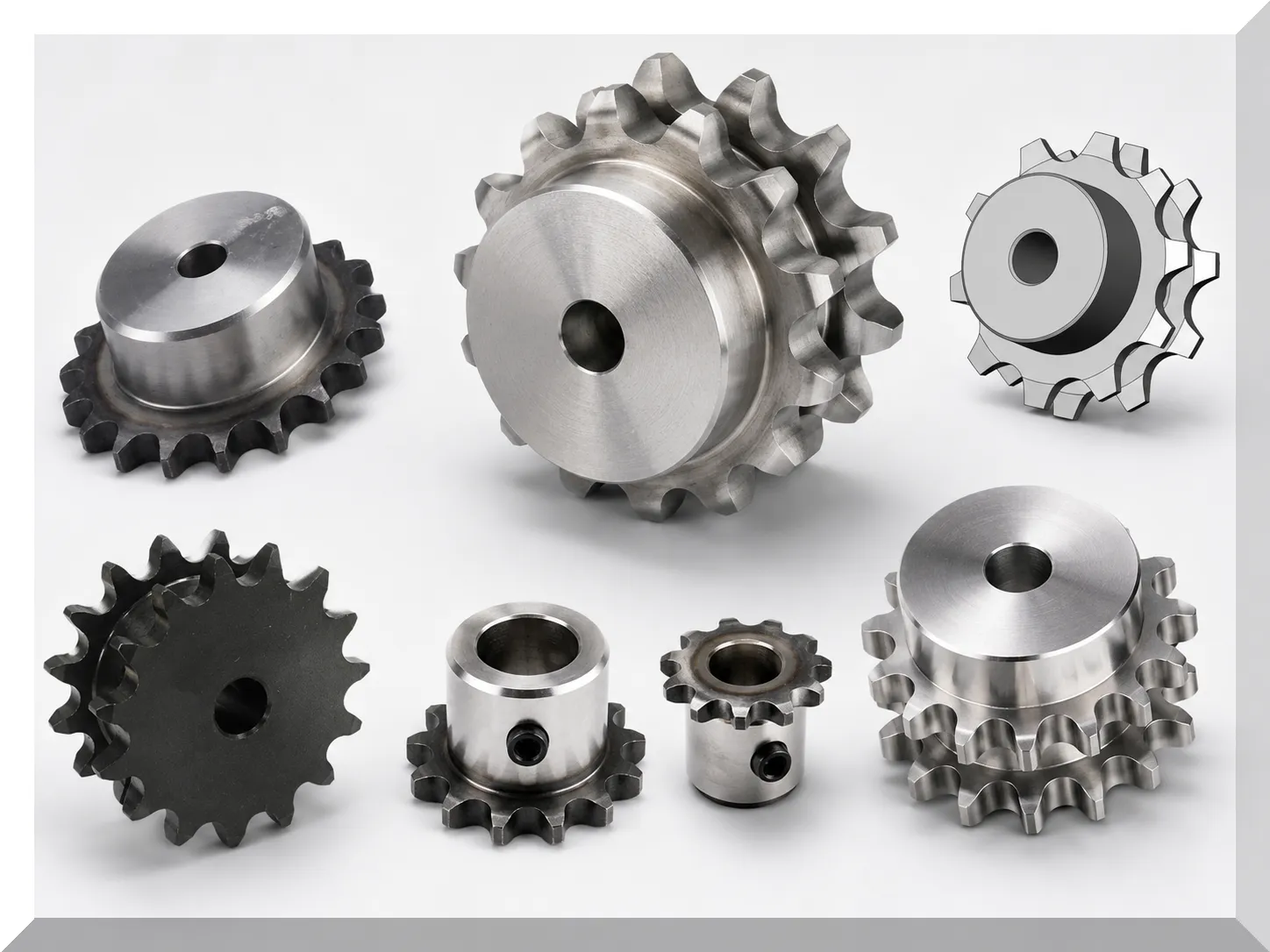
Adjustable Centre Distance (Sliding Bases)
Manual · Most Common
The drive motor or driven machine is mounted on a sliding base that allows the centre distance to be increased manually by adjusting a bolt. Increasing the centre distance increases the chain tension. Simple, reliable, zero additional components. Limitation: requires periodic manual re-adjustment as chain elongates — typically every 500–1,000 hours or at each planned maintenance interval. Cannot compensate for sudden slack due to chain break or pin failure. Adjustment accuracy depends on the operator.
Best for: slow conveyors, light drives, budget-constrained installations where planned maintenance intervals are reliable.
Avoid when: high-cycle drives where tension changes rapidly, remote or inaccessible locations, or when maintenance intervals are irregular.
Spring-Loaded Idler Tensioner
Semi-Automatic · Most Versatile
An idler sprocket (free-spinning, not driving) bears on the slack side of the chain. A compression spring behind the idler mounting bracket applies a continuous force that pushes the idler into the chain, maintaining tension automatically as the chain elongates. As the chain grows, the spring pushes the idler further — maintaining approximately constant tension throughout the spring’s travel range. Critical check: the spring travel range is finite. Once the spring is fully extended, the tensioner provides no further compensation and the chain must be manually adjusted or the tensioner replaced. This is the failure mode described in the opening case of this article.
Best for: moderate-cycle drives where tension changes gradually, applications with limited access for manual adjustment, conveyor drives with regular but infrequent inspection access.
Key maintenance: Check the take-up scale indicator at each inspection — when less than 20% travel remains, plan chain adjustment or replacement. Never let a spring tensioner reach the end of its travel undetected.
Gravity Tensioner (Weight-Loaded)
Fully Automatic · No Travel Limit
The idler sprocket mounting arm is hinged and loaded with a calibrated weight (or spring providing constant force over travel range). Gravity applies a constant downward force on the idler, maintaining tension automatically and continuously regardless of how much chain has elongated. Unlike a spring tensioner, a gravity tensioner has no fixed travel limit — it simply drops lower as the chain elongates, until either the chain is replaced or the idler reaches its mechanical stop. Limitation: requires a mounting orientation where gravity can act on the tensioner — typically applied to the lower slack-side span of a horizontal drive. Not suitable for vertical or near-vertical drives, or for drives where the slack side is on top.
Best for: high-cycle drives, long chains, conveyors where the maintenance interval cannot be reliably maintained, drives in dusty or dirty environments where spring mechanisms may stick or corrode.
Weight calibration: the counter-weight must be calibrated to provide the correct slack-side tension for the specific chain and drive. Too heavy = over-tensioned; too light = under-tensioned. Calculate: Weight = (desired slack-side tension × 2) ÷ 9.81 kg, then verify against the 2% sag specification at installation.
Hydraulic / Pneumatic Tensioner
Precision · High Load
A hydraulic or pneumatic cylinder applies force to the idler mounting bracket, maintaining tension at a controlled pressure regardless of chain elongation. The pressure can be monitored remotely and adjusted through the fluid system without physical access to the tensioner. Used in demanding applications where precise tension control is required — press transfer drives, precision indexing systems, and high-load heavy industrial conveyors. Limitation: requires a hydraulic or pneumatic supply; leak points are potential contamination sources in food and clean-room applications. Significantly more expensive than spring or gravity tensioners. Reserved for applications where tension precision justifies the cost.
Manual Chain Tension Adjustment: The Correct Procedure
- Stop the drive completely and lock out. Chain tension adjustment requires the drive to be stopped and locked out per the applicable lock-out/tag-out procedure. Never adjust tension on a running chain drive — the adjustment screw or sliding base is in the drive hazard zone.
- Locate the slack side. On a standard reduction drive, the slack side is the return strand (the side where the chain is not being pulled by the driver sprocket). On a horizontal drive, the slack side is typically below. For inclined or vertical drives, identify the slack side from the drive direction and rotation.
- Measure current sag. Using a straight-edge laid across the chain path between the two sprocket face-edges on the slack side, measure the vertical drop at mid-span between the straight-edge and the chain surface. Record this as the current sag in mm. Calculate the current sag percentage: sag(%) = (sag(mm) / span(mm)) × 100.
- Calculate required adjustment. If current sag is above 3% of span: tighten. If below 2% of span: loosen. For example: 600 mm span, current sag 28 mm = 4.7% → needs tightening. Target sag = 15 mm (2.5%). Required centre distance increase: approximately 13 mm (from the centre distance formula — adjust in small increments and re-check).
- Adjust in increments of 2–3 mm and re-check. Do not adjust to the calculated value in a single step — the chain catenary equation is non-linear for large adjustments, and over-correction past the upper limit is easy. Adjust 2–3 mm, re-check the sag, and continue until the target range is reached.
- Confirm adjustment uniformly on both sides (duplex/triplex drives). For multi-strand drives, both strands must be adjusted equally — uneven tightening loads one strand preferentially and can cause the chain to track sideways, increasing sprocket side-face wear. Check the sag of each strand independently.
- Record the adjustment. Record the date, measured sag before and after, and the amount of adjustment made to the centre distance or tensioner position. This establishes the chain’s elongation rate history and predicts the next adjustment interval.
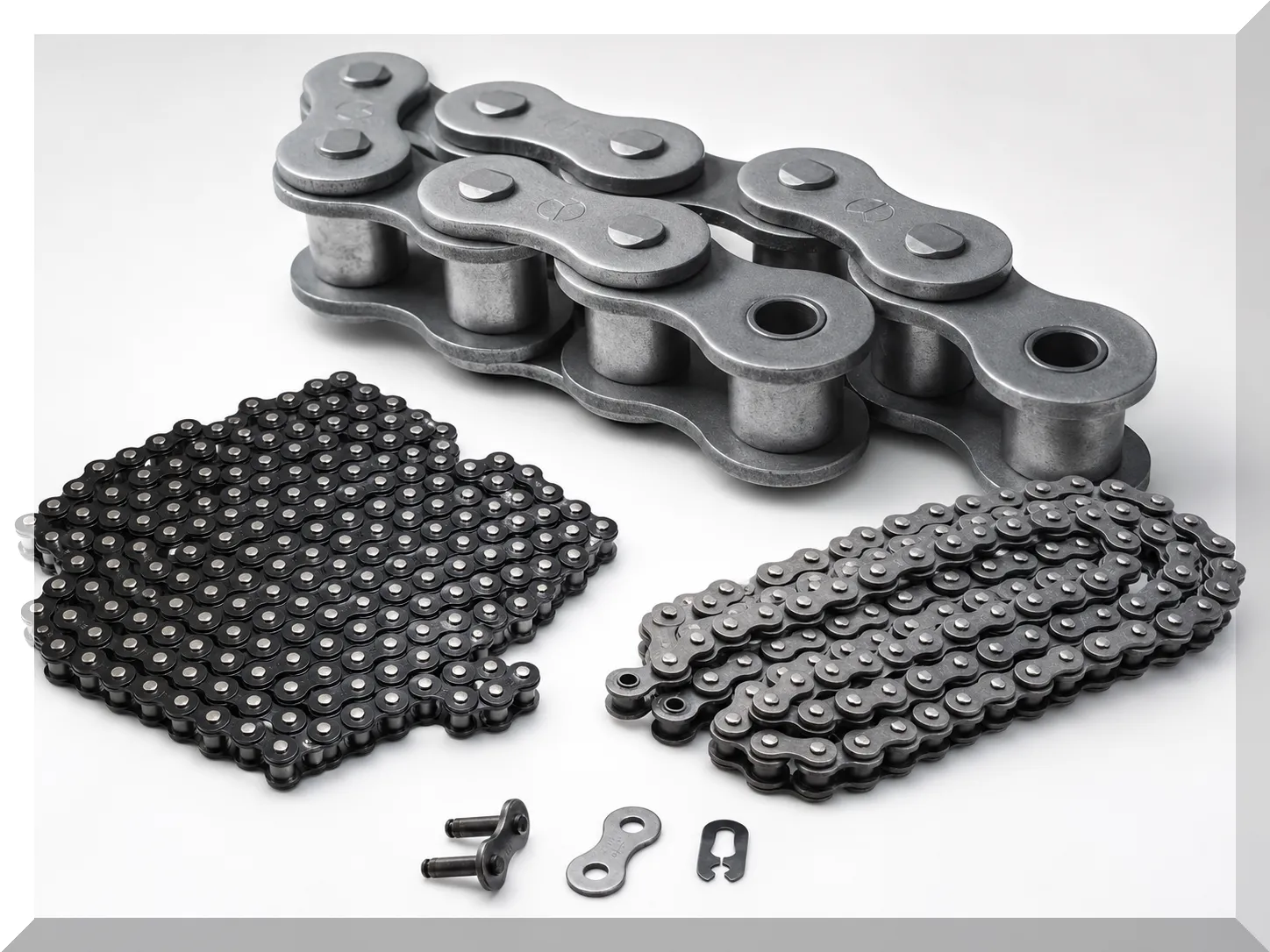
Tensioner Selection for Common Drive Types
Long conveyor drives (centre distance >30× pitch). Gravity tensioners are the most reliable solution for long-span conveyor drives where chain elongation is progressive and regular — grain conveyors, parts accumulation loops, and overhead conveyor tracks. The gravity tensioner compensates continuously without maintenance attention. For food and pharmaceutical applications where the tensioner is inside the food zone, stainless steel tensioner components with no lubricant reservoirs are specified. Standard ANSI roller chain for these applications is ordered with matched idler sprocket tooth counts to minimise the difference in engagement frequency between the drive and idler positions.
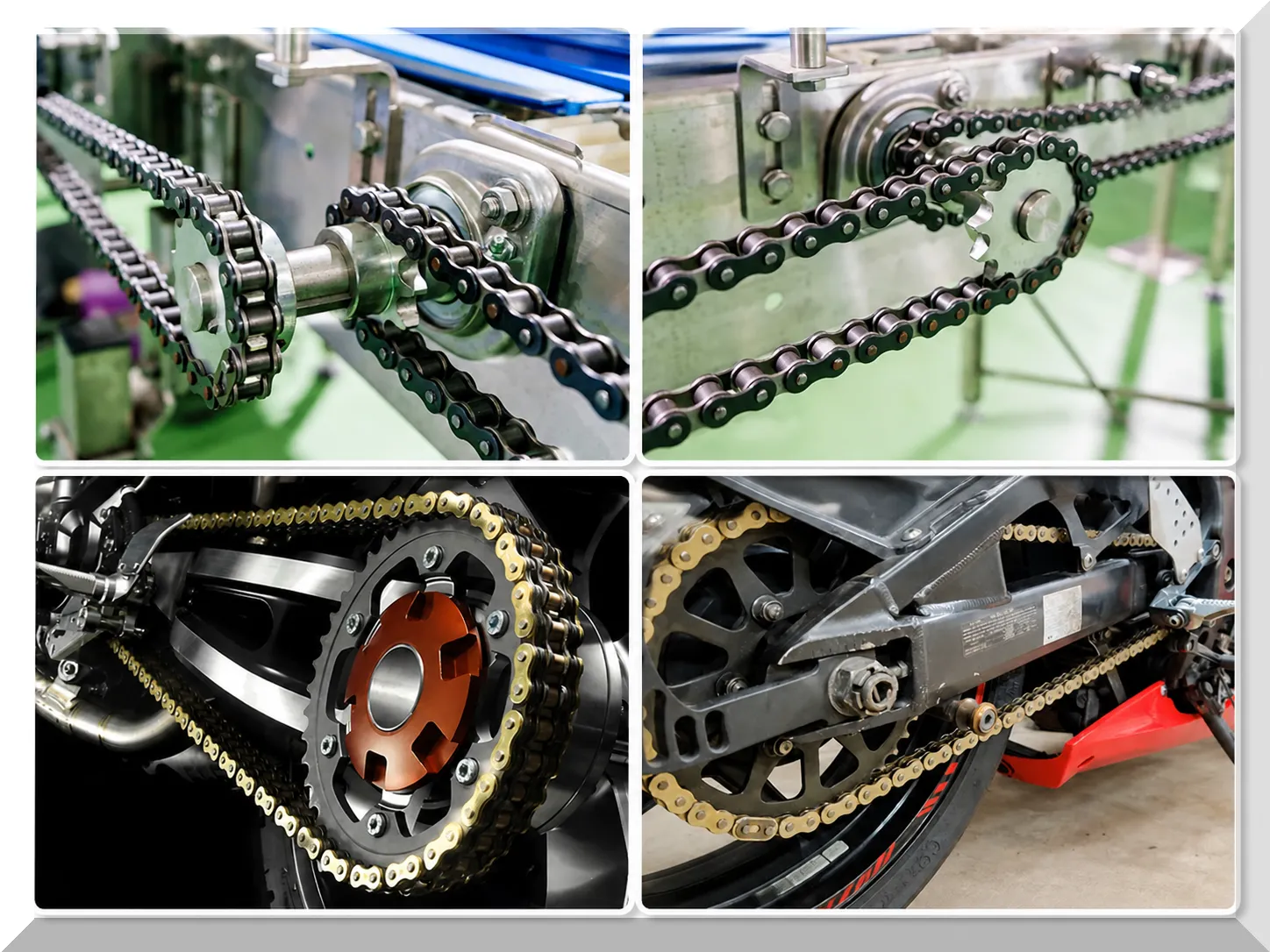
Machine tool main drives. The tensioner specification for machine tool chain drives (where noise and vibration affect machined surface quality) uses a spring-loaded shoe-type tensioner — a curved plastic or rubber shoe that bears on the flat side of the chain link plates rather than an idler sprocket. Shoe tensioners eliminate the engagement noise that an idler sprocket would add to the drive — a sprocket running at the natural chain frequency creates its own engagement pulse that can appear in the machined surface finish at specific spindle speeds. Shoe tensioners are only appropriate for well-lubricated drives (the shoe must be continuously lubricated) and at chain speeds below approximately 5 m/s.
Motor-mounted drives on sliding bases. The most common tensioner configuration in Korean industrial facilities is the sliding motor base — the drive motor is mounted on a plate that slides along guide rails, with a bolt adjustment to increase or decrease the motor-to-driven machine centre distance. Matching sprocket sets for motor-mounted drives are specified with the same pitch, tooth count, and bore configuration as the existing installation — only the centre distance is adjusted at re-tensioning. This configuration is simplest to maintain but requires operator access to the motor mounting plate at each adjustment interval, which is often the binding constraint in compact machine installations.
Frequently Asked Questions
How often should chain tension be checked and adjusted?
The adjustment interval depends on the chain elongation rate in the specific application. For a new chain installation, check tension at 50 hours (run-in elongation), 500 hours, and 1,000 hours. After three measurements, calculate the elongation rate and project how frequently the sag will move outside the acceptable range. Typical intervals: light conveyor chains in clean, well-lubricated environments — check annually; moderate industrial drives — check at 500-hour intervals; high-speed or high-load drives — check at 250-hour intervals; drives with significant shock loading — check at 100-hour intervals. If a drive requires adjustment at every inspection, the base elongation rate is higher than expected — investigate lubrication adequacy and shock loading before assuming the adjustment interval is simply short.
Can a chain drive run without a tensioner if the centre distance is fixed?
Yes — fixed centre distance drives without tensioners are a valid and common configuration. The design requirement is that the centre distance must be adjusted at installation so that the chain has 2–3% sag, and the drive must be designed with enough centre distance adjustment range (typically 1.5–2% of the centre distance) to take up the expected elongation over the design service interval without requiring a new chain length. Drives with very large elongation rates (high shock, poor lubrication) or very long service intervals between planned replacements may require a tensioner to maintain correct tension over the full interval. Drives with predictable, manageable elongation rates in planned maintenance environments are correctly designed without tensioners — the adjustment at each maintenance interval provides the tension correction.
Is there a relationship between chain tension and chain temperature during operation?
Yes — and it is bidirectional. Chain temperature is an indicator of tension and lubrication condition: an over-tensioned chain runs hotter than correctly tensioned chain at the same power because the elevated static tension increases the bearing friction at the pin-bushing interface. A drive that runs 15–20°C above ambient temperature above what a similar drive at another position runs is a candidate for tension and lubrication investigation. Additionally, thermal expansion of the chain at operating temperature changes the sag slightly relative to the cold measurement — a chain adjusted cold to 2% sag will have marginally less sag at operating temperature due to thermal expansion. This effect is small (approximately 0.01% per 10°C for steel chain) and can generally be ignored for drives with centre distances below 2,000 mm. For very long chain drives (above 5 metres span), thermal expansion of the chain during warm-up is a design input for the tensioner travel specification.
Chain, Sprocket and Tensioner System Supply
We supply complete chain drive system components including chain, sprockets, and tensioner specifications. Send your drive parameters — centre distance, chain pitch, tensioner type, and inspection interval — for a matched system recommendation.