An industrial pump manufacturer in Ulsan was experiencing premature chain failure on a cooling water pump drive — ANSI #80 duplex chain reaching 3% elongation in 11 months, against a specification life of 30+ months. The motor was 18.5 kW at 1,450 RPM with a 3:1 reduction. When the original chain selection was reviewed, it became apparent that the engineer had selected the chain from the ANSI B29.1 table using the rated motor power directly. The table showed #80 simplex at 1,450 RPM had a rated power of 21.4 kW — adequate for an 18.5 kW motor, with 15% margin. What the engineer had not applied was the service factor for the application type (medium shock — pump drive with intermittent heavy-load starting: K_s = 1.4), the lubrication correction for the installed drip-oiler type (Type 2 — factor 0.9 on rated power), and the small sprocket correction for the 15T driver sprocket (factor 0.9 below the 17T reference). The corrected rated power for this specific installation was 21.4 × 0.9 × 0.9 = 17.3 kW — less than the 18.5 kW applied load. The chain was running continuously above its corrected rating by 7%, which is more than sufficient to explain the shortened service life.
The ANSI chain rating tables are not a substitute for a complete drive rating calculation. They are one input — the maximum rated power under reference conditions. The reference conditions are rarely replicated in real industrial applications. The calculation below provides the complete procedure.
The Six-Step Chain Drive Power Rating Procedure
1
Determine the design power
P_design = P_motor × K_s
P_motor is the rated motor output power in kW. K_s is the service factor from the table in Step 2. This is the power the chain must be rated to transmit — not the motor nameplate power. For drives with significant inertia (flywheels, large rotors, starting loads), use the peak starting torque as the basis for P_design rather than the rated running power.
2
Determine the service factor K_s
| Load Type |
10h/day (K_s) |
16h/day (K_s) |
24h/day (K_s) |
Example applications |
| Smooth (no shock) |
1.0 |
1.1 |
1.2 |
Centrifugal pumps, fans, light conveyors |
| Moderate shock |
1.3 |
1.4 |
1.5 |
Reciprocating pumps, compressors, machine tools |
| Heavy shock |
1.5 |
1.7 |
1.9 |
Crushers, presses, conveyors with impact loading |
The duty-hour factor accounts for thermal fatigue accumulation. Drives operating 24 hours per day never reach thermal equilibrium — chain temperature remains elevated throughout, increasing elongation rate. The 24h/day factor is higher than proportional to hours because of this thermal effect.
3
Select pitch from ANSI B29.1 power rating table at driver shaft RPM
Look up the ANSI chain power rating table at the driver shaft speed (n₁). Find the first chain pitch where the rated power (at 17T driver, Type 3 oil bath lubrication — the reference conditions) exceeds P_design. This gives the provisional pitch. If no single-strand chain meets P_design, consider duplex or triplex strand options (rated power multiplies by approximately 1.7 for duplex, 2.5 for triplex relative to single-strand at the same pitch).
| Chain Pitch |
400 RPM (kW) |
700 RPM (kW) |
1,000 RPM (kW) |
1,450 RPM (kW) |
2,000 RPM (kW) |
| #40 (12.7 mm) |
1.4 |
2.1 |
2.7 |
3.3 |
3.9 |
| #50 (15.9 mm) |
2.8 |
4.4 |
5.7 |
7.3 |
8.5 |
| #60 (19.05 mm) |
5.0 |
7.9 |
10.4 |
13.7 |
16.2 |
| #80 (25.4 mm) |
9.4 |
15.2 |
20.1 |
21.4 |
22.8 |
| #100 (31.75 mm) |
15.8 |
25.6 |
34.0 |
36.2 |
38.4 |
| #120 (38.1 mm) |
24.6 |
39.9 |
51.5 |
54.7 |
56.1 |
Reference conditions: 17T driver, Type 3 lubrication (oil bath), single strand. Actual rated power in your application requires correction factors from Steps 4–5.
4
Apply lubrication correction factor K_L
The ANSI B29.1 table assumes Type 3 lubrication (oil bath or forced circulation). If the actual lubrication is less effective, apply a derating factor to the table power:
Type 1 — Manual/drip oil
K_L = 0.7–0.8
Manual application ≥ every 8h; drip oiler
Type 2 — Drip or disc oiler
K_L = 0.85–0.95
Drip feed correctly set; continuous feed
Type 3 — Oil bath / circulation
K_L = 1.0
Reference condition — full table rating applies
The corrected rated power = Table rated power × K_L. If this corrected value exceeds P_design, the chain is adequate for the lubrication system. If not, either upgrade the lubrication system or move to the next larger pitch.
5
Apply small sprocket correction factor K_T
The table reference condition is 17T driver. If the driver tooth count differs from 17T, apply K_T:
| Driver Teeth (N₁) |
11 |
12 |
13 |
14 |
15 |
17 |
19 |
21+ |
| K_T |
0.53 |
0.62 |
0.70 |
0.78 |
0.85 |
1.00 |
1.08 |
1.15 |
The corrected rated power = Table rated power × K_L × K_T. This is the power the chain can transmit in the actual installation. Compare to P_design to determine adequacy.
6
Verify the chain tension safety factor
F_tight = (P_design × 1000) / v_chain [N]
SF = F_break / F_tight
Calculate the tight-side tension from P_design and the chain speed in m/s. Divide the chain’s minimum break load (from manufacturer’s table) by the tight-side tension to get the safety factor. ANSI B29.1 requires SF ≥ 5.0 for chain drives under normal conditions. If SF < 5, either select the next larger pitch or add a second strand. Chain speed: v_chain = (n₁ × N₁ × p) / 60,000 where p = pitch in mm and n₁ = driver RPM.
Worked Example: Complete Power Rating Calculation for a Crusher Feed Conveyor
Given conditions
Driver shaft speed
960 RPM
Application
Crusher feed belt drive — heavy shock
Operation
16 h/day continuous
Lubrication
Drip oiler (Type 2)
Step-by-step solution
- K_s: Heavy shock, 16 h/day → K_s = 1.7
- P_design = 22 × 1.7 = 37.4 kW
- Pitch selection at 960 RPM from table: interpolating between 700 and 1,000 RPM values — #100 rates ≈ 31.0 kW at 960 RPM (too low). #120 rates ≈ 47.5 kW at 960 RPM → provisional pitch = #120
- K_L (Type 2 drip oiler) = 0.90. Corrected rating = 47.5 × 0.90 = 42.8 kW
- K_T (15T driver) = 0.85. Final corrected rating = 42.8 × 0.85 = 36.4 kW
- Compare: 36.4 kW < 37.4 kW (P_design). Margin is −2.7%. #120 single strand FAILS by a small margin.
- Options: (a) Upgrade to oil bath lubrication (K_L = 1.0) → 42.8 × 1.0 × 0.85 = 36.4 still marginal. (b) Increase driver to 17T → K_T = 1.0; rating becomes 47.5 × 0.90 × 1.0 = 42.8 kW. PASSES with 14% margin. ✓ (c) Use #100 duplex: 31.0 × 1.7 × 0.90 × 0.85 = 40.3 kW. PASSES with 8% margin. ✓
- Safety factor check (17T driver, #120, drip oil): v_chain = (960 × 17 × 38.1) / 60,000 = 10.3 m/s. F_tight = (37,400 W) / 10.3 = 3,631 N. SF = 124,500 / 3,631 = 34.3. Well above the 5.0 minimum — chain is structurally adequate; the power rating check is the governing criterion for this selection.
Counter-intuitive: in most chain drive selections at moderate power levels, the safety factor against static break load is very high (20–50×) and plays no role in the chain selection decision. The binding constraint is the fatigue power rating — the cyclic load capacity limited by link plate and pin fatigue, not by static yield strength. The ANSI power rating tables encode the fatigue limit, not the static capacity. This is why the safety factor calculation (Step 6) rarely selects a larger chain than the power rating steps — the chain that passes the power rating check typically has a break-load safety factor of 20–50, far above the required 5.0. Conversely, applications with very low speed but very high torque can produce tight-side tensions that approach the chain’s minimum break load — this is when Step 6 becomes the governing constraint. Always check both.
When to Choose Multi-Strand Instead of a Larger Pitch
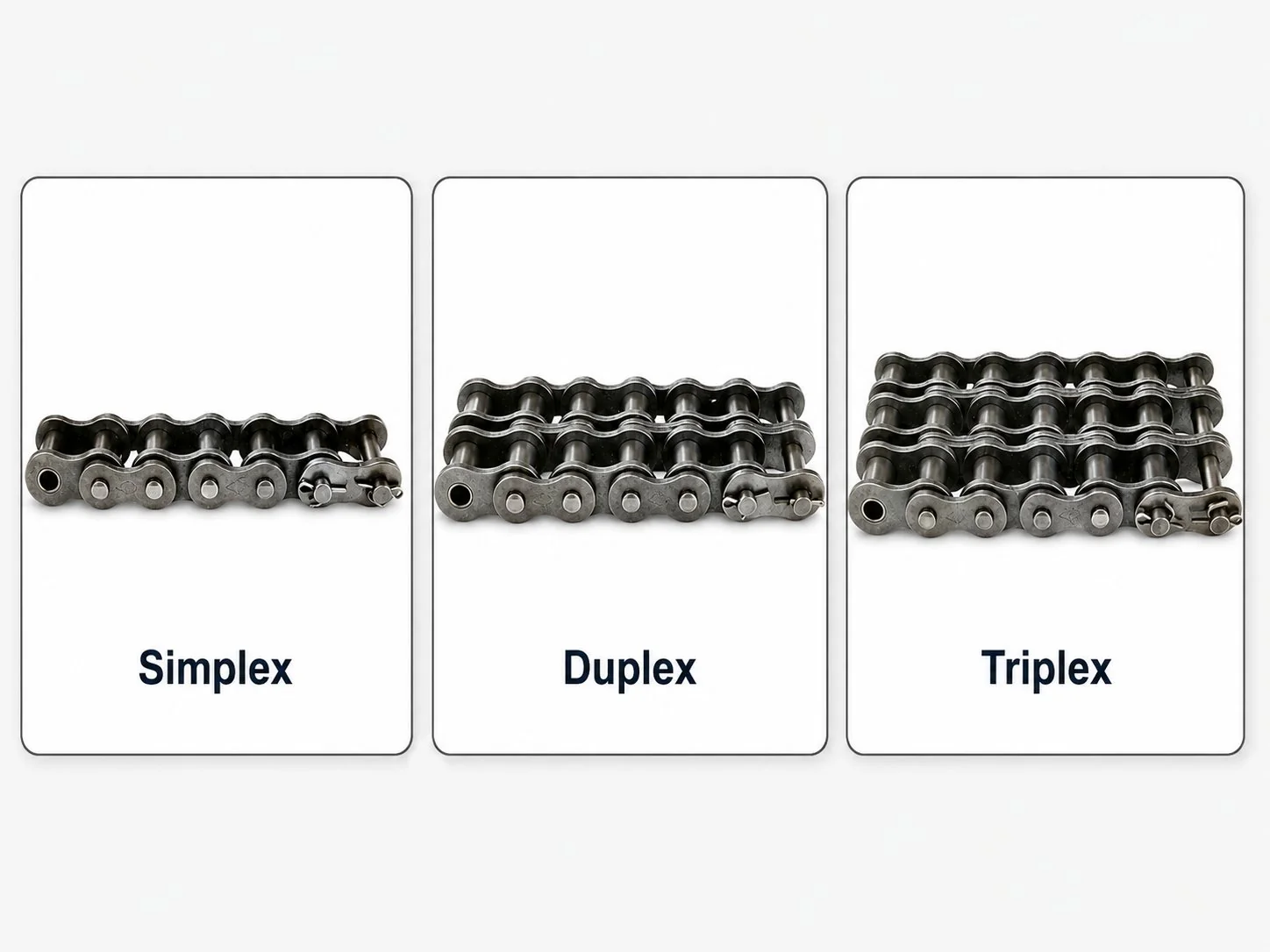
When the single-strand power rating at a given pitch is insufficient, the designer has two options: increase the pitch, or increase the strand count. The choice between them depends on sprocket diameter constraints, availability, and cost.
| Decision Factor |
Increase Pitch (e.g., #80 → #100) |
Add Strand (e.g., #80 simplex → duplex) |
| Sprocket OD impact |
Larger OD — may exceed envelope |
Same OD — wider sprocket face only |
| Power increase |
#80→#100: +80% capacity at same RPM |
Simplex→duplex: ×1.7 capacity |
| Chain width |
Narrower than multi-strand |
Wider — impacts shaft alignment requirements |
| High-speed performance |
Worse (larger pitch = more polygon effect) |
Same as single-strand at same pitch |
| Cost |
Moderate increase |
Proportional increase (×1.7 for duplex) |
| Preferred when: |
Sprocket OD is not constrained; lower speed |
Sprocket OD must remain small; higher speed |
Common Calculation Errors and How to Avoid Them
Using motor power without the service factor. The most common error — selecting a chain based on the motor nameplate power without multiplying by K_s. For a 22 kW motor on a crusher feed application (K_s = 1.7), the design power is 37.4 kW. A chain rated for 22 kW at that speed is significantly undersized. Apply the service factor before looking up the power table. Chain technical specifications for all standard ANSI pitches are available from our product team.
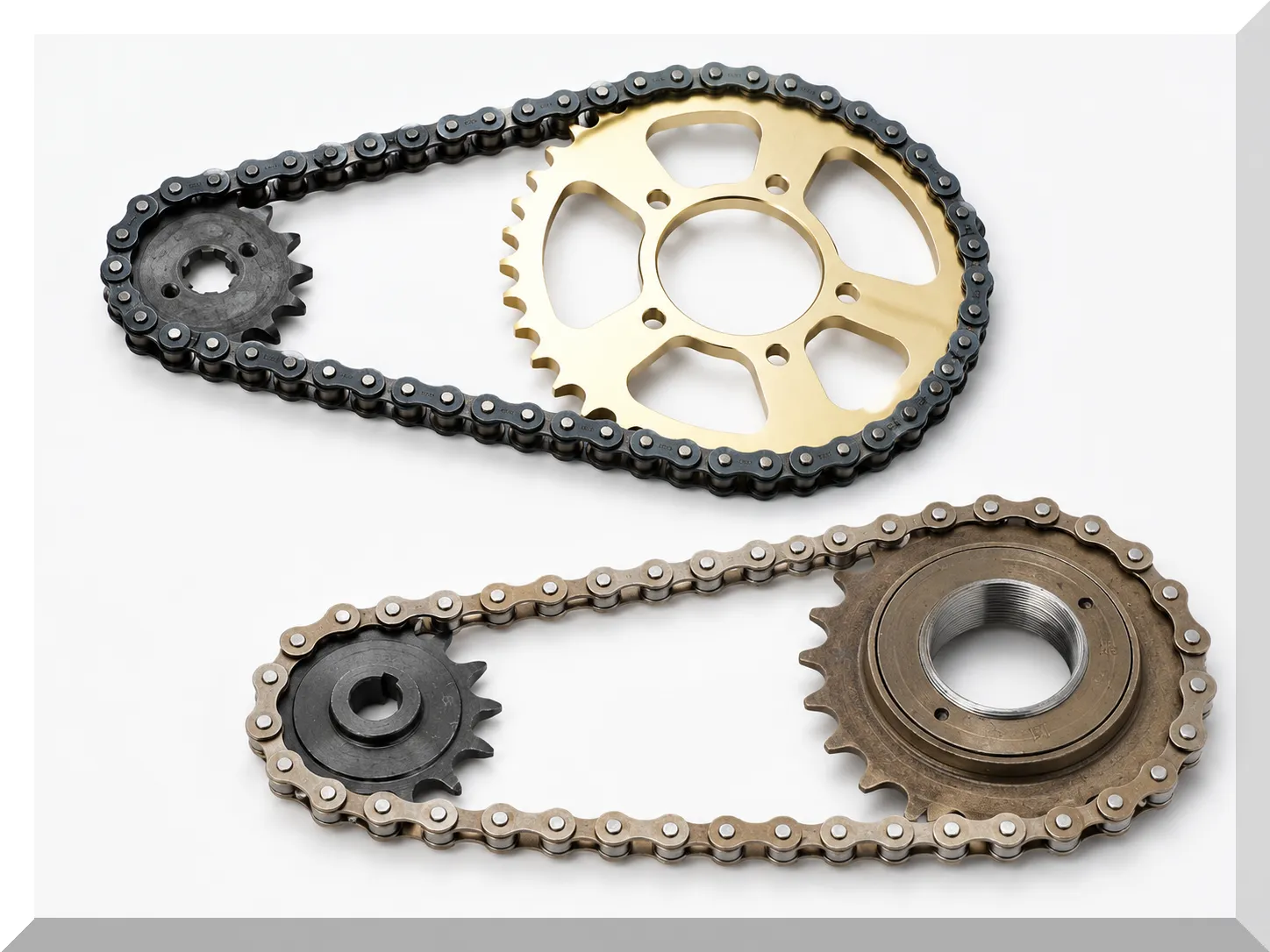
Ignoring the small sprocket correction below 17T. Drives with space constraints frequently use small driver sprockets of 12–15 teeth. A 13T driver at 1,000 RPM reduces the chain’s effective rated power to 70% of the table value. This correction is found in the ANSI B29.1 standard but is frequently not applied by engineers using simplified tables. The only remedy for a drive already installed with a small driver is to increase the sprocket tooth count — replacing the chain pitch will not resolve the K_T deficiency if the sprocket count remains below 17T.
Neglecting chain speed limits at large pitch and high RPM. The ANSI power rating table shows a peak power at an optimal chain speed for each pitch, then declining ratings above that speed. A #120 chain at 1,450 RPM on a 17T driver has a chain speed of (1,450 × 17 × 38.1) / 60,000 = 15.6 m/s — above the optimal speed for this pitch. The table rated power at this condition reflects the reduced rating, but engineers reading an abbreviated table may use the peak rating incorrectly. Always use the RPM-specific column, not the maximum value in a pitch row.
For custom chain and sprocket sets where the calculation produces an unusual chain pitch or tooth count, send the six input values (motor power, RPM, service type, duty hours, lubrication type, driver tooth count) to our technical team — we verify the full six-step calculation and confirm the specification before any order is placed.
Frequently Asked Questions
How does the ANSI power rating account for centre distance and chain length?
The ANSI B29.1 power ratings are based on a reference centre distance that gives approximately 120 links in the drive loop — a midrange span that represents typical operating conditions. For very short centre distances (below 20× pitch), the number of links in contact on the driver sprocket is lower than in the reference condition, and the per-link load is higher, reducing the effective power rating slightly. For very long centre distances (above 80× pitch), chain sag and vibration become significant factors. The standard correction is to maintain centre distances between 30 and 50 times the chain pitch for optimal drive performance. Drives outside this range should use the ANSI B29.1 correction tables for centre distance effects, or be verified by calculation against the actual chain tension at the specific geometry.
Can the power rating procedure be applied to SP-series high-strength chain?
Yes — SP-series chain uses the same power rating procedure with one modification: the rated power from the ANSI B29.1 table applies to standard chain. For SP-series, the fatigue limit is approximately 75% higher than standard chain at the same pitch, which is reflected in SP-series power rating tables published by SP-series manufacturers. Practically, this means that if the six-step procedure produces a borderline result with standard chain (design power within 20–30% of the corrected rated power), SP-series chain may provide adequate margin without changing pitch or strand count. For applications where the standard chain passes by a comfortable margin (design power less than 70% of corrected rated power), SP-series provides no additional benefit — the chain is not being run at a load level where the improved fatigue limit is relevant.
What is the correct service factor for a conveyor drive that starts 4–6 times per hour with high inertia loads?
Frequent starting with high-inertia loads falls into the “heavy shock” category — K_s = 1.5 (10h/day), 1.7 (16h/day), or 1.9 (24h/day). However, for conveyor drives with inertia loads significantly larger than the running load, the ANSI B29.1 service factor alone may be insufficient. In these cases, calculate the peak starting torque from the motor torque-speed curve and the connected inertia, convert to chain tension using the sprocket radius, and verify the safety factor (Step 6) against this peak tension rather than the steady-state running tension. The chain safety factor must remain above 5.0 at the peak starting condition, not only at the rated running condition. For drives with very high starting frequency or very large inertia ratios (rotating mass inertia greater than 5× the motor rotor inertia), the chain may need to be sized based on starting torque alone, with the running load being well within capacity.
P_design → Table rating × K_L × K_T → SF check → Chain confirmed
Need a Chain Selection Verified Before Ordering?
Send motor power (kW), driver shaft RPM, driven shaft RPM, application type, duty hours, and lubrication type. Our engineers run the six-step ANSI B29.1 calculation and confirm the correct pitch, strand count, and sprocket tooth count before manufacture.