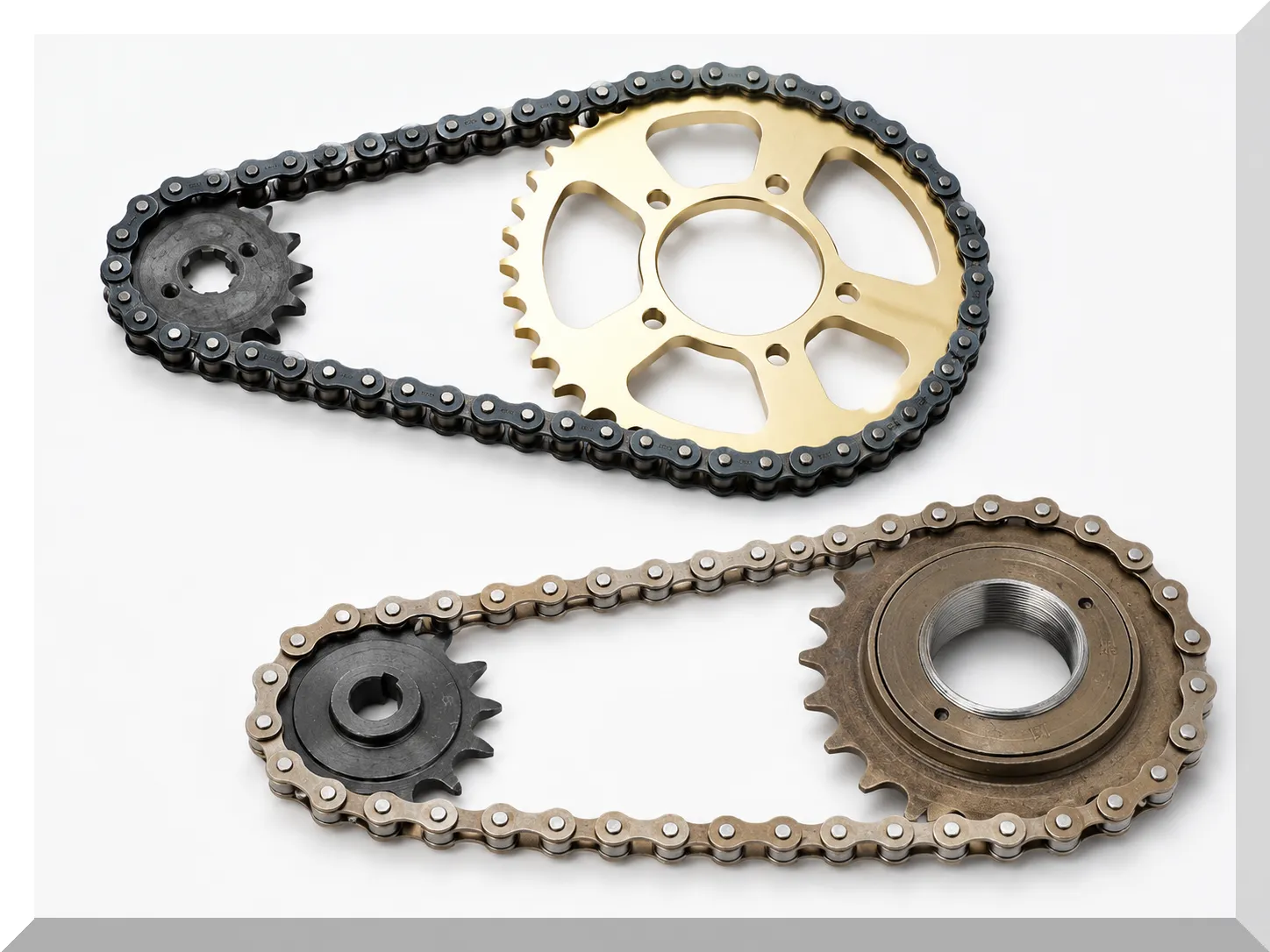
At a polymer film extrusion plant in Gyeonggi-do, a #80 roller chain drive on the main take-off roll failed in 2023 during a 48-hour production run. The post-mortem measured 4.1% chain elongation — well beyond the 3% replacement threshold. More revealing was what the failed chain had done to the sprocket: the tooth faces had been reshaped by 1,400 hours of running against the elongated pitch, and the new chain installed after the failure reached 3% elongation itself within 900 hours. The cost was not just the unscheduled downtime — it was three months of accelerated chain consumption until a new sprocket set was finally ordered and the drive geometry was corrected. Delaying chain replacement past the elongation threshold does not save money; it transfers the wear damage to the sprocket and multiplies the cost of the eventual repair.
Understanding what chain elongation actually is — not just how to measure it — is the foundation of a rational replacement policy. The measurement method takes four minutes. The decision framework takes another two. What follows provides both.
What Chain Elongation Actually Is — Not What Most People Think
The term “chain stretch” is technically misleading and it leads to incorrect conclusions about what can be done to slow it down. No structural elongation of the steel link plates occurs under normal operating loads — the loads are orders of magnitude below the steel’s yield strength. What increases the measured length of a chain over time is material removal at the pin-bushing interface inside each link joint.
Each time the chain articulates over a sprocket tooth — once per tooth engagement — the pin rotates fractionally inside the roller bushing bore. This creates a sliding contact between the hardened pin surface and the inner bore of the sintered steel bushing. Over millions of cycles, this contact removes material from both surfaces, increasing the pin-to-bushing clearance at each joint. The effective pitch of that joint — the distance from pin centre to pin centre — increases by the amount of material removed.
In an ANSI #60 chain with a nominal 19.05 mm pitch, each joint that has worn by 0.10 mm contributes that 0.10 mm to the overall chain elongation. A 100-link chain (100 joints) that has worn 0.10 mm per joint is now 110 mm longer than new — an elongation of 110 / 1905 = 5.8%. The 3% ANSI replacement threshold corresponds to approximately 0.57 mm total growth per 100-link section of #60 chain, or roughly 0.057 mm of pin-bushing clearance per joint on average.
How to Measure Chain Elongation: The Method That Actually Works
There are three common approaches to measuring chain elongation — a tape measure laid alongside the chain, a chain wear indicator tool, and the 12-link pin-to-pin caliper method. Only the third provides the precision needed for a reliable replacement decision. Here is why the other two fail, and how the correct method is executed.
| Chain No. | Nominal Pitch (mm) | 12-link Nominal (mm) | 2% Worn — Inspect (mm) | 3% Replace Threshold (mm) | Per-joint wear at 3% (mm) |
|---|---|---|---|---|---|
| #35 | 9.525 | 114.3 | 116.6 | 117.7 | 0.029 |
| #40 | 12.700 | 152.4 | 155.4 | 157.0 | 0.038 |
| #50 | 15.875 | 190.5 | 194.3 | 196.2 | 0.048 |
| #60 | 19.050 | 228.6 | 233.2 | 235.5 | 0.057 |
| #80 | 25.400 | 304.8 | 310.9 | 313.9 | 0.076 |
| #100 | 31.750 | 381.0 | 388.6 | 392.4 | 0.095 |
| #120 | 38.100 | 457.2 | 466.3 | 470.9 | 0.114 |
Why Lubrication Governs Chain Life More Than Load Does
The most common question about chain elongation is: “How long should my chain last?” The answer depends almost entirely on the lubrication regime, not on the load level. ANSI B29.1 design calculations project 15,000 hours of service at 1% of minimum break load with continuous oil bath lubrication. This is a useful reference point because it separates the two variables — if a chain is reaching 3% elongation in 2,000 hours under a light load, the cause is almost certainly lubricant starvation, not overloading.
| Lubrication Type | Typical Life (ANSI #60, moderate load) | vs. Oil Bath | Primary Wear Mechanism |
|---|---|---|---|
| None / infrequent manual | 800–2,000 hrs | −85% | Metal-to-metal abrasion at pin bore — accelerating wear |
| Manual at correct interval | 3,000–6,000 hrs | −55% | Intermittent lubrication starves pin bore between intervals |
| Drip oiler (Type 2) | 6,000–10,000 hrs | −30% | Pin-bushing boundary lubrication; film thickness marginal at high speed |
| Oil bath (Type 3) | 10,000–18,000 hrs | Baseline | Elastohydrodynamic film at pin-bushing interface; minimal metallic wear |
| Forced circulation (Type 4) | 14,000–25,000 hrs | +40–70% | Full EHD film; oil cooling reduces thermal degradation at pin |
The Real Cost of Running Past the Replacement Threshold
The financial argument for delaying chain replacement past 3% elongation is superficially attractive: the chain is still running, and a new chain plus two sprockets costs more today than leaving the worn chain in place. The calculation changes dramatically when the full chain-sprocket wear interaction is included.
- Chain: replaced at service end
- Sprockets: worn uniformly, inspected
- Next chain service life: full rated hours
- Downtime: planned, minimal
- Total cost: chain + sprockets (if worn)
- Chain: eventual unscheduled failure
- Sprocket teeth: permanently reshaped to elongated pitch
- Next chain service life: 30–50% of rated (worn sprocket)
- Downtime: unplanned, includes emergency call-out
- Total cost: chain × 2 + sprockets + downtime + labour premium
- Chain: fracture or complete link disengagement
- Sprocket teeth: severe hooking — requires replacement regardless
- Potential secondary damage: shaft bearings, housing, guard
- Downtime: full production stop until parts sourced
- Total cost: 5–15× the cost of planned replacement
The sprocket damage is the hidden multiplier in the “run to failure” scenario. Once a sprocket has been running against elongated chain for 500+ hours past the replacement threshold, the tooth faces have been reshaped to match the elongated pitch — a new chain on these reshaped teeth reaches 3% elongation itself in roughly half the normal service time. The facility at the beginning of this article needed three months and two complete chain sets before the replacement cycle returned to normal, because the sprockets were not replaced at the same time as the first chain after the failure.
Tight Links and Non-Uniform Elongation: The Warning Signs Before Failure
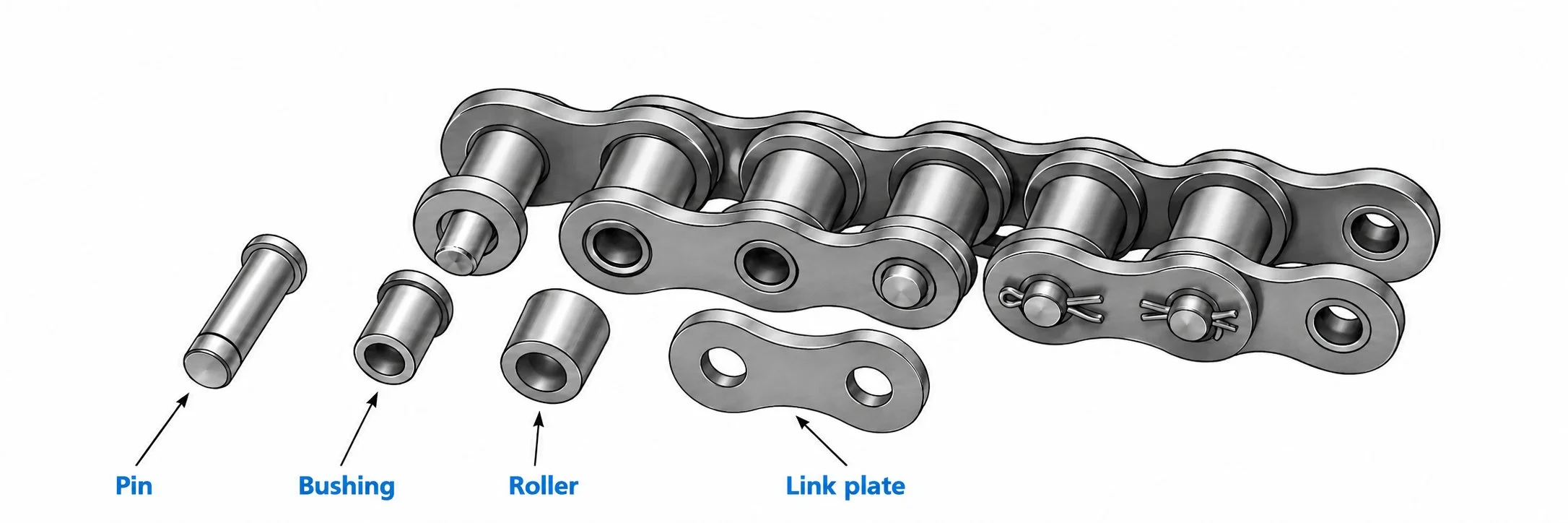
Internal chain structure — the pin-bushing interface is where tight links develop from contamination-induced corrosion or impact damage.
A tight link is a link joint that resists the normal lateral flex of the chain. When the chain is lifted from the sprocket on the slack side and the links are flexed by hand, a tight link is identified by its resistance compared to adjacent links — it requires more force to flex and springs back with more resistance. In severe cases, a tight link will hold the chain in a slightly kinked position even without applied force.
Tight links form from one of two causes: (1) water and contamination enter the pin-bushing clearance and cause fretting corrosion that welds or partially seizes the pin to the bushing; (2) an impact load — such as a hard object entering the drive — plastically deforms the outer link plate and reduces the clearance between the plate and the adjacent inner link plate, creating a mechanical interference that prevents normal flex.
The consequence of a tight link in service is a localised vibration pulse each time that joint passes over a sprocket tooth. The reduced flex means the roller does not follow the normal seating arc into the tooth root — it impacts the tooth face instead, concentrating load at one point rather than distributing it across the seating curve. The sprocket tooth at the engagement position of the tight link wears at 3–5× the rate of adjacent teeth.
Non-uniform elongation is detected by repeating the 12-link measurement at three or more positions around the chain loop. If measurements vary by more than 0.8% between sections on an ANSI #60 chain (more than 1.8 mm difference between the highest and lowest 12-link spans), the elongation is non-uniform. Non-uniform elongation is a strong indicator of localised issues — a section that ran in a contaminated trough, a connecting link joint that was over-tightened during installation, or a section of chain that was exposed to a chemical splash. The section with the highest elongation governs the replacement decision, not the average.
Building a Chain Replacement Interval Into Planned Maintenance
The most effective chain maintenance programmes do not wait for elongation measurements to trigger replacement — they establish a proactive replacement interval based on the known wear rate in the specific application, with elongation measurement used as a check rather than as the sole trigger.
- Establish initial wear rate. For a new chain installation, measure elongation at 500, 1,000, and 2,000 hours. Plot the three data points. The slope gives the elongation rate in percent per 1,000 hours for that specific drive and lubrication combination. Most drives show a higher initial rate (run-in) that stabilises after 500 hours — use the slope from 500 to 2,000 hours for planning.
- Project replacement interval. From the measured wear rate, calculate the number of operating hours to reach 2.5% elongation (the order-trigger point) and 3.0% (the replacement threshold). Build a maintenance task at the 2.5% projected interval — inspect and measure, order chain and sprockets if confirmed worn, plan replacement for the next scheduled shutdown.
- Adjust interval if lubrication changes. Any change to the lubrication system — new oil type, adjustment to drip rate, change from manual to automatic — invalidates the previously established wear rate. Re-establish the rate over the first 1,000 hours under the new lubrication regime before updating the planned interval.
- Inspect sprocket at every chain replacement. Use the tooth hooking assessment described in Article 9 to determine whether the sprocket requires simultaneous replacement. The default decision is to replace both components simultaneously unless the sprocket is demonstrably unworn — this prevents the second-chain premature wear scenario described at the start of this article.
Industry-Specific Elongation Thresholds and Replacement Considerations
Food processing lines. The 3% ANSI threshold applies to roller chain in food processing applications just as in general industrial use, but the inspection interval must be shorter because contamination from washdown chemicals accelerates corrosion at the pin-bushing interface. In chlorinated washdown environments, stainless chain should be measured every 500 operating hours rather than the 1,000–2,000 hour interval appropriate for dry indoor drives. The tight link check — lateral flex along the full chain length — should be included at every inspection because corrosion-induced seizure can develop rapidly between inspections in high-washdown frequency environments.
Agricultural harvest machinery. Combine feeder house chains and grain elevator chains run in heavily abrasive conditions during harvest periods and then sit idle for up to eight months. The idle period contributes to tight link development from fretting corrosion during storage, even when the chain appears dimensionally acceptable by elongation measurement alone. Before returning a combine to service after storage, perform the tight link flex test along the full chain length in addition to the elongation measurement — a chain with multiple tight links should be replaced even if the elongation is below the replacement threshold.
Mining and conveyor drives. Engineer class chains in drag conveyors use the same 2% inspection and 3% replacement thresholds as standard roller chain, but the measurement must also include barrel (bushing) outer diameter wear. In abrasive environments, the barrel outer surface can wear faster than the pin-bushing interface elongation accumulates — a chain may be within elongation tolerance but have barrels worn enough to reduce clearance with the trough floor. Measure barrel diameters at the 1,000-hour inspection along with elongation. Replace when barrel wear exceeds 15% of original diameter.
Precision indexing and servo drives. For servo-coupled sprocket and chain indexing applications where positional accuracy is a requirement, the replacement threshold is typically 1.5% rather than 3%. At 3% elongation in a precision drive, the variation in effective pitch between different sections of the chain (non-uniform elongation) can produce positional errors at the driven shaft that exceed the servo controller’s compensation capacity. These drives should be measured every 250–500 operating hours and maintained below the 1.5% trigger.
Frequently Asked Questions
Time to Replace Your Drive Chain?
Send your chain series, pitch, and the measured elongation value — we confirm the correct replacement chain and check stock availability, including whether the matched sprockets need to be replaced at the same time.
Editor: Cxm