Eine Maschinenbauingenieurin, die 2024 einen neuen Förderantrieb spezifizierte, benötigte eine Drehzahlreduzierung von 1450 U/min für einen Schneckenförderer auf 185 U/min – ein Übersetzungsverhältnis von ca. 7,8:1. Sie wählte eine #80-Kette mit einem 17-zahnigen Antriebsritzel und einem 133-zahnigen Abtriebsritzel, um ein Übersetzungsverhältnis von genau 7,82:1 zu erreichen. Die Berechnung war korrekt. Bereits in der ersten Woche erreichte der Antrieb jedoch nicht die erforderliche Leistung bei der Auslegungsdrehzahl. Das 133-zahnige Abtriebsritzel hatte einen Außendurchmesser von ca. 1082 mm – und überschritt damit den verfügbaren Einbauraum um 220 mm. Das Übersetzungsverhältnis stimmte, die Einbaumaße jedoch nicht. Der Antrieb musste als zweistufige Konstruktion mit Zwischenwelle neu aufgebaut werden, was die doppelten Herstellungskosten verursachte.
Die korrekte Berechnung der Kettenradzähne erfordert mehr als nur die Lösung der Übersetzungsgleichung. Es gilt, die fünf Randbedingungen zu berücksichtigen, die die Nutzbarkeit einer Zähnezahl bestimmen: minimale Anzahl der Antriebszähne, maximaler Durchmesser des Abtriebskettenrads, Umschlingungswinkel, Achsabstand und die Anforderung an die Laufzahnung für eine gleichmäßige Verschleißverteilung. Dieser Leitfaden behandelt alle fünf Bedingungen und enthält Rechenbeispiele für die häufigsten Berechnungsszenarien.
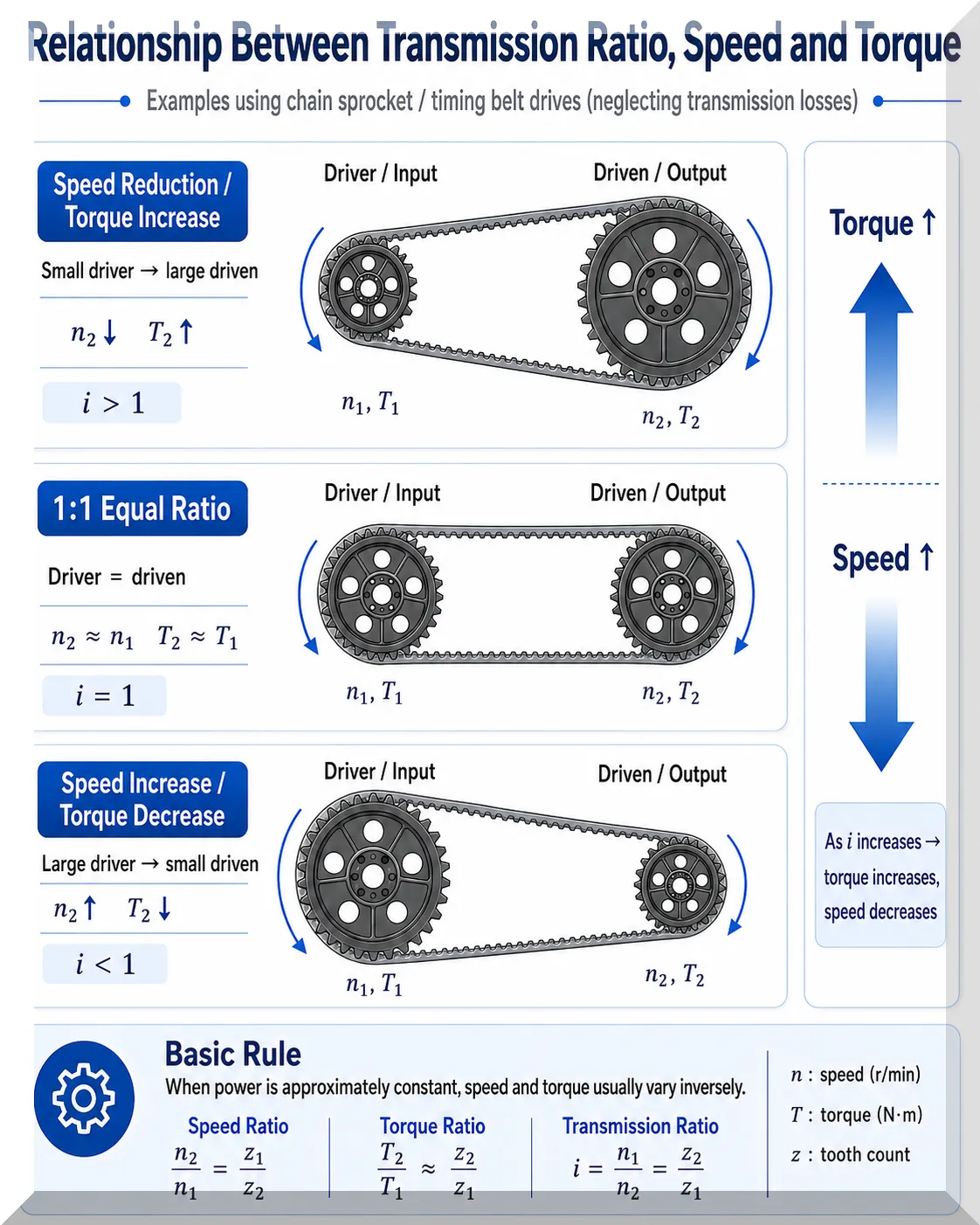
Die fundamentale Verhältnisformel und was sie Ihnen liefert
Die Übersetzungsformel beschreibt das Verhältnis der Zähnezahlen – sie gibt jedoch nicht an, welche Zähnezahlen konkret zu verwenden sind. Ein Verhältnis von 4:1 lässt sich beispielsweise mit 17:68, 18:72, 19:76, 21:84 oder Dutzenden anderer Kombinationen erreichen. Jede Kombination führt zu einem leicht abweichenden Teilkreisdurchmesser des angetriebenen Kettenrads, einer leicht abweichenden Kettenlänge und einer unterschiedlichen Anzahl an Zähnen, die am Antriebskettenrad im Eingriff sind. Die nachfolgenden Einschränkungen bestimmen, welche Kombinationen für eine bestimmte Anwendung tatsächlich geeignet sind.
Die fünf Einschränkungen, die gültige Zahnanzahlkombinationen bestimmen
Beispielrechnung 1: Untersetzungsgetriebe für ein Verpackungsförderband
Spezifikation: Motorausgangswelle: 1450 U/min. Erforderliche Förderwellendrehzahl: 96 U/min. Verfügbarer Einbauraum für das Antriebskettenrad: maximal 280 mm Außendurchmesser. Kettenteilung: ANSI #50 (15,875 mm). Anwendung: Indexierer für Verpackungslinien – reibungsloser Lauf erforderlich.
- Erforderliches Verhältnis: i = n1 / n2 = 1450 / 96 = 15.1:1Dies überschreitet das einstufige Maximum von 7:1 → zweistufiger Antrieb erforderlich.
- Das Verhältnis wird in zwei Schritte unterteilt: √15,1 ≈ 3,89. Zwei ähnliche Stadien anstreben. Verhältnis Stadium 1 ≈ 3,9:1. Verhältnis Stadium 2 ≈ 3,87:1 (3,9 × 3,87 = 15,09 – ausreichend genau). Auf realistische Zahnzahlen runden.
- Zahnzählung in Phase 1: Beginnen wir mit N1 = 19T (Präzisionsanwendung). N2 = 19 × 3,9 = 74,1 → runden wir auf 73T (ungerade – erfüllt die Jagdzahnregel, ggT(19,73) = 1). Tatsächliches Verhältnis Stufe 1: 73/19 = 3,842.
- Zahnzählung in Stadium 2: Zwischenwellendrehzahl = 1450 / 3,842 = 377 U/min. Erforderliches Übersetzungsverhältnis Stufe 2, um 96 U/min zu erreichen: 377 / 96 = 3,927. Start mit N3 = 19T. N4 = 19 × 3,927 = 74,6 → 75T (ggT(19,75) = 1). Tatsächliches Übersetzungsverhältnis Stufe 2: 75/19 = 3,947. Endausgangsleistung: 1450 / (3,842 × 3,947) = 95,6 U/min ≈ 96 U/min ✓
- Überprüfen Sie den Außendurchmesser des Antriebsritzels anhand der Vorgaben: Das größte Kettenrad hat 75 Zähne bei einer Teilung von #50. PD = 15,875 / sin(180°/75) = 15,875 / sin(2,4°) = 15,875 / 0,04188 = 379,1 mm. OD ≈ 379,1 + (0,625 × 15,875) = 379,1 + 9,9 = 389 mmDies überschreitet den Rahmen von 280 mm – die Tonhöhe muss verringert oder die Anzahl der Stufen erhöht werden.
- Auflösung: Reduzierung auf #40-Kette (12,70 mm Teilung). 75 Zähne bei #40-Teilung: PD = 12,70 / sin(2,4°) = 303,3 mm. OD ≈ 303,3 + 7,9 = 311 mmImmer noch 31 mm zu viel. Reduziert auf 70T: PD = 12,70 / sin(2,57°) = 283,2 mm. OD ≈ 283,2 + 7,9 = 291 mmInnerhalb des Rahmens mit maximal 280 mm. Neues Übersetzungsverhältnis Stufe 2: 70/19 = 3,684. Endgeschwindigkeit: 1450 / (3,842 × 3,684) = 102,4 U/minFür diese Anwendung akzeptabel (Spezifikationstoleranz ±10%). ✓
Beispiel 2: Drehzahlerhöhungsantrieb (Overdrive) für einen Generator
Spezifikation: Dieselmotor-Zapfwelle mit 1000 U/min. Generator benötigt 1800 U/min Eingangsdrehzahl. Kettenteilung: ANSI #80 (25,4 mm) – bereits vom Generatorhersteller vorgegeben. Ermitteln Sie die korrekte Zähnezahl des Kettenrads.
N2/N1 = 0,556 → N1 > N2 (Geschwindigkeitssteigerung)
N2 = angetrieben (Generator) = kleineres Kettenrad
N1 = Antrieb (Motor) = größeres Kettenrad
Bei einer Overdrive-Konfiguration ist das größere Ritzel das Antriebsritzel. Beginnen Sie mit mindestens 17 Zähnen am Abtriebsritzel (dem kleineren): N2 = 17 Zähne. N1 = N2 / i = 17 / 0,556 = 30,6 → auf 31 Zähne aufrunden. Tatsächliches Übersetzungsverhältnis: 17/31 = 0,548. Tatsächliche Generatordrehzahl: 1000 / 0,548 = 1.825 U/min — innerhalb von 1,4% vom Zielwert. GCD(31, 17) = 1 ✓ (Jagdzahn erfüllt).
Umschlagprüfung: Abtriebsritzel (17 Zähne) mit #80-Teilung: PD = 25,4 / sin(10,59°) = 138,1 mm. OD ≈ 138,1 + 15,9 = 154 mm. Antriebsritzel (31 Zähne): PD = 25,4 / sin(5,81°) = 250,7 mm. OD ≈ 250,7 + 15,9 = 267 mm. Beide Werte liegen deutlich innerhalb der üblichen Einbaumaße für eine Motor-Generator-Kupplung.
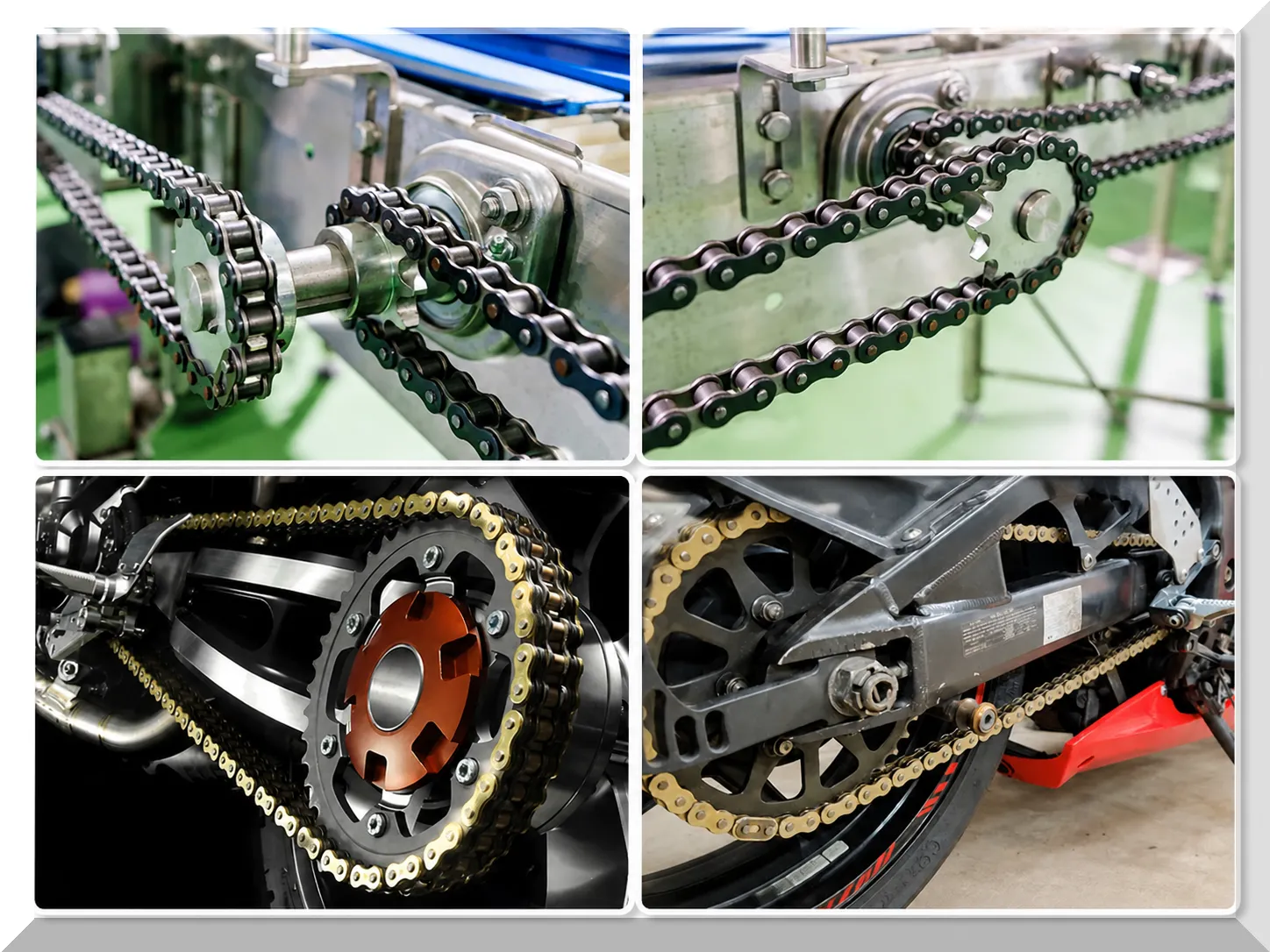
Ketten- und Ritzelantriebssystem – die Berechnung der korrekten Zähnezahl gewährleistet das erforderliche Übersetzungsverhältnis unter Einhaltung der Geometriebeschränkungen des Kettenantriebs.
Kurzübersicht Zahnzahlkombinationen für gängige Verhältnisse
Für die am häufigsten angegebenen Übersetzungsverhältnisse enthält die Tabelle unten vorausgerechnete Zahnzahlpaare, die alle fünf Bedingungen erfüllen – minimal 17T Antriebszahn, GCD = 1, einstufiges Übersetzungsverhältnis ≤ 7:1 und kein exaktes ganzzahliges Übersetzungsverhältnis (was eine ungleichmäßige Zahnverteilung verhindern würde).
| Erforderliches Verhältnis | N1 (Fahrer) | N2 (getrieben) | Tatsächliches Verhältnis | Verhältnisfehler | GCD | PD (N2) bei #60 (mm) | Anmerkungen |
|---|---|---|---|---|---|---|---|
| 1.5:1 | 19 | 29 | 1.526 | +1.7% | 1 ✓ | 174.3 | Kompakt; gute Glätte |
| 2:1 | 19 | 37 | 1.947 | −2,6% | 1 ✓ | 224.5 | 19:38 ist exakt, aber der größte gemeinsame Teiler (ggT) ist 19 – vermeiden Sie das. |
| 2.5:1 | 17 | 43 | 2.529 | +1.2% | 1 ✓ | 261.2 | |
| 3:1 | 19 | 57 | 3.000 | 0% | 19 ✗ | 346.2 | Verwende 19:58 (GCD=1) oder 17:51 (GCD=17!) → verwende stattdessen 17:53 |
| 3:1 (korrigiert) | 17 | 53 | 3.118 | +3.9% | 1 ✓ | 321.8 | Akzeptabel bei einer Drehzahltoleranz von ±5%. |
| 4:1 | 19 | 75 | 3.947 | −1,3% | 1 ✓ | 455.5 | 19:76 genau, aber GCD=19 – vermeiden |
| 5:1 | 19 | 97 | 5.105 | +2.1% | 1 ✓ | 589.2 | Großes Antriebsritzel – Außendurchmesser prüfen |
Konstruktion zweistufiger Kettenantriebe: Zwischenwelle und Stufenübersetzung
Wenn das erforderliche Übersetzungsverhältnis 7:1 übersteigt oder der Außendurchmesser des angetriebenen Kettenrads den Einbauraum in einer Stufe überschreiten würde, ist ein zweistufiger Antrieb mit Zwischenwelle die Standardlösung. Die Zwischenwelle trägt sowohl ein angetriebenes Kettenrad (das die Kraft von Stufe 1 aufnimmt) als auch ein mitführendes Kettenrad (das die Kraft an Stufe 2 abgibt). Die Übersetzungsverhältnisse der beiden Stufen werden multipliziert, um das Gesamtübersetzungsverhältnis zu erhalten: i_gesamt = i_Stufe1 × i_Stufe2.
Für eine optimale Gesamtleistung bei einem zweistufigen Antrieb sollten die Übersetzungsverhältnisse der Stufen annähernd gleich sein. Dadurch wird die Größe des größten Kettenrads im System minimiert. Eine ungleiche Stufenaufteilung (z. B. 3:1 und 5:1 bei einem Gesamtübersetzungsverhältnis von 15:1) führt zu einem größeren maximalen Kettenrad als eine gleiche Aufteilung (z. B. 3,87:1 und 3,87:1 bei demselben Übersetzungsverhältnis von 15:1). Gleiche Stufenaufteilungen erzeugen zudem in beiden Stufen die gleiche Kettenspannung, wenn die übertragene Leistung gleich ist. Dies vereinfacht die Kettendimensionierung.
Die Zwischenwellenlager müssen für die kombinierten Radialkräfte beider Kettenantriebe auf die Welle ausgelegt sein. Bei einem zweistufigen Antrieb wirken die Zugkräfte der Stufen 1 und 2 in Richtungen, die durch die Kettenlaufgeometrie bestimmt werden. Ziehen beide Zugkräfte in entgegengesetzte Richtungen an der Zwischenwelle, heben sich die Lagerkräfte teilweise auf. Ziehen sie in die gleiche Richtung, addieren sie sich. Erstellen Sie stets ein Diagramm der Kettengeometrie und berechnen Sie den resultierenden Lastvektor der Welle, bevor Sie die Zwischenwellenlager spezifizieren. Dieser Schritt wird in der Praxis häufig vernachlässigt, was zu unterdimensionierten Zwischenwellenlagern führt, die vor den Ketten ausfallen.
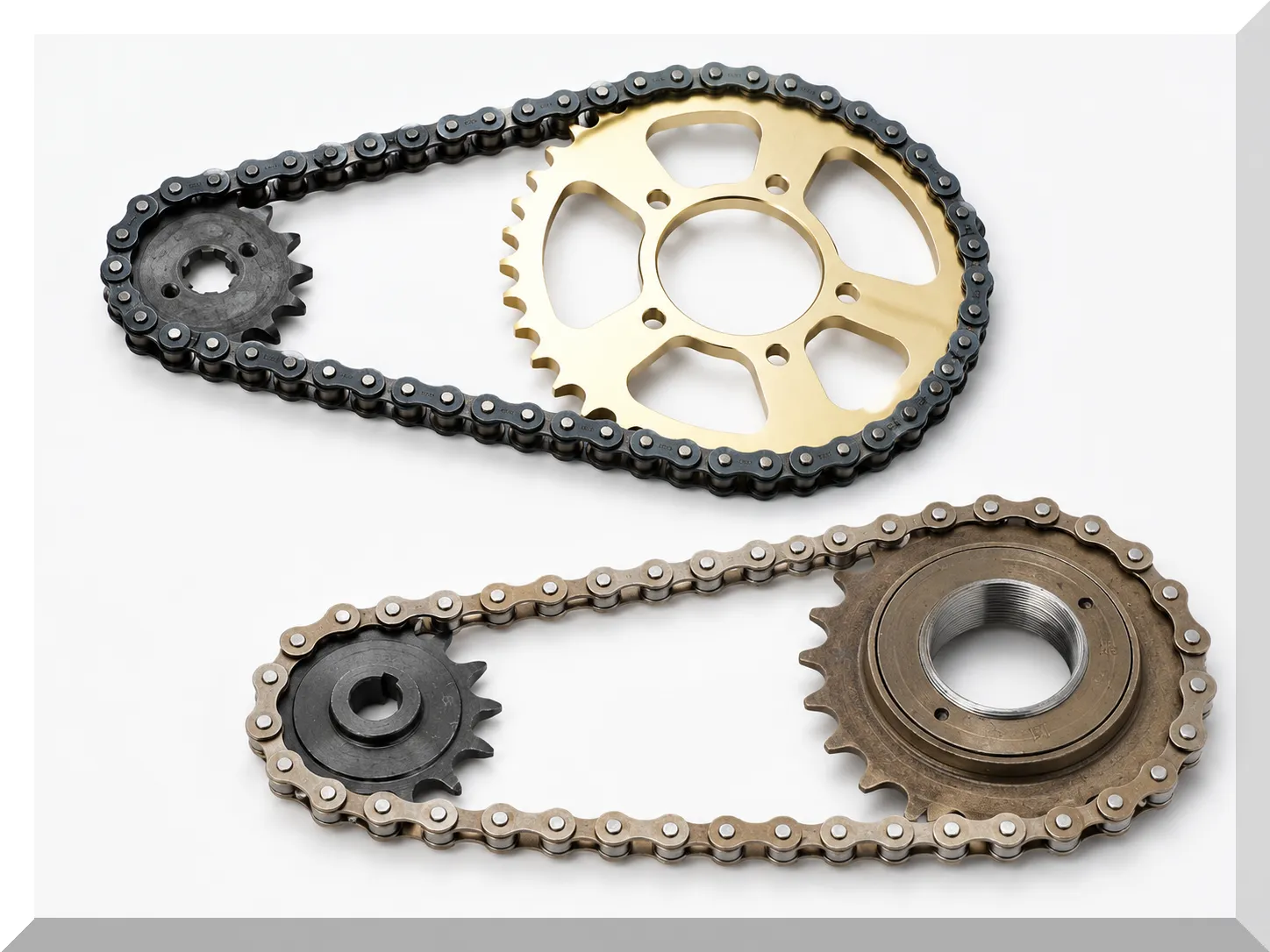
Wo die Berechnung der Zahnanzahl der entscheidende Konstruktionsschritt ist
Ersatz für landwirtschaftliche Maschinen. Beim Austausch beschädigter oder verschlissener Kettenräder an älteren Maschinen, für die keine Dokumentation mehr vorliegt, lässt sich die korrekte Zähnezahl nur durch Messen des Originalkettenrads (sofern vorhanden), Berechnen des Übersetzungsverhältnisses anhand der gemessenen Zähnezahl und Abgleich mit den Betriebsparametern der Maschine ermitteln. Falsche Zähnezahlen verändern Vorschubgeschwindigkeit, Förderbandgeschwindigkeit und Dreschgeschwindigkeit und beeinträchtigen so die Erntequalität und -effizienz, anstatt einen unmittelbaren mechanischen Ausfall zu verursachen – was die Fehlerdiagnose erschwert. Ersatzteile für landwirtschaftliche Kettenräder Falls die Dokumentation unvollständig ist, senden Sie uns bitte die ursprüngliche Zähnezahl des Kettenrads sowie die Drehzahl der Eingangs- und Ausgangswelle, damit unsere Ingenieure das korrekte Übersetzungsverhältnis bestätigen können.
Anpassung der Förderbandgeschwindigkeit. Wenn die Förderbandgeschwindigkeit geändert werden muss – typischerweise im Rahmen einer Produktionssteigerung – ist die wirtschaftlichste Methode bei einem Kettenantrieb die Änderung der Zähnezahl des Antriebsritzels. Der Wechsel von einem 45-Zahn- auf ein 40-Zahn-Antriebsritzel an einem bestehenden #60-Kettenantrieb mit einem 19-Zahn-Antriebsritzel erhöht die Förderbandgeschwindigkeit von 100% auf 45/40 = 112,5% des ursprünglichen Wertes. Die Kettenteilung und das Gesamtsystem bleiben unverändert. Standard-Ritzel mit gängigen KettenteilungenEine Änderung der Zahnanzahl um einen Zahn kann in der Regel innerhalb eines geplanten Wartungsfensters mit minimalen Ausfallzeiten durchgeführt werden.
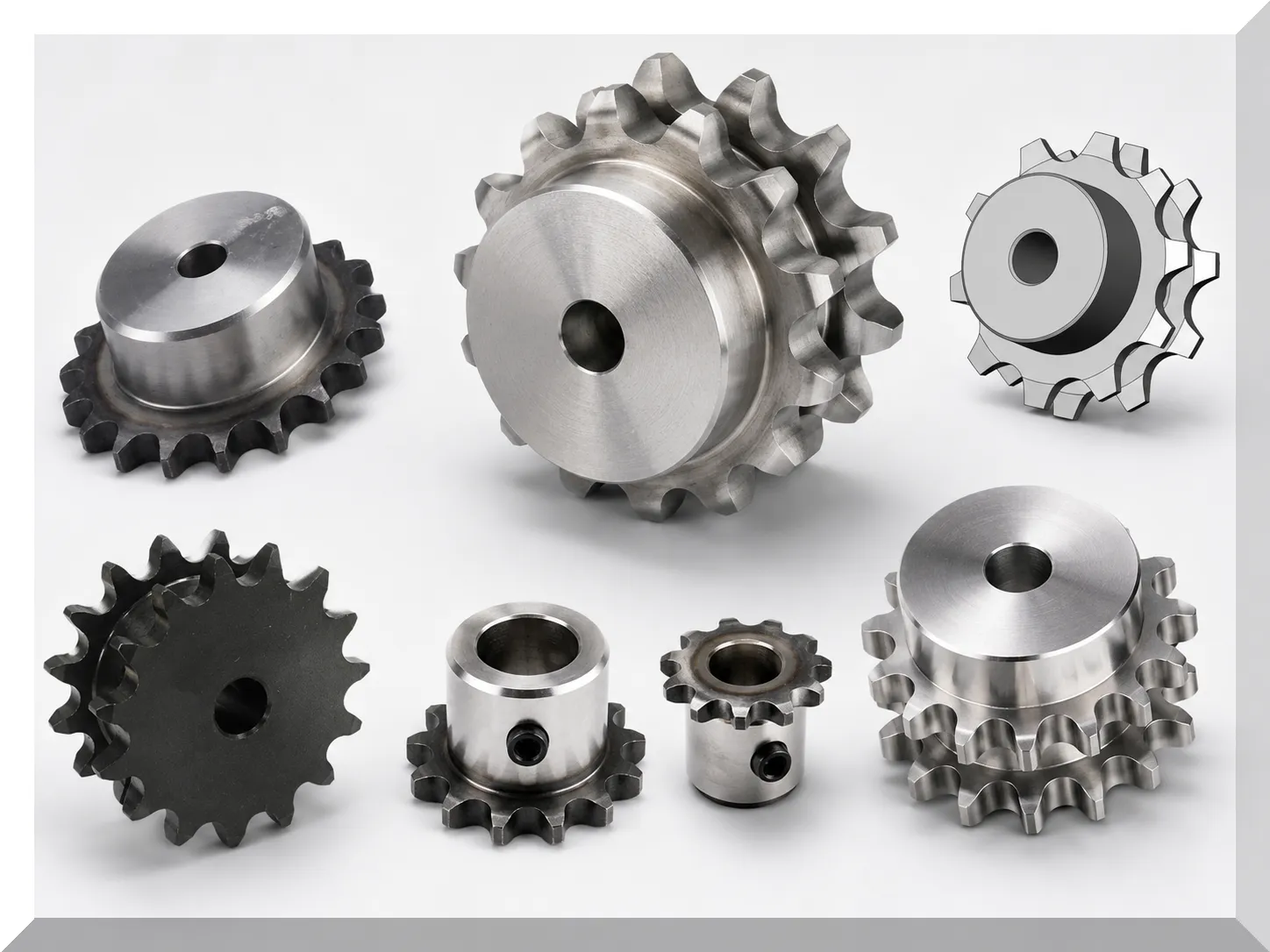
Getriebeüberbrückung oder Übersetzungsänderung. Bei manchen Industrieantrieben ist ein Getriebe beschädigt oder ein neuer Motor mit abweichender Nenndrehzahl eingebaut. Anstatt das Getriebe auszutauschen, kann mitunter ein neues Kettenantriebsübersetzungsverhältnis die benötigte Ausgangsdrehzahl direkt erreichen. Beispielsweise entfällt durch den Austausch eines 4:1-Getriebes an einem Förderband gegen einen direkten Kettenantrieb mit einem Übersetzungsverhältnis von 4:1 die Getriebewartung vollständig. Dies ist jedoch nur dann realisierbar, wenn die Abmessungen des Kettenantriebs und die Kettengröße das volle Nenndrehmoment aufnehmen können – wofür die fünf in diesem Artikel beschriebenen Einschränkungen berücksichtigt werden müssen.
Häufig gestellte Fragen
Herausgeber: Cxm