A mechanical engineer specifying a new conveyor drive in 2024 needed to step a 1,450 RPM motor down to a 185 RPM shaft speed for a screw conveyor — a ratio of approximately 7.8:1. She selected a #80 chain with a 17-tooth driver and a 133-tooth driven sprocket to achieve exactly 7.82:1. The calculation was correct. The drive failed to meet the required output at the design speed within the first week. The 133-tooth driven sprocket had an outer diameter of approximately 1,082 mm — which exceeded the available installation clearance by 220 mm. The ratio was right. The physical envelope was not. The drive had to be rebuilt as a two-stage arrangement with an intermediate shaft, at twice the original fabrication cost.
Calculating sprocket tooth counts correctly means more than solving the ratio equation. It means working through the five constraints that determine whether a set of tooth counts is actually usable — minimum driver tooth count, maximum driven sprocket diameter, wrap angle, centre distance, and the hunting tooth requirement for even wear distribution. This guide covers all five, with worked examples for the most common calculation scenarios.
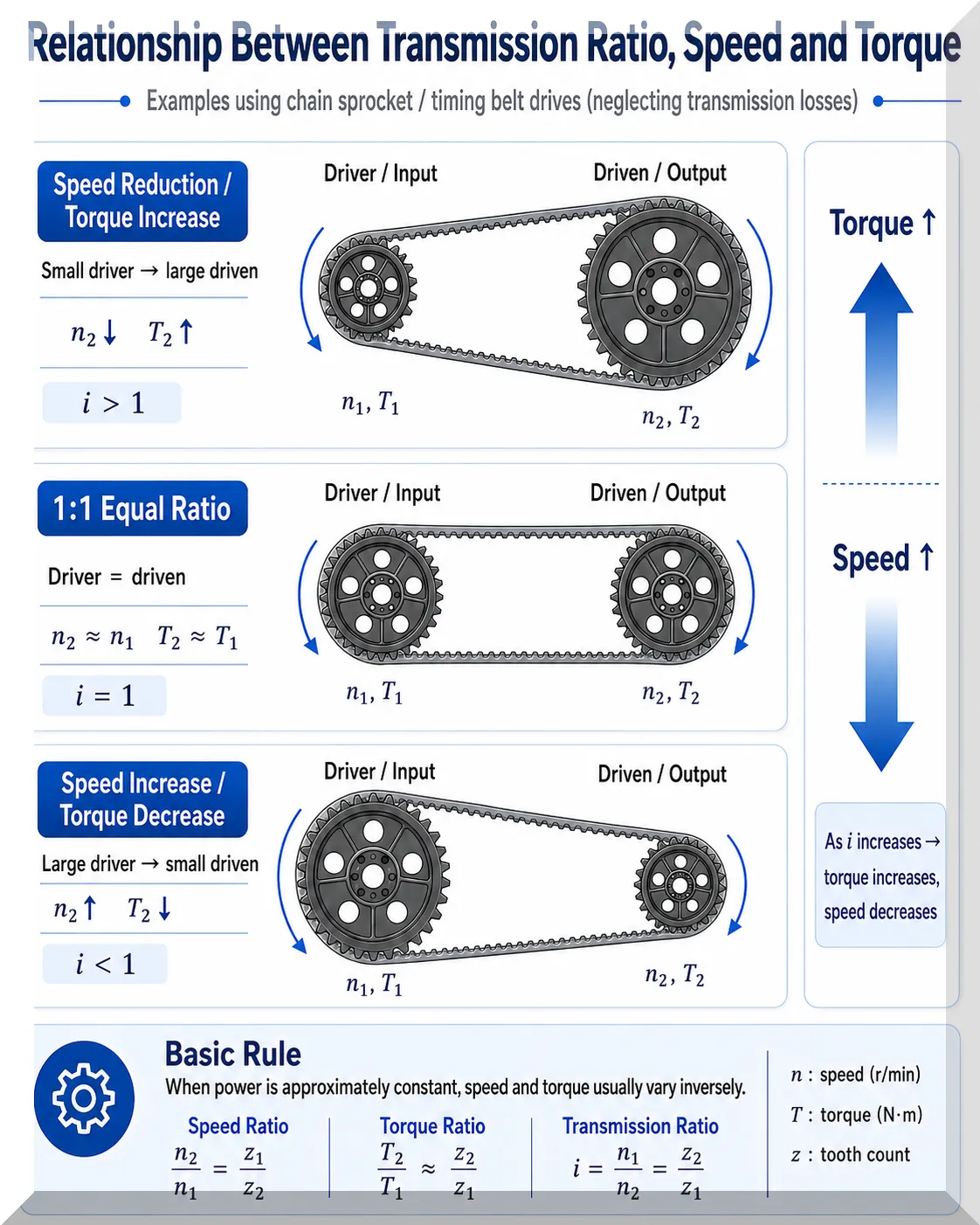
The Fundamental Ratio Formula and What It Gives You
The ratio equation tells you the relationship between tooth counts — it does not tell you which specific tooth counts to use. A ratio of 4:1 can be achieved with 17:68, 18:72, 19:76, 21:84, or dozens of other combinations. Each combination produces a slightly different pitch circle diameter for the driven sprocket, a slightly different chain length, and a different number of teeth in contact on the driver. The constraints that follow determine which combinations are actually usable for a given application.
The Five Constraints That Determine Valid Tooth Count Combinations
Worked Example 1: Speed Reduction Drive for a Packaging Conveyor
Specification: Motor output shaft at 1,450 RPM. Required conveyor shaft speed: 96 RPM. Available installation envelope for driven sprocket: 280 mm maximum OD. Chain pitch: ANSI #50 (15.875 mm). Application: packaging line indexer — smooth operation required.
- Required ratio: i = n1 / n2 = 1450 / 96 = 15.1:1. This exceeds the 7:1 single-stage maximum → two-stage drive required.
- Split the ratio into two stages: √15.1 ≈ 3.89. Aim for two similar stages. Stage 1 ratio ≈ 3.9:1. Stage 2 ratio ≈ 3.87:1 (3.9 × 3.87 = 15.09 — close enough). Round to achievable tooth counts.
- Stage 1 tooth counts: Start with N1 = 19T (precision application). N2 = 19 × 3.9 = 74.1 → round to 73T (odd — satisfies hunting tooth rule, GCD(19,73) = 1). Actual ratio stage 1: 73/19 = 3.842.
- Stage 2 tooth counts: Intermediate shaft speed = 1450 / 3.842 = 377 RPM. Required stage 2 ratio to reach 96 RPM: 377 / 96 = 3.927. Start with N3 = 19T. N4 = 19 × 3.927 = 74.6 → 75T (GCD(19,75) = 1). Actual ratio stage 2: 75/19 = 3.947. Final output: 1450 / (3.842 × 3.947) = 95.6 RPM ≈ 96 RPM ✓
- Check driven sprocket OD against envelope: Largest sprocket is 75T at #50 pitch. PD = 15.875 / sin(180°/75) = 15.875 / sin(2.4°) = 15.875 / 0.04188 = 379.1 mm. OD ≈ 379.1 + (0.625 × 15.875) = 379.1 + 9.9 = 389 mm. This exceeds the 280 mm envelope — must reduce pitch or increase stage count.
- Resolution: Reduce to #40 chain (12.70 mm pitch). 75T at #40 pitch: PD = 12.70 / sin(2.4°) = 303.3 mm. OD ≈ 303.3 + 7.9 = 311 mm. Still 31 mm over. Reduce to 70T: PD = 12.70 / sin(2.57°) = 283.2 mm. OD ≈ 283.2 + 7.9 = 291 mm. Within envelope with 280 mm maximum. New stage 2 ratio: 70/19 = 3.684. Final speed: 1450 / (3.842 × 3.684) = 102.4 RPM. Acceptable for this application (specification tolerance ±10%). ✓
Worked Example 2: Speed Increase Drive (Overdrive) for a Generator
Specification: Diesel engine PTO at 1,000 RPM. Generator requires 1,800 RPM input. Chain pitch: ANSI #80 (25.4 mm) — already specified by the generator OEM. Find the correct sprocket tooth counts.
N2/N1 = 0.556 → N1 > N2 (speed increase)
N2 = driven (generator) = smaller sprocket
N1 = driver (engine) = larger sprocket
In an overdrive configuration, the driver is the larger sprocket. Begin with a minimum of 17T on the driven sprocket (the smaller one): N2 = 17T. N1 = N2 / i = 17 / 0.556 = 30.6 → round to 31T. Actual ratio: 17/31 = 0.548. Actual generator speed: 1000 / 0.548 = 1,825 RPM — within 1.4% of target. GCD(31, 17) = 1 ✓ (hunting tooth satisfied).
Envelope check: Driven sprocket (17T) at #80 pitch: PD = 25.4 / sin(10.59°) = 138.1 mm. OD ≈ 138.1 + 15.9 = 154 mm. Driver sprocket (31T): PD = 25.4 / sin(5.81°) = 250.7 mm. OD ≈ 250.7 + 15.9 = 267 mm. Both well within typical installation envelopes for an engine-generator coupling.
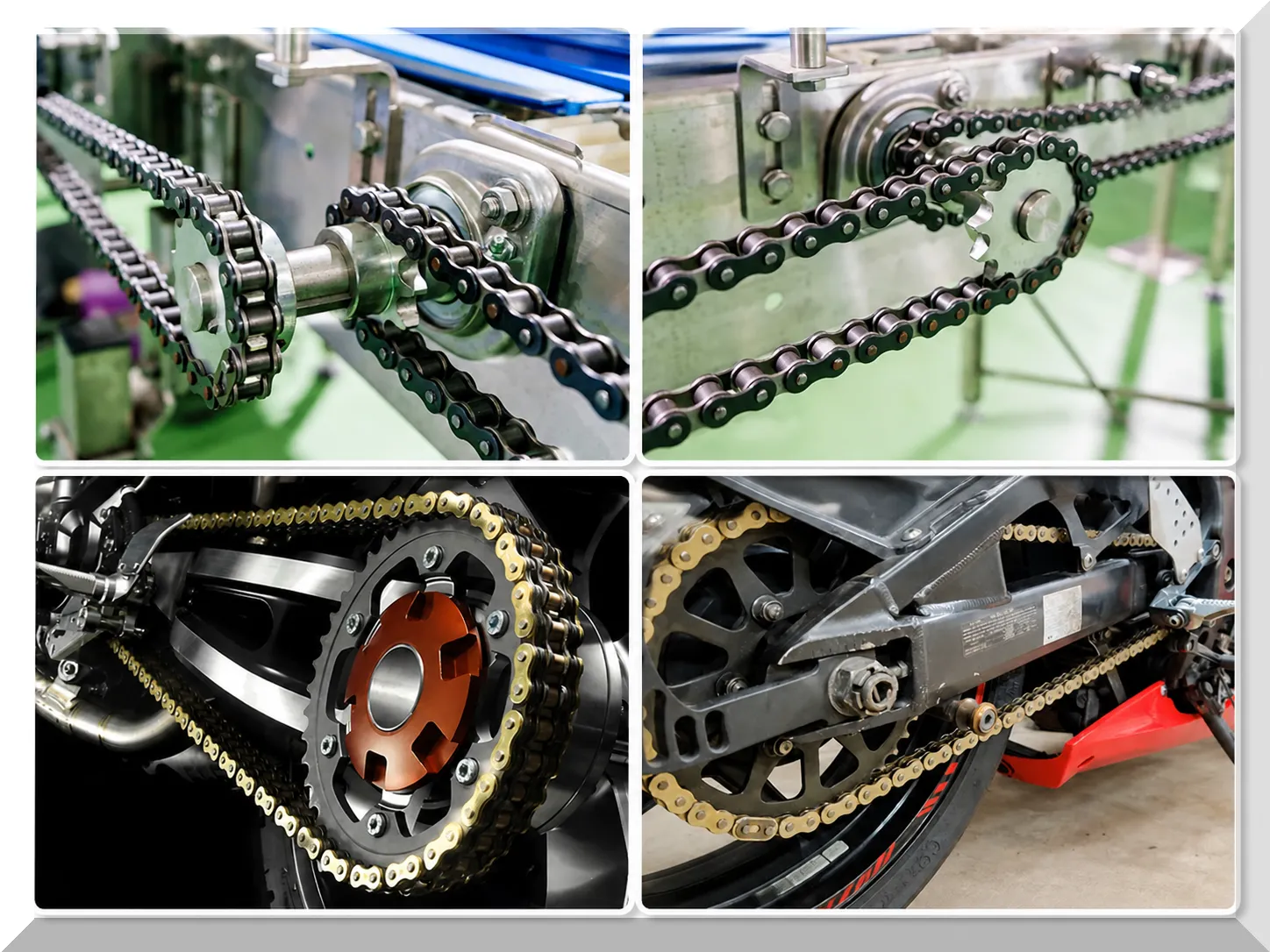
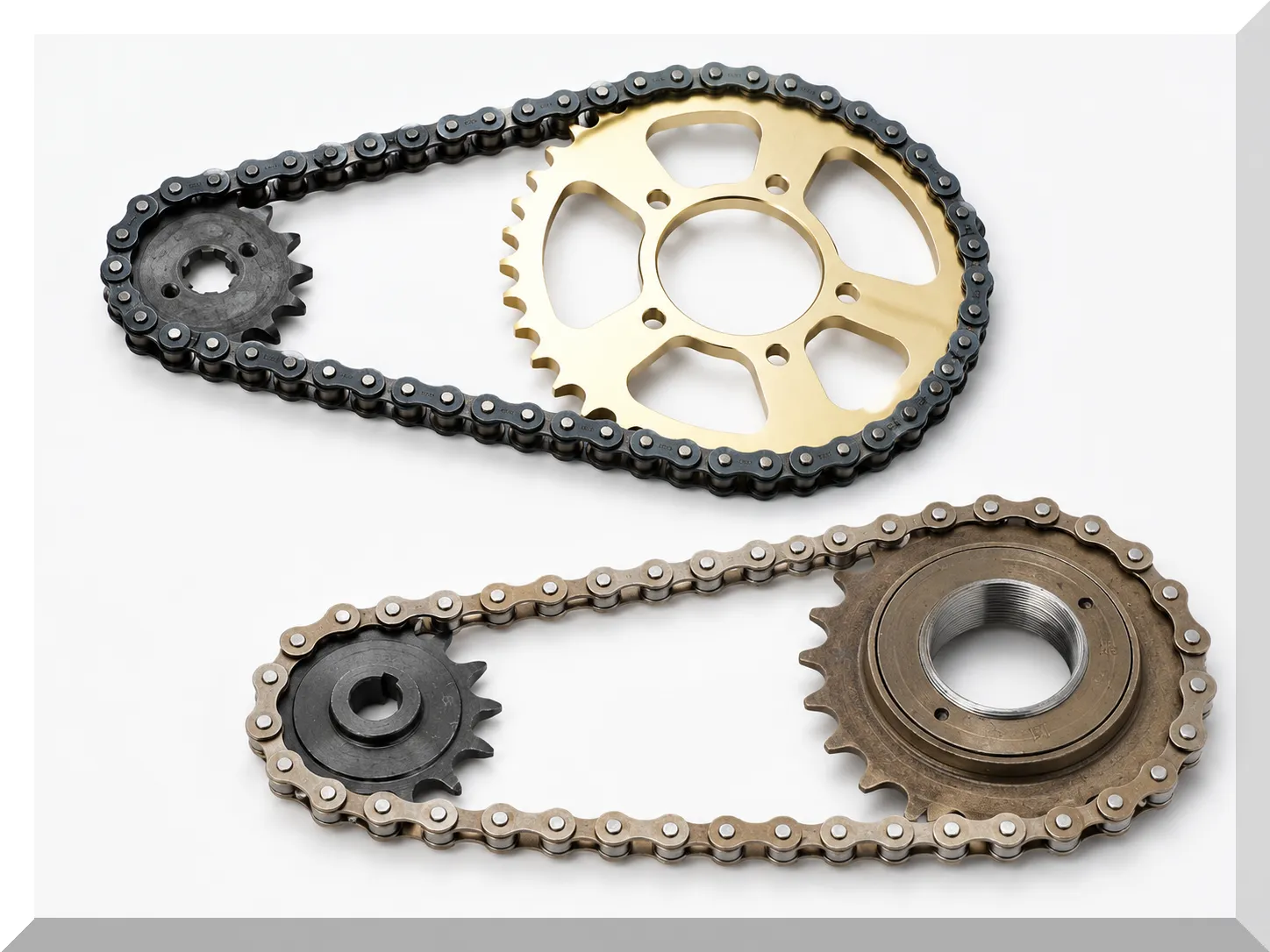
Chain and sprocket drive system — calculating correct tooth counts ensures the required speed ratio while maintaining chain drive geometry constraints.
Quick-Reference Tooth Count Combinations for Common Ratios
For the most frequently specified ratios, the table below provides pre-calculated tooth count pairs that satisfy all five constraints — minimum 17T driver, GCD = 1, single-stage ratio ≤ 7:1, and no exact integer ratio (which would prevent hunting tooth distribution).
| Required Ratio | N1 (driver) | N2 (driven) | Actual Ratio | Ratio Error | GCD | PD (N2) at #60 (mm) | Notes |
|---|---|---|---|---|---|---|---|
| 1.5:1 | 19 | 29 | 1.526 | +1.7% | 1 ✓ | 174.3 | Compact; good smoothness |
| 2:1 | 19 | 37 | 1.947 | −2.6% | 1 ✓ | 224.5 | 19:38 is exact but GCD=19 — avoid |
| 2.5:1 | 17 | 43 | 2.529 | +1.2% | 1 ✓ | 261.2 | |
| 3:1 | 19 | 57 | 3.000 | 0% | 19 ✗ | 346.2 | Use 19:58 (GCD=1) or 17:51 (GCD=17!) → use 17:53 instead |
| 3:1 (corrected) | 17 | 53 | 3.118 | +3.9% | 1 ✓ | 321.8 | Acceptable if ±5% speed tolerance |
| 4:1 | 19 | 75 | 3.947 | −1.3% | 1 ✓ | 455.5 | 19:76 exact but GCD=19 — avoid |
| 5:1 | 19 | 97 | 5.105 | +2.1% | 1 ✓ | 589.2 | Large driven sprocket — check OD |
Designing Two-Stage Chain Drives: Intermediate Shaft and Stage Ratio Splitting
When the required ratio exceeds 7:1 or when the driven sprocket OD would exceed the installation envelope at a single stage, a two-stage drive with an intermediate shaft is the standard solution. The intermediate shaft carries both a driven sprocket (receiving power from Stage 1) and a driver sprocket (delivering power to Stage 2). The two stage ratios multiply to give the overall ratio: i_total = i_stage1 × i_stage2.
For the best overall drive performance in a two-stage arrangement, the stage ratios should be approximately equal — this minimises the size of the largest sprocket in the system. An unequal stage split (e.g., 3:1 and 5:1 for an overall 15:1) produces a larger maximum sprocket than an equal split (e.g., 3.87:1 and 3.87:1 for the same 15:1). Equal stage ratios also produce equal chain tensions in both stages when the transmitted power is the same, which simplifies chain sizing.
The intermediate shaft bearings must be sized for the combined radial loads from both chain drives acting on the shaft. In a two-stage drive, the tight-side tensions from Stage 1 and Stage 2 act in directions determined by the chain run geometry — if both tight sides pull the intermediate shaft in opposite directions, the bearing loads partially cancel. If both pull in the same direction, they add. Always draw the chain geometry diagram and calculate the resultant shaft load vector before specifying intermediate shaft bearings. This step is frequently omitted in practice, resulting in undersized intermediate shaft bearings that fail before either chain.
Where Tooth Count Calculation Is the Critical Design Step
Agricultural machinery replacement. When replacing damaged or worn sprockets on older machines where documentation is lost, the only way to confirm the correct tooth count is to measure the original sprocket (if available), calculate the speed ratio from the measured tooth counts, and verify against the machine’s operational parameters. Incorrect tooth counts alter feed rates, conveyor speeds, and threshing speeds in ways that affect crop quality and harvest efficiency rather than causing immediate mechanical failure — making the error harder to diagnose. For agricultural sprocket replacements where documentation is incomplete, send the original sprocket tooth count plus the input and output shaft RPM and our engineers can confirm the correct ratio.
Conveyor speed modification. When a conveyor line speed needs to be changed — typically as part of a production throughput upgrade — the most economical approach in a chain drive system is to change the driven sprocket tooth count. Changing from a 45T to a 40T driven sprocket on an existing #60 chain drive with a 19T driver increases conveyor speed from 100% to 45/40 = 112.5% of original. The chain pitch and overall system remain unchanged. For standard bore sprockets in common chain pitches, a single-tooth count change can usually be implemented within a planned maintenance window with minimal downtime.
Gearbox bypass or ratio change. In some industrial drives, a gearbox has been damaged or a new motor with different nameplate speed is being fitted. Rather than replacing the gearbox, a new chain drive ratio can sometimes achieve the required output speed directly. For example, replacing a 4:1 gearbox on a conveyor with a direct chain drive at 4:1 ratio eliminates the gearbox maintenance requirement entirely. This is only viable if the chain drive envelope and chain size can accommodate the full rated torque — which requires working through the five constraints outlined in this article.
Frequently Asked Questions
Editor: Cxm