A production engineer at a Korean industrial bakery specified a replacement for a failed drive chain on a dough mixer drive. She took the motor nameplate — 7.5 kW at 1,450 RPM — applied the ANSI service factor of 1.3 for moderate shock, found a suitable chain in the selection chart, and ordered it. The replacement failed at the same location after 1,100 hours, almost exactly matching the service life of the original. The chain selection was technically correct for a standard moderate-shock application. What it did not account for was that the dough mixer starts under full load three times per shift — cold, stiff dough — and each start event peaks at approximately 4× the running torque for the first 2–3 seconds. The ANSI service factor system applies to steady-state and moderate cyclic loads; it does not capture inertial start-up loads. Designing the drive for the start-up torque rather than the running torque would have required a chain two sizes larger, or a fluid coupling upstream to limit the start-up peak. Neither option was considered because the start-up condition was not included in the selection calculation.
Selecting the correct drive chain requires working through four distinct engineering questions in sequence, and it requires that each question is answered for the actual operating condition — not the nameplate condition. This guide provides the method for each step.
Step 1 — Determine Corrected Design Power
The ANSI B29.1 selection method begins with the corrected design power, which is the motor nameplate power multiplied by a service factor that accounts for the load character of the driven machine. The published ANSI service factors are:
| Load Type | Load Character | ANSI Service Factor | Typical Equipment Examples |
|---|---|---|---|
| Smooth | Steady torque, no pulses | 1.0 | Centrifugal pumps, fans, liquid agitators |
| Moderate Shock | Cyclic or pulsing, occasional peaks | 1.3–1.5 | Belt conveyors, dough mixers, machine tools |
| Heavy Shock | Severe intermittent peaks, reversals | 1.7–2.0 | Rock crushers, presses, compressors (reciprocating) |
Beyond the standard service factor, two additional multipliers apply in specific cases: a multiple-strand factor (when running duplex or triplex chain, the power rating is multiplied by 1.7 or 2.5 respectively rather than simply doubled or tripled, because the strands do not share load perfectly equally); and an idler sprocket factor (a plain idler on the slack side reduces the rated power capacity by approximately 10–15% due to the additional flex fatigue cycle introduced).
Step 2 — Select Chain Pitch from the Power Rating Chart
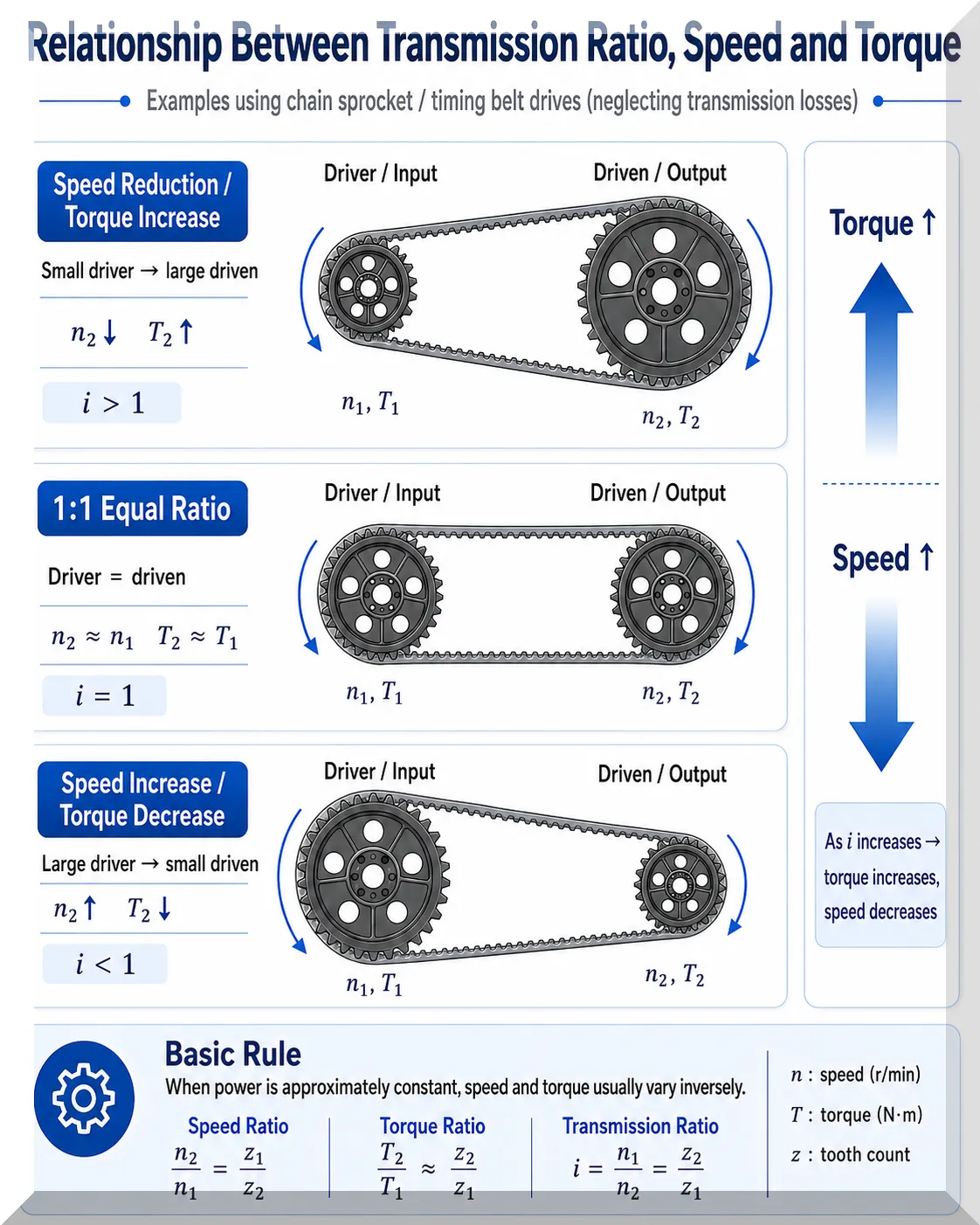
The relationship between transmission ratio, shaft speed, and torque — fundamental to correct chain pitch selection.
The ANSI B29.1 power rating charts map any combination of corrected design power (kW) and small sprocket speed (RPM) to a recommended chain pitch. The chart is divided into regions — each region bounded by a minimum and maximum RPM at the chain’s rated power capacity for each pitch. The correct pitch is the one whose region contains the design point (power × RPM intersection).
Two selection rules that the chart alone does not communicate: first, when the design point falls near the boundary between two pitch zones, always select the smaller pitch and confirm whether double-strand in the smaller pitch is preferable to single-strand in the larger. Second, at low speeds (below approximately 100 RPM on the small sprocket), the chart power ratings become conservative because lubrication film formation becomes marginal — at very low speeds, selecting the next size up from the chart result and specifying continuous lubrication is the correct approach regardless of the chart boundary.
| Chain Pitch | Practical Speed Range (RPM) | Rated Power at 500 RPM (kW, 17T) | Rated Power at 1450 RPM (kW, 17T) | Max Recommended Speed (RPM, 17T) |
|---|---|---|---|---|
| #35 (9.525 mm) | 400–3,000+ | 0.37 | 0.82 | 4,800 |
| #40 (12.70 mm) | 200–2,500 | 1.20 | 2.90 | 3,200 |
| #50 (15.875 mm) | 150–2,000 | 2.30 | 5.20 | 2,500 |
| #60 (19.05 mm) | 100–1,800 | 4.20 | 9.10 | 2,000 |
| #80 (25.40 mm) | 60–1,200 | 9.50 | 19.5 | 1,400 |
| #100 (31.75 mm) | 40–900 | 18.0 | 35.5 | 1,100 |
| #120 (38.10 mm) | 30–700 | 30.0 | 57.0 | 800 |
All power ratings in this table apply to single-strand chain on 17 teeth with Type 2 drip lubrication. Actual rated power increases with tooth count (17T → 21T adds approximately 18% capacity) and decreases with inadequate lubrication (manual lubrication at the rated speed reduces effective capacity by 30–40% from the Type 2 value). The table is a starting point for chain selection, not an end point — always cross-check against the manufacturer’s published selection chart for the specific chain grade being considered.
Step 3 — Select Sprocket Tooth Counts and Confirm Transmission Ratio
Once the chain pitch is confirmed, the sprocket tooth counts are selected to achieve the required speed ratio. The transmission ratio formula is exact for chain drives because of the positive engagement:
Three tooth-count rules that affect drive quality beyond the ratio:
ANSI B29.1 specifies 17 teeth as the practical minimum for smooth, quiet operation. Below 17 teeth, the polygon effect velocity variation exceeds ±1.7%, producing audible noise and measurable shaft speed ripple. Below 13 teeth, the wrap angle on the small sprocket drops below 120°, reducing the number of teeth in engagement and requiring the published power ratings to be derated. Use 17T minimum on the driver; 21T or more for precision-indexing and servo-coupled drives.
Using an odd tooth count on one sprocket and an even count on the other ensures that each roller contacts every tooth on its sprocket rather than repeatedly contacting the same tooth. This distributes wear across the full sprocket circumference rather than concentrating it at the fraction of teeth that would be repeatedly engaged by the same rollers. The effect is most pronounced when the chain length is a whole multiple of the pitch — avoiding this “hunting tooth” relationship by using tooth counts with a common factor of 1 produces measurably more even wear distribution.
ANSI B29.1 recommends a maximum single-stage transmission ratio of 7:1. Above this ratio, the wrap angle on the small sprocket drops to the point where chain tension cannot be maintained reliably without a tensioner. More practically, ratios above 5:1 in a single stage are usually better addressed by a two-stage chain drive or a combined chain-and-gearbox arrangement — the large driven sprocket required for a 7:1 ratio at common shaft speeds becomes physically impractical at medium and large chain pitches.
Step 4 — Centre Distance, Chain Length and Sag Setting
The recommended centre distance for standard horizontal chain drives is 30–50 times the chain pitch. For ANSI #60 chain with a 19.05 mm pitch, this gives a recommended range of 571–952 mm. Closer than 30 pitches reduces the wrap angle on the small sprocket; farther than 50 pitches creates a long free span on the slack side that develops resonant vibration at certain RPM ranges. Both extremes require additional measures — a tensioner at short centres, a centre-span guide or vibration damper at long spans.
Chain length in pitches (links) is calculated from:
Round the result to the nearest even number to allow a standard full connecting link (half links or offset links are weaker and should be avoided in all but light-duty applications). The centre distance is then adjusted slightly to accommodate the whole-link chain — reduce centre distance if rounding down, increase if rounding up.
Slack-side sag for a horizontal drive should be set to approximately 2% of the centre distance. For a 600 mm centre distance drive, the correct sag — measured at the centre of the lower chain run with the drive at rest — is about 12 mm. Over-tight chain increases bearing loads and runs hotter; insufficient tension allows the slack side to flap and increases the impact velocity of roller engagement on the driving sprocket. On drives with vertical or inclined chain runs, the sag requirement reduces to 0–1% of centre distance because gravity assists chain tensioning on the lower span.
Step 5 — Selecting the Lubrication System to Match the Power Rating
The ANSI power rating charts are published at specific lubrication types. Using a lower-grade lubrication method than the rated lubrication type reduces the effective power capacity from the tabulated value. This is the single most frequently ignored aspect of chain drive selection, because the lubrication decision is often made independently of the chain sizing — by maintenance engineering, after the mechanical design is complete.
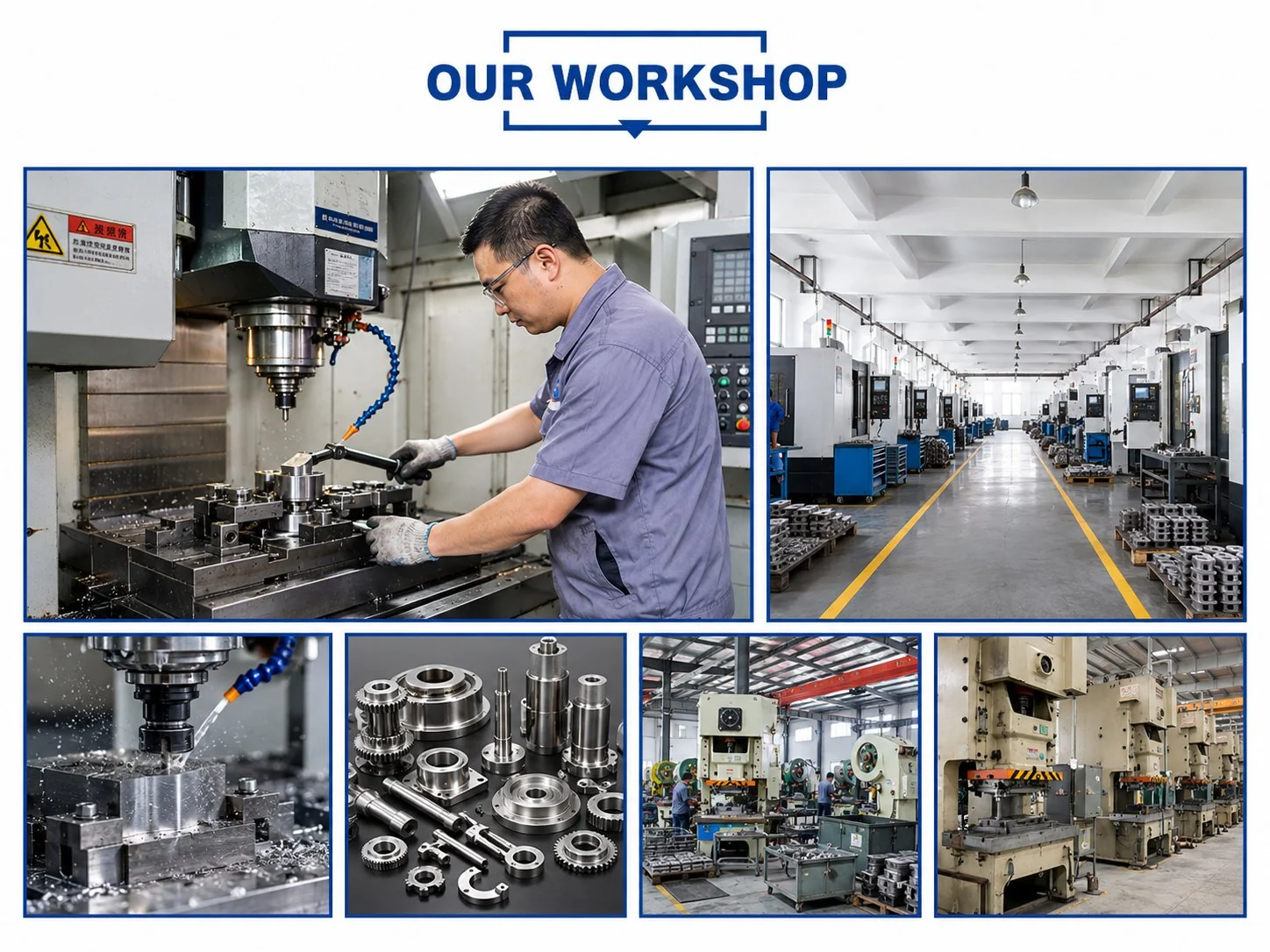
Drive chain systems installed in controlled industrial environments — lubrication system selection is as critical as chain size selection.
| Lubrication Type | Method | Applicable Speed (rpm, small sprocket) | Power Capacity vs. Rated |
|---|---|---|---|
| Type 1 — Manual | Periodic brush or squeeze bottle to slack side | Below 200 RPM | 60–70% of rated |
| Type 2 — Drip | Metered oil drops from reservoir to chain inside | 200–1,000 RPM | 100% of rated (chart basis) |
| Type 3 — Bath / Slinger | Chain dips in oil sump or disc slings oil onto chain | Up to 2,000 RPM | 130–150% of rated |
| Type 4 — Forced Stream | Oil pump delivers continuous stream; filter + cooler | All speeds including 2,000+ RPM | 150–175% of rated |
The implications of this table are significant for drive design. A chain selected at the border of its rated capacity under Type 2 drip lubrication and then installed with only manual lubrication is effectively running at 140–167% of its capacity — a condition that will produce fatigue failure before the design service life regardless of the chain quality. Conversely, upgrading from drip to oil bath lubrication on an existing drive can effectively increase power capacity by 30–50%, sometimes deferring a chain upsizing project entirely.
Six Drive Chain Selection Errors That Account for Most Premature Failures
Motor nameplate power is the maximum continuous rating, not the average running power. A 7.5 kW motor driving a half-loaded conveyor at 3.8 kW effective load should use the effective load for selection, not the nameplate — this error can over-specify the chain by 50–100%, which wastes cost but is benign. The dangerous direction is applying the service factor to the nameplate when the drive routinely peaks above nameplate during start-up or transient conditions.
Direct-on-line (DOL) motor starts produce 5–7× rated torque for 0.5–2 seconds. On a chain drive directly coupled to the motor (no belt or fluid coupling to absorb the start-up peak), this peak torque is transmitted entirely through the chain. At 6× rated torque, a chain correctly sized for the steady-state condition with a 7:1 safety factor is momentarily at 1.2:1 safety factor — below the single-event failure threshold for fatigue damage accumulation.
Chain selection and lubrication selection must be done simultaneously. A chain selected at the upper limit of its Type 2 drip lubrication rating and then installed without a drip oiler — relying on monthly manual lubrication — is operating at 40–50% beyond its actual capacity under the installed lubrication condition.
Using 13 or 15 teeth to save space introduces the polygon effect velocity ripple described above. This is a design compromise, not an engineering optimisation. If space genuinely cannot accommodate a 17-tooth sprocket at the required centre distance, the correct response is to change the chain pitch, not the tooth count minimum.
An offset link (half link) reduces the local fatigue life at that joint by 20–35% compared with a press-fit connecting link. On standard light-duty applications this is acceptable. On heavy or high-shock drives, the correct approach is to adjust the centre distance to accommodate an even number of links and use a rivet-type press connecting link.
A sprocket that has run against an elongated chain has had its tooth geometry modified to match the elongated pitch. Installing a new chain on modified tooth geometry produces accelerated early elongation — the new chain reaches its replacement threshold in a fraction of the normal service life. Replace both chain and sprockets at the elongation threshold.
Applications Where Correct Drive Chain Selection Has the Highest Consequence
Servo-driven indexing systems. Servo motors operating in precise positioning applications tolerate very little velocity variation in the chain drive. The polygon effect from low tooth counts appears as a sinusoidal position error at the driven shaft — a 17-tooth driver produces ±1.7% velocity variation, which corresponds to a positional error of approximately ±0.3 mm at a 100 mm pitch circle radius. For high-precision indexing, 21 teeth minimum on the driver, with a fixed centre distance (no slack adjustable tensioner) and oil bath lubrication, provides the best combination of positional accuracy and service life. See our range of finished-bore sprockets for precision drives for compatible configurations.
Agricultural equipment drives. Combine feeder house, thresher, and elevator drives all operate under highly variable loads in abrasive environments. The selection principle here is to size the drive chain for the worst-case load scenario — not the average — and to specify O-ring sealed chain for the critical drives where lubrication access is limited. An ANSI #80 or #100 sealed chain in a combine feeder house will outlast an open chain of equivalent rating by a factor of 4–6 under Korean field conditions. Sealed roller chain variants for agricultural applications are stocked in #60 through #120 pitch sizes.
Continuous process industry drives. Paper mills, cement plants, and steel service centres often run chain drives continuously for weeks at a time between scheduled maintenance windows. For these applications, the selection should be based on a minimum 10,000-hour service life, which requires selecting the chain at a working load no greater than 8–10% of the minimum break load with continuous oil circulation lubrication. This appears very conservative — and it is, intentionally — because unscheduled downtime in continuous process industries typically costs 10–30× the cost of the chain itself per incident.

Frequently Asked Questions
Have Our Engineers Verify Your Drive Chain Selection
Send your application data — motor power, speed, load type, lubrication access, and environment — and we will confirm the chain pitch, service factor, sprocket tooth counts, and lubrication specification before any parts are committed. No-obligation specification review within one business day.
Editor: Cxm