A maintenance technician at a Vietnamese food processing plant pulled a worn sprocket off a bucket elevator in 2024. The original part number was stamped on the hub but unreadable — years of washdown had erased it. The machinery was Korean-built, but the documentation was incomplete and the original supplier had stopped stocking the part. The technician measured the sprocket with a tape measure, counted the teeth, and sent a supplier an order for “25-tooth sprocket, approximately 150 mm diameter.” Three suppliers sent three different sprockets. None of them fit correctly. The error was not in the tooth count — it was in the unspecified hub configuration, the unmeasured bore diameter, and the unknown chain series. A complete measurement sequence on the original sprocket would have defined all of these in 20 minutes and produced a correct replacement on the first order.
This guide covers every measurement required to fully specify a sprocket for replacement, with the formulas to convert those measurements into catalogue values and the tolerances that define acceptable measurement accuracy.
Tools Required and Measurement Accuracy Standards
Digital vernier calliper (150 mm capacity minimum) or outside micrometer. Do not use a standard steel ruler — the ±0.5 mm accuracy of a ruler is insufficient to distinguish between adjacent bore sizes, and will produce wrong specifications for keyway fitting.
The same vernier calliper, measuring across the tooth root seating curve. The ±0.1 mm tolerance is adequate to distinguish ANSI #40 from #50, and to confirm the chain series from the tooth root radius measurement.
Outside diameter and hub projection length can be measured to ±1.0 mm accuracy using a rule or tape measure — these dimensions are used for clearance confirmation, not for specification matching. Precision here is less critical.
The Six-Measurement Sequence: Full Sprocket Identification
Count every tooth around the full sprocket circumference. Mark the starting tooth with chalk or a marker to avoid double-counting on large sprockets. If the sprocket has visible tooth damage making individual teeth hard to count, count from the underside of the tooth (from root to root) rather than tip to tip. For engineer class sprockets with deep barrel pockets between teeth, count the barrel pockets rather than the tooth tips — they are easier to distinguish.
The tooth root seating curve radius is the single most useful dimension for identifying the chain series that the sprocket was designed for. Measure the diameter of the concave curved surface at the root of any tooth using internal jaw callipers or a set of radius gauges. The seating curve diameter equals twice the roller radius plus the seating clearance — typically 0.5–1.2% of the roller diameter for standard commercial sprockets. For ANSI #60 (11.91 mm roller), the nominal root seating radius ri is 6.26 mm; for #80 (15.88 mm roller), ri is 8.28 mm. Matching the measured root radius to these nominal values confirms the chain series independently of any other dimension.
The pitch circle diameter is the theoretical circle passing through the centres of the chain rollers when seated in the sprocket. It cannot be measured directly with external callipers because it is not a physical surface on the sprocket — it is a calculated dimension. The formula is: PD = p / sin(180° / N), where p is the chain pitch in mm and N is the tooth count. To work backwards from a measured sprocket: for an even-tooth-count sprocket, measure across opposite tooth roots using pin gauges of the chain roller diameter — the measurement gives the pitch circle diameter directly. For odd-tooth sprockets, measure from one tooth root to the midpoint of the opposite side using a formula that accounts for the non-diametrically-opposite measurement geometry.


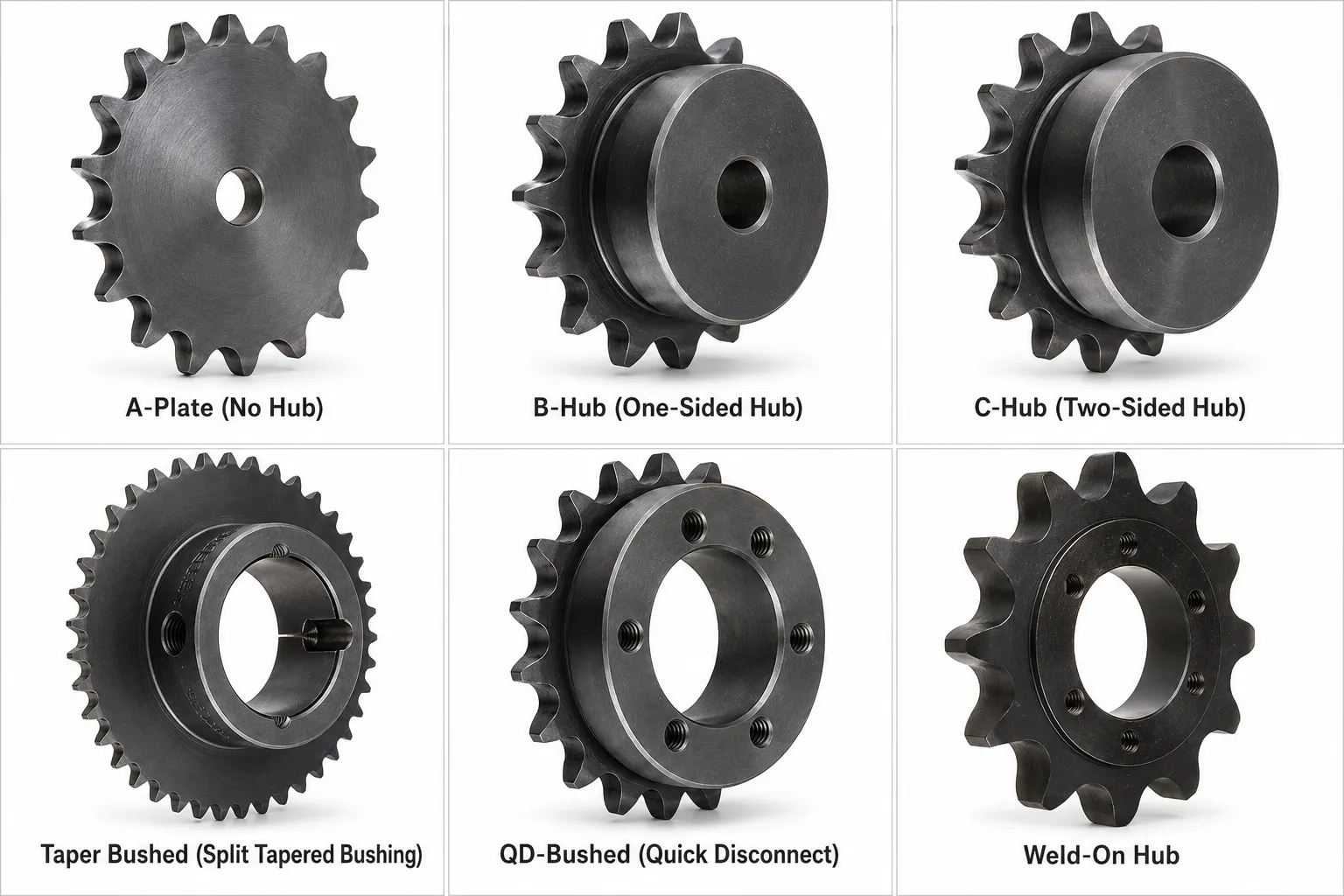
Standard bore and plate wheel sprocket configurations — each requires specific measurement points to confirm the hub style and chain series.
Measure the bore diameter at two perpendicular positions (horizontal and vertical) and take the average. If the two measurements differ by more than 0.10 mm, the bore has been distorted by improper removal (using a hammer blow rather than a puller) and must be noted in the replacement specification. Keyway dimensions are measured as width and depth from the bore surface: use a digital vernier with inside measurement capability. Confirm whether the keyway is cut to ASME B17.1 (inch, used on ANSI-standard machines) or DIN 6885 (metric, used on European and Korean-built machines) by comparing the measured depth to the published table values for the bore size.
| Bore Range (mm) | DIN 6885 Key Width (mm) | DIN 6885 Key Depth (mm) | ASME B17.1 Key Width (inch) |
|---|---|---|---|
| 10–12 | 4 | 2.5 | 3/8 |
| 14–18 | 5 | 3.0 | 1/2 |
| 20–22 | 6 | 3.5 | 1/2 |
| 24–30 | 8 | 4.0 | 5/8 |
| 32–38 | 10 | 5.0 | 7/8 |
| 40–44 | 12 | 5.0 | 1 |
| 50–58 | 14 | 5.5 | 1 1/4 |
Determine whether the hub extends to one side only (B-Hub), both sides (C-Hub), or not at all (A-Plate). Measure the hub projection distance — the distance from the sprocket disc face to the end of the hub — on each side that has a hub. Record both the projection dimension and which side carries the hub (the chain side or the shaft-end side). This distinction changes the chain line position when the replacement is installed and cannot be assumed — it must be confirmed from the original installation. For Taper Lock or QD bushed sprockets, identify the bushing series (1610, 2012, 3020, etc.) from any markings on the bushing flange, or measure the bushing taper bore dimensions for cross-reference.
Before ordering a replacement, assess whether the worn sprocket dimensions are within replacement tolerance or have been deformed beyond the nominal range. Measure tooth tip height on three evenly-spaced teeth and compare — if one tip is 2 mm lower than the others, that tooth has experienced accelerated wear from a specific chain engagement pattern. Measure the tooth root radius on the same three teeth and compare against the nominal value — if the root radius has increased by more than 15% from nominal, the sprocket has been shaped by an elongated chain and cannot be reused with a new chain. Record any asymmetry in tooth faces — a tooth whose trailing face is visibly lower than the leading face has developed the hooked profile that will destroy a new chain.
Calculating Pitch Circle Diameter: The Formula and the Shortcut
The pitch circle diameter (PD) formula is: PD = p / sin(180° / N), where p is the chain pitch in mm and N is the tooth count. This formula gives exact results for any pitch and tooth count combination. For common combinations, the values below are pre-calculated:
| Tooth Count | PD — #35 (9.525mm) | PD — #40 (12.70mm) | PD — #50 (15.875mm) | PD — #60 (19.05mm) | PD — #80 (25.40mm) |
|---|---|---|---|---|---|
| 11 | 34.3 | 45.8 | 57.2 | 68.6 | 91.5 |
| 13 | 40.4 | 53.9 | 67.3 | 80.8 | 107.7 |
| 15 | 46.5 | 62.0 | 77.5 | 93.0 | 124.0 |
| 17 | 52.6 | 70.1 | 87.6 | 105.2 | 140.2 |
| 19 | 58.8 | 78.4 | 97.9 | 115.7 | 157.0 |
| 21 | 64.9 | 86.5 | 108.1 | 129.7 | 173.0 |
| 25 | 77.1 | 102.8 | 128.5 | 154.2 | 205.6 |
| 30 | 91.4 | 121.9 | 152.4 | 182.9 | 243.8 |
| 40 | 121.5 | 162.1 | 202.6 | 243.1 | 324.1 |
All values in mm. Calculated from PD = p / sin(180° / N). To verify a measured sprocket: measure the outside diameter (OD) of the sprocket. OD = PD + tooth height. Standard tooth height is approximately 0.625 × chain pitch (a conservative approximation). For ANSI #60 with 19 teeth: calculated PD = 115.7 mm; OD ≈ 115.7 + (0.625 × 19.05) = 115.7 + 11.9 = 127.6 mm. If the measured OD is within ±3 mm of this calculated value, the sprocket is most likely the correct chain-pitch and tooth-count combination.
Measuring Taper Lock and QD Bushed Sprockets: Additional Steps
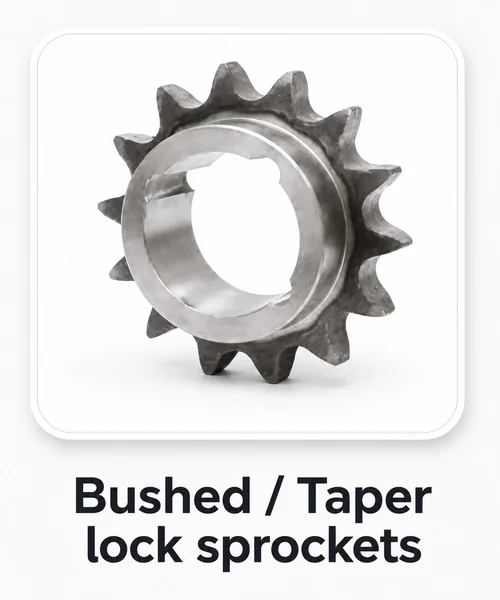
Taper lock sprocket — the bushing must be identified separately from the sprocket body; the bushing series determines the available bore range.
For taper lock and QD bushed sprockets, the sprocket body and the bushing are specified as two separate items. The sprocket body specification follows the six-step process above. The bushing is specified by series designation (which determines the taper bore geometry and the bushing outer flange dimensions) and by bore size (which determines the shaft diameter the bushing can accept).
Identifying the taper lock bushing series from a removed bushing: measure the maximum outer diameter of the bushing flange (not the taper length) and the small end bore diameter (the bore at the narrow end of the taper, before the straight bore section). These two dimensions together uniquely identify the bushing series for standard industrial taper lock systems (1008, 1108, 1210, 1610, 2012, 2517, 3020, 3030, 3525, 3535, 4030, 4535, 5040, and so on). A 1610 bushing has a 59.5 mm maximum flange OD; a 3020 has a 82.5 mm maximum flange OD.
For QD bushings, the series identification follows the same approach using the bushing body length and flange diameter. QD series SH, SK, SF, E, F, J, M, N, P, W are common in industrial applications and each has a specific size range for shaft diameters. Confirmed taper lock and QD sprocket configurations are available with bore machining to match the measured shaft diameter before despatch.
Creating a Measurement Record for Future Replacement Orders
Once the complete measurement sequence has been completed, documenting the results in a standardised format prevents the same identification work from being repeated at the next replacement interval. The minimum record should include:
| Machine / Location: | e.g. “Line 3 bucket elevator, head shaft, left” |
| Tooth count (N): | Counted directly from sprocket |
| Chain series: | Confirmed from root radius measurement (e.g. “ANSI #60”) |
| Bore diameter: | e.g. “35.00 mm” (average of two measurements) |
| Keyway: | Width × depth, standard (e.g. “10 × 5 mm, DIN 6885”) |
| Hub style: | A/B/C/Taper Lock series/QD series |
| Hub projection: | Side 1 and Side 2 dimensions (mm) |
| Material / treatment: | Carbon steel / SS304 / cast iron / UHMW — and any surface treatment visible |
| Wear condition: | Notes on hooked teeth, root radius change, last replacement date |
| Replacement part confirmed: | Supplier part number or specification once confirmed |
Maintaining this record for every sprocket in the facility — even those still in service — creates a maintenance-ready replacement specification that can be sent directly to a supplier when needed. The six-step measurement process described above takes 15–20 minutes per sprocket. The time investment is repaid the first time a sprocket needs replacement under time pressure and the complete specification is already on file.
Frequently Asked Questions
Send Us Your Six Measurements for a Free Replacement Confirmation
Tooth count, root radius, bore diameter, keyway, hub style, and hub projection — send these six measurements to our engineers and we will confirm the exact replacement specification, including chain series, material, and bore machining requirements, before any parts are committed.
Editor: Cxm