A Korean track-day rider rebuilt his 600cc supersport with a 15T-to-14T front sprocket change — a single-tooth reduction that is widely recommended online for improved corner exit torque. Within 4,000 km, his rear sprocket was visibly hooked and the chain had elongated past the adjuster limit. His previous stock setup had lasted 12,000 km under identical use. The tooth reduction had not caused the chain to fail in any catastrophic sense — it simply increased chain wear rate by a factor of three, a predictable outcome that follows directly from the geometry of how the drive chain contacts the front sprocket at different tooth counts. The physics of this relationship is less intuitive than most motorcycle maintenance guides suggest, and getting the front-to-rear tooth ratio right is the foundation of correct motorcycle chain and sprocket specification.
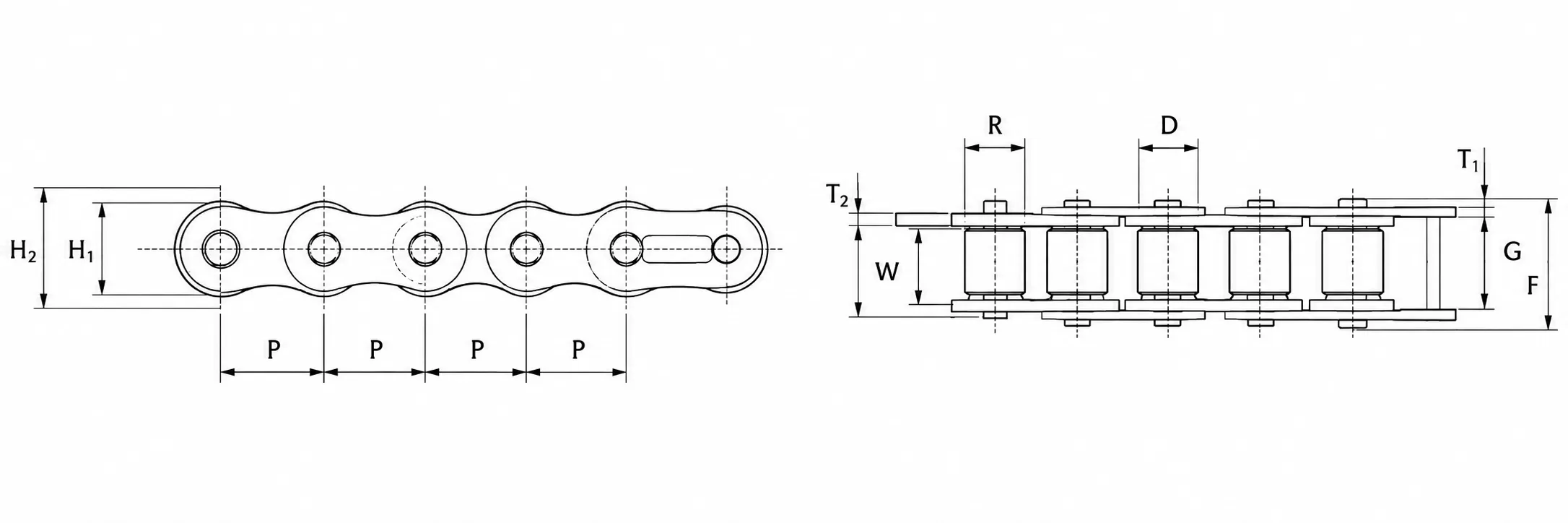
Motorcycle Chain Pitch Nomenclature: 420, 428, 520, 525, 530 and 630 Decoded
Motorcycle chain pitch designations confuse every new buyer because they appear to follow a different logic from standard ANSI or ISO chain numbering. They do not directly state the pitch in millimetres or any other unit. The three-digit code encodes two dimensions: pitch and inner width, using an encoding system inherited from early American industrial chain practice.
| Designation | Pitch (mm) | Inner Width (mm) | Typical Application | Weight/metre (approx) |
|---|---|---|---|---|
| 420 | 12.70 | 6.35 | Small motorbikes (50–150cc), pit bikes, mopeds | 0.52 kg/m |
| 428 | 12.70 | 7.94 | 125–250cc commuters and trail bikes | 0.65 kg/m |
| 520 | 15.875 | 6.35 | 250–450cc sportbikes, motocross, track conversions of 600cc bikes | 0.80 kg/m |
| 525 | 15.875 | 7.94 | 600–750cc sport and sport-touring bikes | 0.92 kg/m |
| 530 | 15.875 | 9.53 | 750–1000cc sport, naked, and touring bikes — OEM standard on many platforms | 1.10 kg/m |
| 630 | 19.05 | 9.53 | Heavyweight touring (1200–1800cc), cruisers, sidecars | 1.65 kg/m |
Sprocket Ratio and Chain Wear: The Arithmetic Most Riders Miss
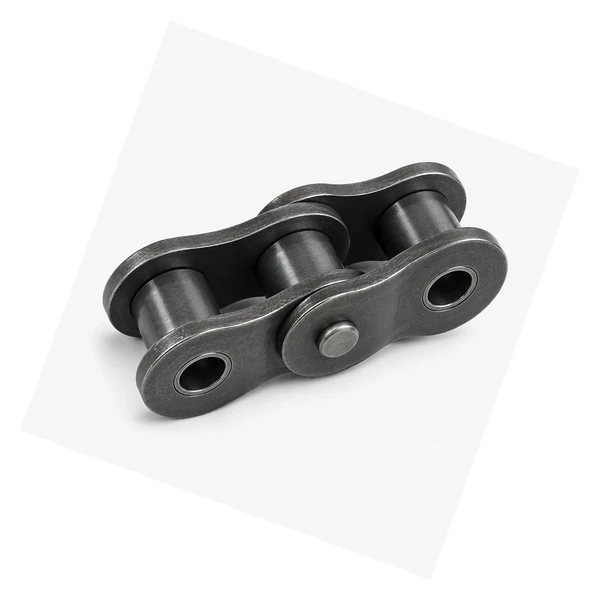
Motorcycle drive chain engagement at the front sprocket — roller contact area and wrap angle are critically dependent on front sprocket tooth count.
The front sprocket has a disproportionate effect on chain wear for two reasons that are independent of each other. The first is the polygon effect: at low tooth counts, the chain velocity varies sinusoidally on each revolution, with an amplitude that increases as tooth count decreases. A 14-tooth front sprocket produces ±2.3% velocity variation; a 16-tooth produces ±1.75%; a 17-tooth (the ANSI practical minimum for smooth operation) produces ±1.7%. These appear close, but the effect compounds because the 14-tooth is also running at higher RPM for a given road speed.
The second reason is wrap angle. A front sprocket with fewer teeth has a smaller pitch diameter. At the same centre distance to the rear sprocket (approximately fixed by the swingarm length), a smaller front sprocket means reduced wrap angle — the chain contacts fewer teeth on the front sprocket simultaneously. With 15 teeth and a 45-tooth rear, a typical 600cc supersport has approximately 6–7 teeth in contact on the front sprocket. With 14 teeth, this drops to 5–6 teeth. Each tooth now carries proportionally more of the total chain tension, increasing contact stress and tooth wear rate.
The relationship between front sprocket tooth count and chain tension can be stated as: Fc = 2T × π / (N × p), where T is the engine torque at the countershaft (Nm), N is the front sprocket tooth count, and p is the chain pitch (m). For a 600cc engine producing 65 Nm peak torque at the countershaft with a 15T front sprocket and 15.875 mm pitch: Fc = 2 × 65 × π / (15 × 0.015875) = 408.4 / 0.238 = 1,716 N — approximately 1.72 kN. Changing to a 14T front sprocket at the same torque: Fc = 2 × 65 × π / (14 × 0.015875) = 408.4 / 0.2223 = 1,837 N — approximately 1.84 kN, a 7% increase in peak chain tension from a single tooth change.
Standard, O-Ring and X-Ring Chain: What the Seals Actually Do
Sealed motorcycle drive chain — the category that includes O-ring and X-ring variants — is one of the most frequently misunderstood products in the aftermarket. Most buyers assume the seals are there to keep lubricant on the chain exterior. They are not. The seals are positioned between the inner and outer link plates at each pin location, where they seal factory-applied grease inside the pin-bushing interface for the life of the chain. The exterior of the chain still benefits from additional lubrication applied during service — the seals do not make external lubrication unnecessary. What they prevent is contamination of the internal grease by road grit and water, which is the primary wear mechanism in the pin-bushing interface of a standard open chain.
Sprocket Materials: Steel, Aluminium and Why the Rear Always Wears Faster
The front sprocket is almost always steel, regardless of the motorcycle’s price point. Steel is the correct material here — the front sprocket runs at high RPM, sees high chain tension on every tooth engagement, and must be harder than the chain rollers to resist tooth wear. Carbon steel front sprockets are typically case-hardened to 55–60 HRC on the tooth surface, matching the hardness of the chain rollers to produce a wear partnership where both components wear at a manageable and roughly equal rate.
The rear sprocket is where material decisions become interesting. Steel rear sprockets outlast aluminium by a factor of 4–5, but they add 300–500 g of rotational mass at the wheel — mass that reduces acceleration more than the same mass added to the chassis because it must be both accelerated and gyroscopically stabilised. Aluminium rear sprockets (typically 7075-T6) are approximately 60–65% lighter than the steel equivalent, which is why they are standard equipment on performance-oriented motorcycles. Anodised aluminium sprockets with a hardcoat anodising layer can achieve reasonable tooth life — typically 15,000–25,000 km of normal road use — but in harsh conditions (track use, sand, gravel roads) the hardcoat can be abraded through rapidly, exposing the soft aluminium core and producing rapid tooth hooking.
| Rear Sprocket Material | Typical Weight (50T, 530) | Typical Life (road) | Best for |
|---|---|---|---|
| Carbon steel, plain | 780–900 g | 40,000–60,000 km | Touring, commuters, max longevity |
| Carbon steel, case-hardened | 780–900 g | 50,000–80,000 km | Performance road use with longevity priority |
| Aluminium 7075, plain anodised | 280–340 g | 10,000–18,000 km | Track use, weight-sensitive builds |
| Aluminium 7075, hardcoat anodised | 285–350 g | 18,000–28,000 km | Sport bikes, occasional road/track use |
| Stainless 316, machined | 720–850 g | 35,000–55,000 km | Coastal/marine environments, alloy-wheel aesthetics |
Measuring Chain and Sprocket Wear: The Three Checks That Tell You When to Replace
Chain elongation check. Position the chain on the rear sprocket under moderate tension. Measure across 20 links from pin centre to pin centre. For a 530 chain with a nominal 15.875 mm pitch, 20 links should span 317.5 mm. Replacement is necessary when the measured span exceeds 327.0 mm — a 3% elongation threshold. Many chain manufacturers stamp a replacement wear indicator into the chain link plate; these are less precise than a direct measurement but useful for a quick field assessment.
Sprocket tooth wear check. A worn sprocket tooth develops a “shark fin” or hooked profile — the tooth becomes asymmetric, with the trailing face worn below the leading face. Viewing the rear sprocket from the side while slowly rotating the wheel reveals this asymmetry. Alternatively, hold a straight edge across three adjacent tooth tips — on a worn sprocket, the tips will be at different heights rather than the smooth arc of an unworn sprocket. Any visible hooking means replace immediately. Running a new chain on a hooked sprocket will destroy the new chain within 3,000–5,000 km.
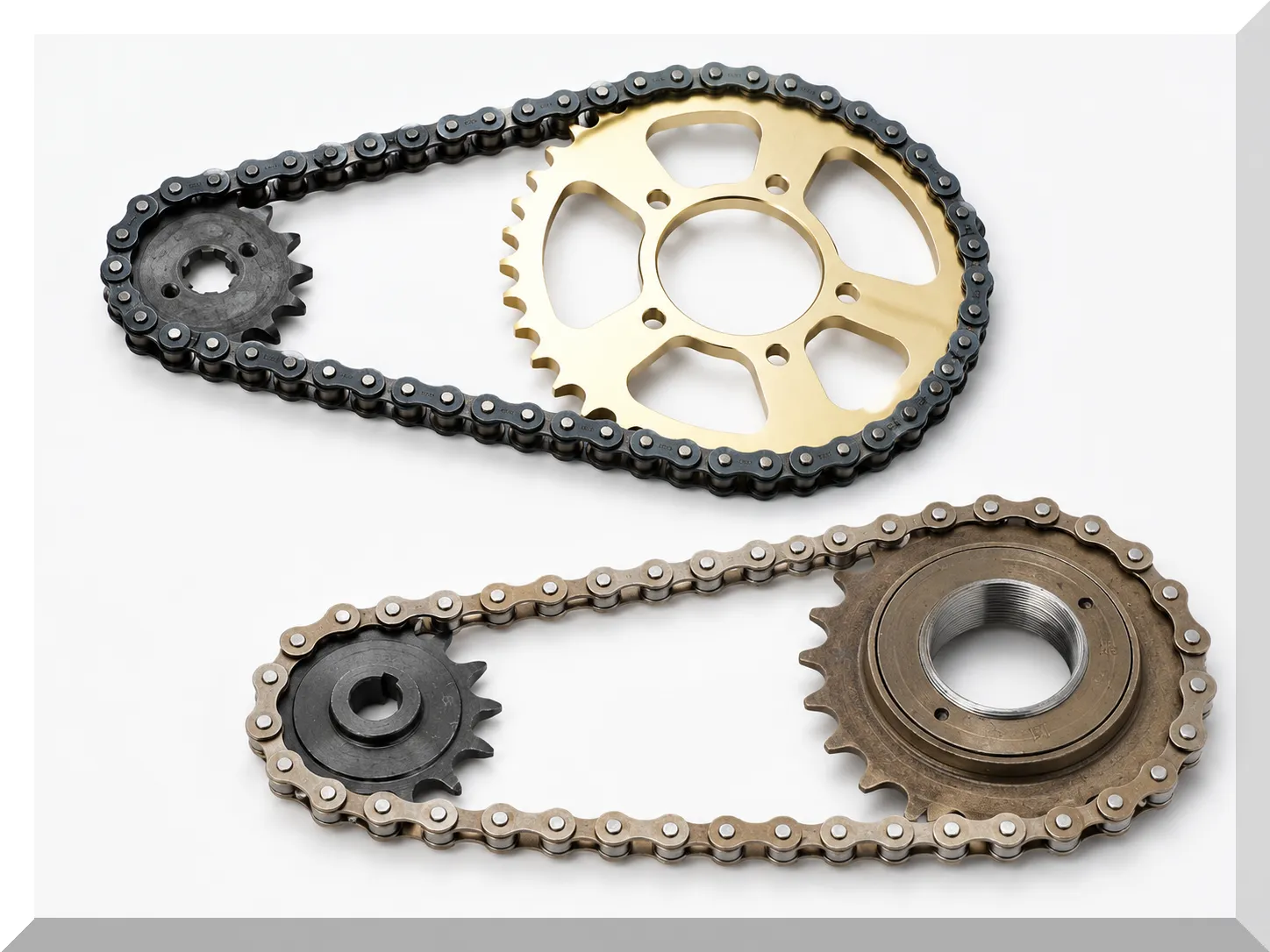
Motorcycle chain and sprocket in a high-performance powersport application — both components should be replaced simultaneously at the elongation limit.
Stiff link check. Lift the chain away from the rear sprocket on the lower run and flex each link laterally by hand across the full chain length. A link that resists lateral flex compared to adjacent links is a stiff link — it has a partially seized pin-bushing joint, usually from water ingress and rust formation in an un-lubricated section. Stiff links cause vibration, accelerate sprocket tooth wear at the specific engagement point of each stiff link, and eventually fatigue-fracture the pin. A chain with stiff links that does not respond to penetrating oil treatment should be replaced rather than returned to service.
Ordering Replacement Sprockets: OEM Cross-Reference and Custom Options
Replacement motorcycle sprockets are specified by chain pitch designation (e.g., 525), tooth count, and the mounting interface to the hub or carrier. The mounting interface specification varies between manufacturers and cannot be inferred from the tooth count alone. Korean OEM specifications for common domestic models follow a consistent pattern for the countershaft (front) sprocket: the number of splines, spline pitch, and retaining method (nut, circlip, or flange bolt) determine which countershaft sprocket fits.
The rear sprocket bolts to a carrier that is part of the rear wheel hub assembly. The bolt circle diameter, number of bolts, and bolt size define the mounting — a rear sprocket with the correct tooth count and chain pitch but the wrong bolt pattern simply cannot be fitted. For aftermarket suppliers and OEM matching, providing three measurements ensures the correct part: (1) chain pitch designation, (2) tooth count, and (3) bolt circle diameter in mm with bolt count and thread size.
Motorcycle sprockets with custom bore and mounting configurations are available for non-standard applications — custom-ratio builds for track use, sidecar rigs, and three-wheeled conversions often require non-catalogue tooth counts. Custom sprockets at non-standard tooth counts are manufactured from the same blanks as catalogue parts and differ only in the final tooth-cutting operation. Lead time is typically 3–5 business days for sizes up to 60 teeth in standard pitches.
Motorcycle Chain Lubrication: Interval, Product and Application Method
Motorcycle chain lubrication is the maintenance task most riders perform most inconsistently. The standard recommendation — every 500–800 km or after each rain exposure — is correct but underexplained. The reason for the interval is the centrifugal fling-off rate of lubricant from the chain at speed. A motorcycle chain at 100 km/h on a 530 chain with a 17T front sprocket is running at approximately 3,600 RPM at the front sprocket. The centrifugal acceleration at the outer link surface is sufficient to remove all surface-applied lubricant within 30–60 minutes of continuous motorway riding.
The correct application method is to apply lubricant to the inside of the lower chain run — the surface that contacts the sprocket teeth — rather than the outside of the upper run, which is where most people spray. Lubricant applied to the inside faces is flung outward by centrifugal acceleration and redistributes itself across the link plates and into the pin-bushing interface clearance by capillary action. Lubricant applied to the outside of the upper run is flung radially away from the sprocket and deposits primarily on the swingarm and rear tyre sidewall.
Use a dedicated drive chain lubricant rather than general-purpose oil or WD-40. Chain-specific lubricants are formulated with tackifiers that resist centrifugal fling-off, anti-wear additives for the pin-bushing interface, and a solvent carrier that penetrates the seal and link clearances before evaporating. WD-40 penetrates well but has no film strength and evaporates completely within 20–30 minutes of riding — it is a rust dissolver and water displacer, not a chain lubricant. For O-ring and X-ring chains, ensure the lubricant is rated as seal-compatible — certain solvents in some chain cleaners can swell or degrade NBR or HNBR O-ring seals.
Frequently Asked Questions
Editor: Cxm