An MRO buyer at a Korean packaging equipment manufacturer maintains a storeroom with 14 different roller chain sizes on the shelf. Twice in the past three years, a chain replacement that looked right from the pitch measurement caused premature sprocket wear within two months of installation. Both times the cause was the same: a chain with the correct pitch but an incorrect roller diameter was installed on sprockets cut for a different standard. The first incident involved ANSI #40 chain installed on sprockets cut for ISO 08B — same 12.70 mm pitch, different roller diameter (7.92 mm vs 7.94 mm for short-pitch BS and 8.51 mm for standard-pitch BS). The second incident involved double-pitch #2060 chain on standard-pitch #60 sprockets — again, same roller diameter, but the 38.1 mm pitch chain spanned two tooth root positions on a sprocket designed for 19.05 mm pitch, loading only every other tooth.
This reference guide covers every standard ANSI pitch size from #25 through #240, the corresponding ISO equivalents, the roller diameters that distinguish them, and the dimensional data needed to identify a chain correctly from physical measurement rather than from label reading.
How ANSI Chain Numbers Work — and Where the System Breaks Down
The ANSI chain number encodes the pitch in a simple way: the number divided by 8 gives the pitch in eighths of an inch. ANSI #40 has a pitch of 40/8 = 5/8 × 25.4 = … wait, that does not work: 40/8 = 5, and 5 eighths of an inch = 5 × 3.175 mm = 15.875 mm. But ANSI #40 has a 12.70 mm pitch, not 15.875 mm. The actual rule is that the leading digit(s) represent the pitch in eighths of an inch, where the number before the trailing zero (for even pitch chains) is the pitch designator. For #40: the “4” = 4/8 inch = 4 × 3.175 mm = 12.70 mm. This is correct.
The trailing digit encodes the chain type: “0” indicates standard roller chain; “1” indicates light series (reduced plate thickness); “5” indicates a roller chain of the half-pitch design (#35 is a 3/8-inch pitch chain — 3 × 3.175 mm = 9.525 mm). The #25 chain follows the same rule: “2” = 2/8 inch = 6.35 mm pitch. This encoding is consistent for the standard series, but it breaks down for heavy series (H suffix), double-pitch (2xxx prefix), and multiple-strand (number-of-strand suffix) designations, which use separate conventions.
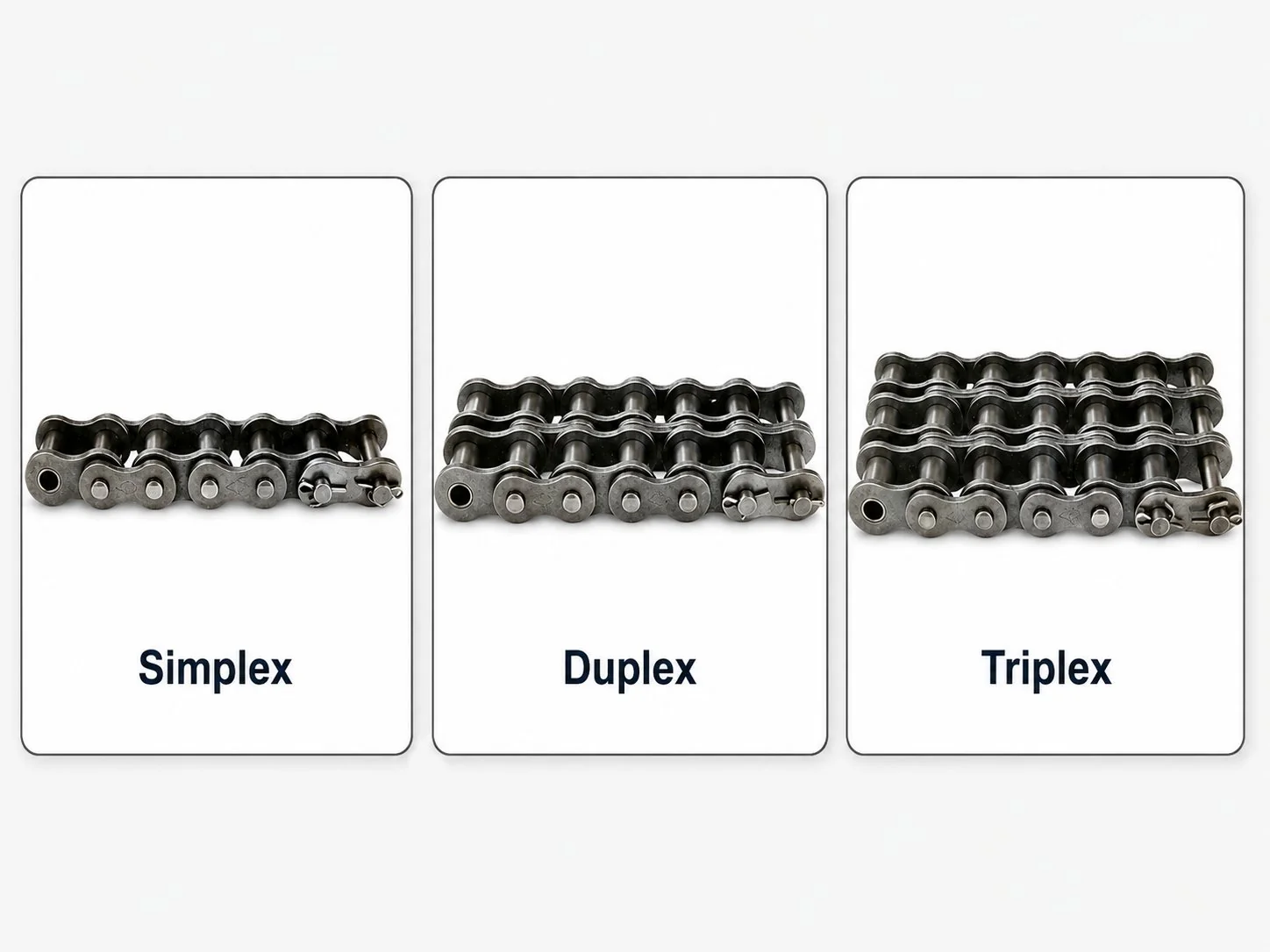
Simplex, duplex, and triplex roller chain — strand count changes the sprocket face width but not the pitch numbering system.
Complete ANSI Roller Chain Dimensional Reference — #25 Through #240
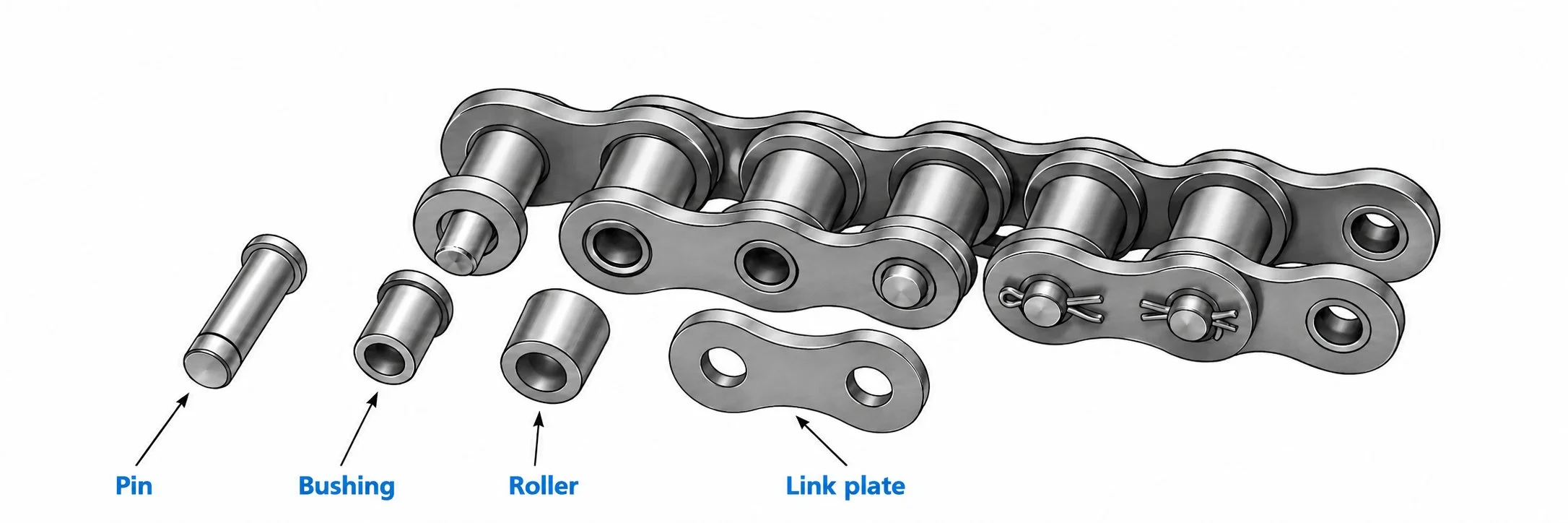
All dimensions per ANSI B29.1. Minimum breaking loads are the published minimum, not average values — actual product breaking loads from quality manufacturers typically exceed these values by 5–15%. Inner link width tolerance is +0.00 / −0.05 mm for standard chain; roller diameter tolerance is ±0.025 mm. These tolerances define the permissible clearance between the chain and the tooth root geometry of an ANSI-profile sprocket.
| ANSI No. | ISO Equiv. | Pitch (mm) | Roller Dia. (mm) | Inner Width (mm) | Pin Dia. (mm) | Plate Thick. (mm) | Min Break Load (kN) | Weight (kg/m) |
|---|---|---|---|---|---|---|---|---|
| #25 | — | 6.350 | 3.30 | 3.18 | 2.31 | 0.76 | 3.6 | 0.10 |
| #35 | — | 9.525 | 5.08 | 4.78 | 3.58 | 1.27 | 7.8 | 0.22 |
| #40 | 08A | 12.700 | 7.92 | 7.85 | 3.97 | 1.52 | 14.1 | 0.37 |
| #41 | — | 12.700 | 6.35 | 6.25 | 3.66 | 1.27 | 7.9 | 0.26 |
| #50 | 10A | 15.875 | 10.16 | 9.53 | 5.09 | 2.03 | 22.2 | 0.59 |
| #60 | 12A | 19.050 | 11.91 | 12.57 | 5.96 | 2.39 | 31.8 | 0.84 |
| #80 | 16A | 25.400 | 15.88 | 15.75 | 7.94 | 3.18 | 56.7 | 1.58 |
| #100 | 20A | 31.750 | 19.05 | 18.90 | 9.54 | 3.96 | 88.5 | 2.46 |
| #120 | 24A | 38.100 | 22.23 | 25.22 | 11.11 | 4.78 | 127.0 | 3.56 |
| #140 | 28A | 44.450 | 25.40 | 25.22 | 12.71 | 5.56 | 172.4 | 4.75 |
| #160 | 32A | 50.800 | 28.58 | 31.55 | 14.29 | 6.35 | 226.8 | 6.43 |
| #180 | 36A | 57.150 | 35.71 | 35.48 | 17.46 | 7.94 | 288.2 | 8.20 |
| #200 | 40A | 63.500 | 39.68 | 37.85 | 19.85 | 9.53 | 400.3 | 11.20 |
| #240 | 48A | 76.200 | 47.63 | 47.63 | 23.81 | 12.70 | 508.0 | 16.50 |
† Red values in the #40 roller diameter column indicate a dimension that differs from the BS/ISO 08A equivalent — the most common source of cross-standard substitution errors at this pitch size. ISO 08A uses a 7.94 mm roller; BS 08B uses an 8.51 mm roller. Neither seats correctly in ANSI #40 sprocket tooth geometry.
ANSI vs ISO vs BS: Where the Standards Diverge and Why It Matters
The critical point of ANSI–ISO divergence is the roller diameter at small pitches. For chain sizes #80 (16A) and above, ANSI and ISO roller diameters are functionally identical — the chains are interchangeable on correctly profiled sprockets in practice, though technically they remain different standards. Below #80, the roller diameter differences are large enough to cause measurable tooth root engagement errors when the wrong chain is fitted to a correctly profiled sprocket.
| ANSI No. | ISO equiv. | Pitch (mm) | ANSI Roller Dia. (mm) | ISO Roller Dia. (mm) | BS Roller Dia. (mm) | Interchangeable? |
|---|---|---|---|---|---|---|
| #35 | No ISO equiv. | 9.525 | 5.08 | N/A | N/A | ANSI only |
| #40 | 08A (ISO/DIN) | 12.700 | 7.92 | 7.94 | 8.51 (08B) | Not recommended |
| #50 | 10A | 15.875 | 10.16 | 10.16 | 10.16 (10B) | Roller same — width differs |
| #60 | 12A | 19.050 | 11.91 | 11.91 | 11.91 (12B) | Roller same — width differs |
| #80 | 16A | 25.400 | 15.88 | 15.88 | 15.88 | Functionally interchangeable |
| #100+ | 20A+ | 31.75+ | All three standards use identical roller diameter from #100 upward | Yes (verify inner width) | ||
Double-Pitch and Heavy Series: How They Differ From Standard
| Standard (ANSI) | Double-Pitch Equiv. | Heavy Series (H) | Roller Dia. Change? | Sprocket Compatibility | Primary Application |
|---|---|---|---|---|---|
| #40 | #2040 | #40H | No (same roller) | H: standard #40 sprocket. 2040: dedicated 2040 sprocket. | H: high-load drives. 2040: slow conveyor. |
| #60 | #2060 | #60H | No (same roller) | H: standard #60 sprocket. 2060: dedicated or standard. | H: heavy industrial. 2060: light conveyor, parts handling. |
| #80 | #2080 | #80H | No (same roller) | H: standard #80 sprocket. 2080: dedicated 2080 sprocket. | H: shock loads. 2080: grain handling, slow conveyors. |
| #100 | #2100 | #100H | No (same roller) | H: standard #100 sprocket. 2100: dedicated 2100 sprocket. | H: heavy mining/industrial. 2100: bulk conveyor. |
Identifying Any Roller Chain by Three Physical Measurements
When markings are worn off or the original specification documentation is lost, three measurements from the chain uniquely identify the series in nearly all cases. Take each measurement with a calibrated vernier calliper or digital micrometer; tape-measure or ruler measurements do not provide adequate precision for this purpose.
Measure the distance between pin centres across exactly 10 links (pin 1 to pin 11). Divide by 10. This averages out any individual joint wear and gives a more accurate nominal pitch than a single-link measurement. A worn chain measuring 128.5 mm across 10 links gives 12.85 mm per link — matching worn #40 chain (nominal 12.70 mm plus approximately 1.2% elongation).
Measure the outer diameter of the cylindrical roller (not the bushing). Take several readings on different rollers — the variation shows whether the chain has experienced unusual wear. This measurement is the primary discriminator between ANSI and ISO at the same pitch. At 12.70 mm pitch: 7.92 mm = ANSI #40; 7.94 mm = ISO 08A; 8.51 mm = BS 08B.
Measure the clear distance between the two inner link plates. This confirms the correct sprocket face width and distinguishes between chain variants of the same pitch and roller diameter. It also identifies whether the chain is simplex, duplex, or triplex — the measurement gives the width of the strand gap, not the total assembly width.
Matching Chain Pitch to Application: A Practical Overview
#25 and #35 (miniature drives). These pitches are found in precision instruments, small conveyor index drives, and automation equipment where the drive envelope is tight and loads are low. #25 chain running at 3,000+ RPM is a valid configuration for small servo-coupled drives. The sprockets for these sizes require careful tooth hardness specification because the small physical size means tooth wear becomes visible rapidly — case-hardened miniature sprockets are available in the standard bore sprocket range down to 9 teeth at #35 pitch.
#40 and #50 (light-to-medium industrial). The most common pitch sizes in packaging, pharmaceutical, and food processing equipment. These pitches are the zone where ANSI–ISO substitution errors are most frequent, making roller diameter verification before ordering especially important. #40 is the standard pitch for most Korean agricultural seeding and transplanting equipment drives — specifically for row-spacing adjustment mechanisms where light-load, precise positioning is required.
#60 and #80 (medium industrial). Standard for most general industrial drives — conveyor drives, pump drives, fan drives, and mixer drives. #60 chain covers the majority of drives with motor sizes from 3.7 kW to 22 kW at standard industrial speeds. #80 covers the 11–55 kW range. At these pitch sizes the chain is robust enough to be forgiving of minor misalignment and imperfect lubrication, which is part of why they are so widely used. ANSI and ISO roller chain in #60 and #80 are stocked in Korean warehouse inventory for same-week delivery.
#100 through #240 (heavy industrial). Used in drives where the power transmission requirement exceeds what is practical in smaller pitches without going to multiple strands. At these pitches the chain weight and inertia become significant factors — a #240 chain weighs 16.5 kg/m, and a drive with 3 metres of chain on each side has over 100 kg of chain rotating in the system. The inertial load from the chain itself contributes measurably to start-up motor torque requirements at these pitch sizes.

Frequently Asked Questions
Need the Right Roller Chain, Confirmed Before You Order?
Send us your three measurements — pitch, roller diameter, inner width — and our engineers will confirm the chain series, standard, and material variant. We check stock availability before confirming any order.
Editor: Cxm